Showing posts with label singing. Show all posts

Saturday, February 15, 2014

Ella Fitzgerald Saved My Life

In my early teens I spent a lot of time by myself, alone.

As I have written before, as the youngest of four children I was the only one living at home with my parents during the several years leading up to when I went off to Saint Grottlesex.  We had recently moved to Connecticut from Washington, D.C., and into a beautiful, albeit glacial, modernist house at the end of a winding road on the top of a steep hill, with few nearby neighbors.  My parents' marriage had taken a serious turn for the worse by then, and they were barely on speaking terms.  They were often away, and I spent many evenings and weekends alone in our house.  Even when my parents were present physically, more often than not they were not present emotionally.  They had other things in their minds, I was later to learn.


If you've seen the film Ice Storm you'll have a fairly good idea of what my home life was like at the time.

At thirteen, then, I found myself rudderless in a strange new world where everything had suddenly gone haywire, and I was in a state of shock.  I had been very happy in Washington, where we lived in a rambling house in a neighborhood full of children my own age, and I had loved the country day school I attended there, where I was popular and had a close knit group of friends.  Now I found myself living in a strange modern house with parents who no longer spoke to each other in a strange and remote New England suburb where I knew no one, and I was attending a strange, decidedly mediocre school full of strange people who weren't all that interested in welcoming a newcomer into their ranks.  I felt awkward and alien, as if I'd been dropped there from the sky.  Given the physical isolation of the house where I lived and the fact that neither of my parents were at all inclined (or available) to shuttle me about to promote my social life, it was challenging for me to make any friends.  Besides, it was assumed that I'd be leaving for boarding school in a year or two, so why bother?

Nonetheless, it was a damnably solitary and lonely existence for Reggie, and he didn't care for it one bit.

But that's not the point of this story, Dear Reader.  No, it is the context for it.

Reggie is a resourceful chap, and he isn't one to sit around bemoaning his fate, crying into his lukewarm, curdled milk.  No, when things don't work out for Reggie as he planned, he finds a way to do something about it.  Which is exactly what I did.

I discovered Ella Fitzgerald.

The album that started it all . . .

One evening when I found myself, yet again, alone at home, I opened the door to the cabinet containing my parents' record collection, to see what I could find to amuse myself.  Both my parents were jazz aficionados, and I grew up listening to albums by Dave Brubeck, Thelonious Monk, and John Coltrane, and also Peggy Lee, Anita O'Day, and Miriam Makeba.  My father was also a fan of Frank Sinatra's Come Fly With Me era recordings, and he loved Benny Goodman's later, jazz records, too.  Flipping through the albums that evening I came across Ella Fitzgerald Sings the Cole Porter Songbook.  I didn't recall ever listening to it, and so I put it on the turntable of our KLH stereo sound system to give it a try.

It was on a KLH stereo sound system like this one, ca. 1966,
that I played the records that changed my life
Image courtesy of furnishmevintage.com

I've never been the same since.

I instantly fell in love with Miss Fitzgerald's lovely, rich, crystal clear voice, along with Nelson Riddle's lush arrangements, and I was transfixed.  I couldn't get enough of it!  I found half a dozen more of her recordings on the cabinet's shelves, and over the next weeks and months I played them over and over until I knew every word of every song, and I could sing along to Ella's marvelous and impeccable phrasing without missing a beat.


I soon found my way into the bins at record stores searching for more Ella Fitzgerald albums, and I amassed several dozen of them to add to my parents' collection.  I bought many of the other Great American Songbook albums that she recorded, including most of what she made under the Verve label, and also earlier albums she recorded under the Decca label.


While other thirteen year old boys I knew at the time were obsessed with the music of Cream and Jethro Tull, I was swingin' to the musical beat of Miss Fitzgerald, far away in my own little world.  I soon broadened my listening to include her peers, including Frank Sinatra, Keely Smith, Julie London, Sarah Vaughan and Dinah Washington, and I also developed an appreciation for the horn-filled Big Band recordings of the great bandleaders of the 1940s.  This was the music that came to define my teenage years and that I continue to enjoy today, along with more contemporary fare.


I consider those few lonely years I spent in Connecticut as a lad as fortunate ones, for it was then that I was introduced to—and took to heart—the sublime music and superb vocal performers of the pre-rock and roll Great American Songbook.  Listening to it transported me away from my solitary existence into a sophisticated, grownup world of swell nightclubs, swinging orchestras, vocal champagne, the shimmer of romance, and the glorious singing of the incomparable Miss Ella Fitzgerald, the most talented popular female vocalist of the twentieth century.

This is my absolute favorite Ella Fitzgerald album.
I play it at least once or twice a month

My love affair with Ella Fitzgerald has been a life-long one, and has continued unabated since I first came across that Cole Porter songbook album more than forty years ago.  I was fortunate to see Miss Fitzgerald in concert three or four times, first as an undergraduate at Yale in the nineteen seventies, when she was still relatively in her prime, and last at Carnegie Hall in the nineteen nineties, when she was a very old and fragile lady.  I will always treasure the memories of those concerts.

Thank you, Miss Ella Fitzgerald, for befriending a young Reggie all those years ago, and for giving him so much pleasure then, and ever since.

Friday, January 21, 2011

Reggie's Greatest Regret In Life

. . . is that he cannot play the piano.  And it is not for lack of trying, either.

Reggie grew up in a house where the children were expected to become proficient in playing a musical instrument, among other basic skills of the well-rounded life.  When Reggie was a little boy, no more than six or seven years old, his mother, MD, asked him what instrument he would like to learn to play.  He wasn't given the option of whether he wanted to learn to play an instrument, but rather which one.  Fortunately, Reggie was more than agreeable to the prospect, despite having listened for years to his older siblings torture their way through practicing on various instruments for which they had little aptitude.  Aside from enjoying singing and playing records, the Darlings weren't exactly what Reggie would describe as a musically gifted family.

A young Reggie at the piano with his teacher, Mrs. Lee

Rather than follow in the footsteps of his older brother Frecky and take lessons on the French horn (a choice that to this day Reggie finds to be a peculiar one for his brother), Reggie asked to be given piano lessons.  He was attracted to the piano for several reasons: he liked the way it sounded, one could sing along to it when playing tunes upon it, and one wasn't expected to cart it about from place to place, unlike more portable but often cumbersome options, such as the cello or bassoon.

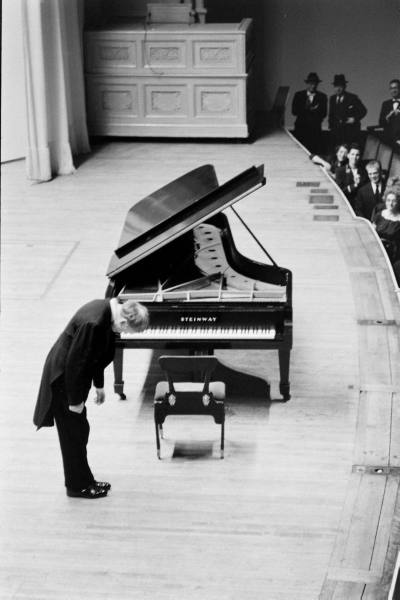
Performing classical music in concert halls
wasn't what attracted Reggie to the piano

The prospect of learning to play Beethoven's sonatas and other serious music and then performing them one day in concert halls was not the reason Reggie wanted to play the piano.  No, he was far more interested in learning to accompany himself and others while singing show tunes, popular songs, and Christmas carols in the comfort of fashionable drawing rooms.  For Reggie is a sociable chap, and has been one since the get-go, and he liked the idea of being the lucky fellow sitting at the piano at the parties he imagined himself attending, at the center of all the fun.

Everyone enjoys singing show tunes around the piano!

Yes, even at the age of seven Reggie was already a show tune lovin' laddie, which some may interpret as manifesting the propensity to be "that way," but which Reggie takes exception to since many of the composers of same were well-known for their prowess with the opposite sex—but that's a topic for another day, I suppose . . . .  On a less flibbertigibbety note, Reggie also enjoyed then (and still does) a good hymn sing, at least from the 1940 edition of the Episcopal Hymnal that was then still found in the pews at the church we attended on Sunday mornings.

This is how I saw myself
Photograph courtesy of Getty Images

In short, Reggie was interested in learning to play the piano because he thought it would be his ticket to becoming the life of the party.

But it didn't work out that way.

My parents signed me up for piano lessons with a neighbor, named Mrs. Lee, who lived only two doors from our house and who had three pianos in her large living room where she gave lessons in the afternoon, when her husband, an editor at the Washington Post, was at the office.  Mrs. Lee was a pleasant lady, and I liked her.  She started me with the exercises that one would expect and was encouraging of the progress I initially made under her tutelage.  I remember the pride I felt when I performed for the first time at the annual recital she held for her students, the highlight of which was—at least for little Reggie—the sweet and salty praline cookies she served at such gatherings.  I remember those cookies vividly to this day.

Doesn't Every Good Boy Deserves Fudge?

The problem was, after an initial spurt of facility at the piano, my progress slowed to a virtual standstill, and I barely advanced beyond rank beginner after several years of taking lessons.  Part of the problem, I admit, is that after the first flush of excitement wore off I became less than enthralled with practicing for more than half an hour at a time, and I was frustrated that I was forced to learn the likes of Bartok's compositions for children when what I really wanted to play was "I Could Have Danced All Night" from My Fair Lady.

I played this album to death as a child

It also didn't help that the piano we had at home was a rather pathetic upright one that MD had bought at a yard sale and painted cherry red (she had a thing for painting furniture with bright enamel colors at the time), and that was only rarely tuned, if ever.  MD refused to consider buying a better piano for me to practice on, given my level of skill at the time.  "Why should I buy you another piano when you can't even play the one we've got?" she would ask me when I would complain about the quality of the instrument I was expected to practice upon.

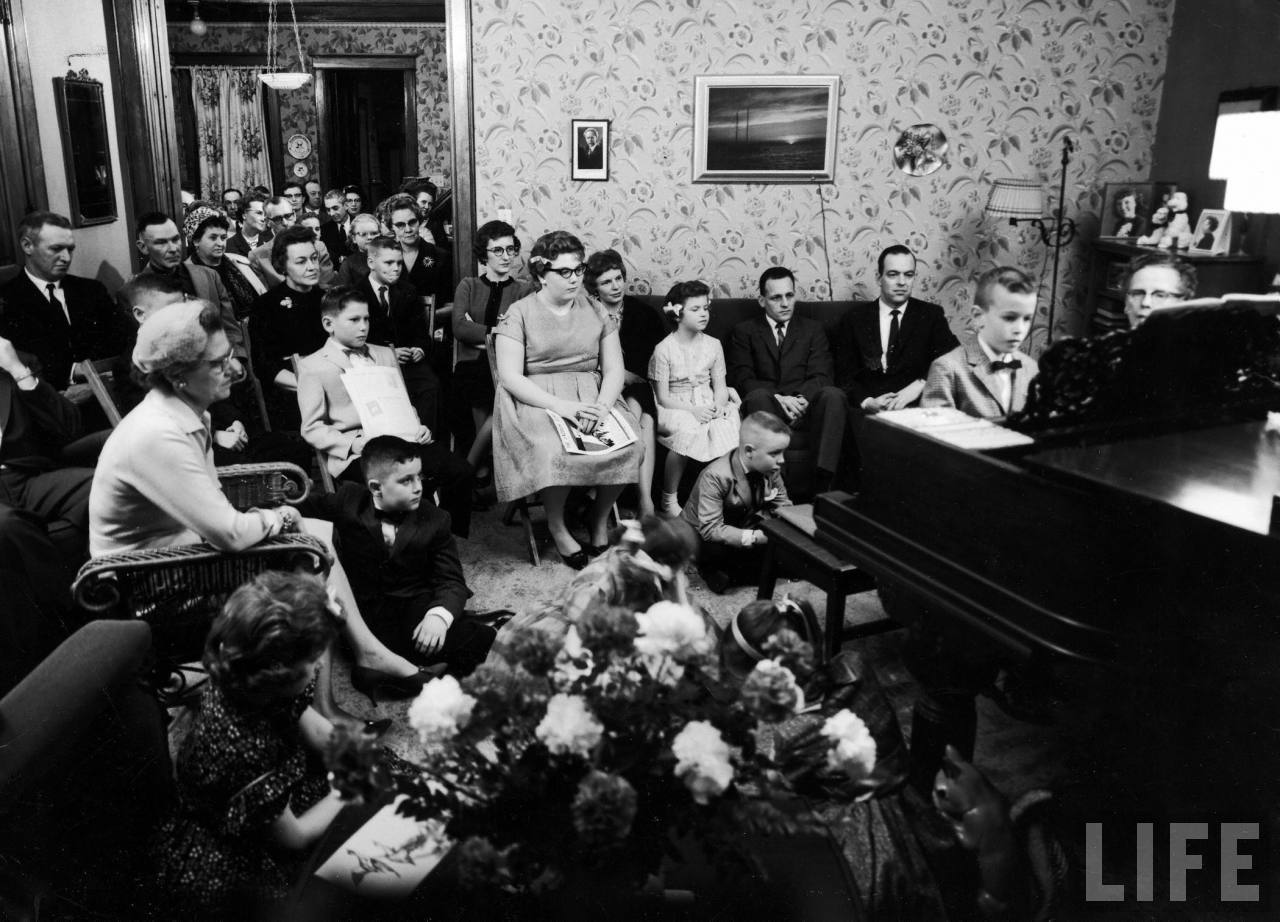
The dreaded, and for Reggie embarrassing, piano recital

But despite that, Mrs. Lee and I soldiered on for the next several years.  Every year at her annual recital concert I was still lumped with the beginners, and I would find myself—with some humiliation, I might add—towering over the little ones who surrounded me there.  By that point, MD had given up attending the recitals as she had—she informed me with a snort—other and better uses of her time.

My piano recital competition

One day, when I was twelve years old, I arrived at Mrs. Lee's house for my weekly lesson.  After several minutes she put her hand on mine as I was stumbling through the day's piece and said, "Stop."

I turned to her to see why.  She had an odd expression on her face.  She hesitated, as if building her courage, and said to me, "Reggie, you are a nice boy, and I like you, but I am afraid that I must tell you that you will never learn to play the piano.  Of all the students I have taught over the years, and there have been many, I have never come across one who has as little talent for it as you do."

"Really?" I asked.

"Yes, really.  There's simply no point in trying any more, because you will never learn to play the piano.  You have no aptitude for it, and no matter how much you practice you will never learn to play it.  I am sorry, but I can't teach you anymore.  I simply cannot, in good conscience, accept any more money from your parents.  Today is your last lesson.  We are done."

"But what will I tell my parents?" I asked her.

"I will telephone your mother now and let her know."

It was with mixed feelings that I left Mrs. Lee's house that late afternoon and walked back to my parents' house.  On one hand I was relieved that the burden I had endured for the last four years was now over, but on the other hand I was disappointed to learn—once and for all—that I had absolutely no talent for playing the piano and that I would never find myself the life of the party, tinkling ivories and singing show tunes to the delight of those gathered around me.

That's how I saw myself.  Erroneously, as it turns out . . .

When I got home MD was waiting for me.  "Thank God that's over," she said with a smirk, letting me off the hook.  She had the piano carted away the very next day.

Not for Reggie, as I learned . . .
Photograph courtesy of Getty Images

But it always rankled me that I had never learned to play the piano, and that I had been told that I never would, nor should I bother even trying to.  I still, deep down inside of me, wanted to be that happy fellow sitting at the piano at the smart parties I imagined attending, singing and laughing away.

Half a decade later I got another chance . . .

During my final year at Saint Grottlesex I applied for and was the fortunate recipient of a scholarship to attend school in England for a year, with all of my expenses paid for.  It was an exchange program between English and American boarding and secondary schools under the auspices of the English Speaking Union, an organization devoted to fostering good will among (or as they would say "amongst") the English speaking nations.  I was not given a choice as to which school I would attend under the program, except to request one that was strong in music and where the students were largely drawn from within Great Britain, as opposed to from a broader, more international base.


The school that the E.S.U. selected for me was Sherborne School, a quintissentially English, all-boys public boarding school located in a bucolic market town of the same name in Dorset, a several-hour train ride west of London.  Sherborne (pronounced "Shuh-bn") was founded in 1550 by Edward VI (the short-lived son of Henry VIII) on the site of a deconsecrated monastery.  It was and remains a beautiful school with handsome buildings and grounds, and it was used as the location for the 1969 movie of Goodbye Mr. Chips starring Peter O'Toole.

Sherborne School, Dorset, England
Image courtesy of same

When I arrived at Sherborne I was given the opportunity to take music lessons on an instrument of my choice.  I decided that I would—once again—attempt to take up the piano and show "them" that I really could learn to play the instrument that Mrs. Lee said I would never be able to master.

I was given as a teacher an elderly, archtypal English maiden-lady named Miss Whipple, who looked like a character right out of an "English Cosies" murder mystery of the type filled with village eccentrics, vicars on bicycles, and such.  Miss Whipple, who was in her early seventies at the time, lived in a cottage not far from the school with her equally elderly spinster sister.  Her sensible clothes were from another long-gone era, and she wore stout, sturdy shoes.  I recall that she wore a pince-nez, too.

Miss Whipple looked remarkably like
the writer Agatha Christie

Photograph courtesy of ezdia.com

I told Miss Whipple my story of how I had taken piano lessons as a boy, and that I regretted that I had been considered incapable of ever learning to play one.  She responded encouragingly that she had had great success with her pupils, even ones with only modest innate talent, and that she was sure she would have success with me, too, so long as I promised to apply myself.  With that agreed to, we set off.

Could this still be in my future, I wondered?
Image courtesy of dorisday.net

In the first several weeks under Miss Whipple's tutelage I made leaps and bounds of progress, and she was delighted with me and how quickly I proceeded.  I practiced diligently, hours every day, and I was determined to make a success of learning to play the piano.

But after several months had passed I was no longer making any progress, and—no matter how much I practiced—I had once again become stuck at the very same place I had been when Mrs. Lee put her hand on mine.  Whereas Miss Whipple had initially been pleased to see me and was quite enthusiastic about my progress, over time she became increasingly restless and fidgety during our lessons, which were no longer the pleasant fun they first had been.  Despite my best efforts, she started to become impatient with me and at times quite short with me, clearly irritated by my incompetence.  "No!" she would cry as I fumbled my way through a piece, "That's not how it is done!"  She would then demonstrate once again, with mounting irritation, how I should play the section of music at hand and what technique I should use.

Sadly, no jolly shout-outs for Reggie with a happy gang
of fellows gathering 'round him at the piano

But I didn't make any more progress, and it became increasingly clear to me, as it certainly had to Miss Whipple by this time, that what Mrs. Lee had said to me all those years ago was, in fact, true—that I had absolutely no aptitude for playing the piano, and my attempting to learn to play one was futile and an utter waste of my (and others') time.

After several more painful weeks had passed, by which point Miss Whipple had grown openly hostile to me and was now sitting through our lessons in angry, stony silence, I decided to throw in the towel and put both of us out of our misery.  Not surprisingly, Miss Whipple was more than pleased to let me go and agreed with alacrity that it was far better that I concentrate my efforts on activities where I had at least some chance for success.  So, instead, I signed on for the school's choral society where I was able to happily sing away without unduly embarrassing myself or visibly annoying the conductor . . . or Miss Whipple.

And that, Dear Reader, is why Reggie cannot—nor will he ever be able to—play the piano.

All black and white photographs, unless noted, are courtesy of LIFE Images.  Reggie had rather a lot of fun finding vintage photographs to illustrate his story.  He makes no claims to actually appearing in any of them.

Wednesday, December 22, 2010

Reggie's Favorite Christmas Music Around the House

Like most people, Reggie enjoys listening to and playing Christmas music this time of year.  He is known to sing along to it—sometimes quite loudly and much to the annoyance of those around him—in the car, while out shopping, and around the house.  Even though he would like to, Reggie is not allowed to start playing Christmas music before the morning of the first Saturday after Thanksgiving, and he is required to stop playing it at midnight on Boxing Day.  He didn't make this rule, but he good naturedly agreed to it and follows along with it in the interest of maintaining matrimonial harmony.


Reggie spent much of his boyhood and adolescence singing in church choirs and secular choruses, and he knows—or at least thinks he can recall—the bass/baritone part to many carols of the season.  He happily sings along at church, at least when he finds himself there, and he is overjoyed to attend parties where carols are sung, where he joins in enthusiastically.  Most of the time this is met with bemused tolerance by those around him, but sometimes not.  Only last week Reggie attended a party where a quartet of caroling singers dressed in period garb out of A Christmas Carol had been engaged to stroll throughout the rooms, entertaining the guests.  They were distinctly not pleased when Reggie tried to join in on their fun by adding his own harmonies at one point.  Ah well, he thought while reaching for another glass of egg nog, at least he wasn't the one walking around in pseudo-Victorian clothing that night.

In any event, today's post is not supposed to be about Reggie, but rather about the music that he plays (some claim endlessly) around the house during the Christmas season.  I've divided it into three categories: contemporary, popular classics, and traditional.  They are all favorites of mine, and are given a lot of airplay at Darlington House this time of year.


The first and newest recording on this list, Let it Snow!, is a short and swell offering from today's King of Swing, Michael Bublé, that is sure to please even the most jaded member of your household.  Man, this guy can sing!


I first learned of the Blenders, an extremely talented a cappella quartet that has been singing together since their college days, from my dear brother Frecky, who sent me Nog, their first Christmas album CD, five or so years ago.  I cannot get enough of the Blenders' gorgeous close harmony singing of carols and standards on this and their other Christmas albums CDs.


I reach for Diana Krall's Christmas Songs when I'm in the mood for something sultry, which she delivers in jazzy spades on this recording.  I usually play it after sundown, as it is best listened to accompanied by a scotch on the rocks.  I mean, look at her!


Moving on from contemporary and into the popular classics, the first on my list is the Carpenters' Christmas Portrait, featuring Karen Carpenter's mellifluous renditions of popular Christmas songs.  I can't help myself—I love this recording!  I play it so often this time of year that if it were an album I'd have worn out the grooves by now.  I'm not surprised the Carpenters were the only "rock band" invited to perform at the Nixon White House, given their wholesome appeal.


If I want to play classic Christmas standards during a party or while decorating the house for the holiday, I put on Croon and Swoon, a compilation of timeless classics by some of the most popular, pre-rock-'n'-roll vocalists of the mid-twentieth century.  You know the ones I mean.  There are two song-packed CDs in this series, and I have both of them.  There's just nothing quite like the velvety sound of Mel Torme singing "Chestnuts Roasting on an Open Fire" to get me into the Christmas spirit.


Go ahead and laugh at me, but I love this album.  Recorded before he became a parody of himself, Andy Williams is fabulous here.  Did you know that he got his start singing backup in a night club act for Kay Thompson of Eloise at the Plaza fame?  Yes, he did, which attests to his vocal creds, given that Miss Thompson coached some of the best singers of her day, including Judy Garland and Lena Horne.  His rendition of Miss T's "Jingle Bells" arrangement is a knockout.


Now, I know I'm pushing it here with this one, but I play this recording at least a couple of times every Christmas season.  And that's because Miss Doris Day is at her absolute whipped-creamiest on this, her Christmas Album.  But be forewarned: in order to avoid an onset of hyperglycemia do not attempt to listen to this album CD while consuming anything sweet, such as cocoa or cookies.


Moving on from the popular classics and into traditional Christmas music, the first on my list is Pops Christmas Party by the Boston Pops Orchestra, under the direction of Arthur Fiedler.  In addition to orchestrations of holiday standards, it includes beloved music from The Nutcracker and the Pops' iconic rendition of "Sleigh Ride."  What's not to love?


She may have multiple personality disorders, but Miss Kathleen Battle has the voice of an angel from Heaven, and on A Christmas Celebration she sings traditional carols with stunning lyric beauty.  The first time I heard her rendition of "I Wonder as I Wander" it stopped me in my tracks.


Moving on to England and back in time more than a century, A Victorian Christmas is a collection of traditional English carols and music from New York's Metropolitan Museum of Art.  Many of the works on this disc are from Sir John Stainer's Carols New and Old, first published in London in 1871.  This is the perfect album CD to play while opening presents on Christmas morning.


Closing out my Christmas-music favorites is a recent recording that I received for supporting the local public radio station I listen to in the country.  A Christmas Festival features the Cambridge Singers and the Royal Philharmonic Orchestra, accompanied by the organ of the Royal Albert Hall, under the direction of John Rutter.  It is full of traditional English carols, hymns, and music, and is perfect to play on a wintry December afternoon spent wrapping presents.  It's also a good warm-up for the annual Christmas Eve radio broadcast of "The Festival of Nine Lessons and Carols" service held at King's College, Cambridge, that Reggie makes sure he listens to every year.

So, here you have Reggie's favorite Christmas recordings, and the ones that you would be sure to hear should you find yourself at Darlington House between now and Boxing Day.  I encourage you to add any of these albums CDs recordings downloads to your own collection of Christmas music, as I think you, too, will enjoy listening to them.

Tell me, what are some of your Christmas music favorites?

Photograph of boy choristers courtesy of Getty Images; all album CD covers scanned by Reggie Darling
Related Posts with Thumbnails