I've got to get something off my chest, Dear Reader. I am supremely weary of hearing people drop the F-bomb. It seems that almost every place I go these days I hear someone using it over and over in casual conversations, in restaurants, at work, in stores, everywhere.
It's almost as prevalent as the mind-numbing use of "like," "uh," and "um" as conversation filler. But it is far worse. While those three words may be grating to listen to when repeated endlessly in conversation, they are but tedious only. Flagrant use of the F-word, on the other hand, is rightly frowned upon by people of refinement and banned from broadcast airwaves (at least for now) for a reason: it is intensely and vividly vulgar. I believe its use should be reserved for situations and circumstances that are either private or where the speaker has been provoked to the point of explosion. And it most certainly shouldn't be used within earshot of children.
Don't get me wrong, Dear Reader, Reggie is not a prude. He has been known to use the F-word himself, along with other pithy Anglo Saxon expletives. He acknowledges that doing so can at times be very satisfying, indeed. However, he believes the use of the F-bomb in general conversation today has become so prevalent and gratuitous as to have lost its potency, at least in the minds of those he overhears using it repeatedly and unblinkingly in public.
If they stopped to actually listen to themselves, as Reggie is often forced to against his wishes, he believes they might be surprised to hear how crude and unattractive they sound. And how unimaginative—can't they think of any other words to use?
Maybe not. At least that's what he concludes when he casts a gimlet eye on many of those he overhears using it in public.
But that's not always the case, Dear Reader. Reggie is often surprised when he turns to examine who is speaking so fouly to find that it is a person who should know better. They have fallen into the habit of using the F-word unthinkingly, with no comprehension that it does not reflect well upon themselves (to say the least), nor do they have any consideration that others might find it unpleasant—if not offensive—to listen to.
When I am out in public, Dear Reader, I do not like hearing other people repeatedly use the F-bomb or other rude expletives, particularly strangers at other tables in restaurants, in lines at stores, in places of entertainment, or while walking about the streets of the city in which I live. I find it ugly and intrusive.
So I make every effort not to drop the F-bomb or use other obscenities in public. Sometimes I slip up, though, because I am far from perfect. But I try to be sensitive to the fact that there are people within listening distance who may find such language offensive, and so I refrain from using it in public whenever possible.
I think the world would be a better place if more of us did the same, too.
Tell me, Dear Reader, what do you think?
Showing posts with label civilized behavior. Show all posts
Sunday, March 30, 2014
Saturday, October 19, 2013
Count Your Blessings
One of the lessons that Reggie has learned while bumbling about on this planet is that it is useful to pause every once in a while and take stock of one's life. He believes spending a portion of such time doing so focusing on the positive aspects of one's existence is time well spent.
It certainly helps him put it all in perspective when he does so . . .
Too often Reggie comes across people, some of whom he knows and some of whom he overhears in public, who spend an inordinate amount of their time complaining. And these are people who appear to be financially stable, in reasonable health, and speaking with what appear to be friends or loved ones. It's all too much for them, or its just not good enough for them—it's such a trial, or such a disappointment.
Poor things.
Reggie believes they'd be much happier and more content if they stopped moaning and think for a moment about what the alternatives might be. The less-appealing ones, that is . . .
On the other hand, Dear Reader, all of us respond well to appreciation and gratitude. I know I do. I think we'd all be better off—and a lot happier—if we made a concerted effort to spend less time complaining and more time being grateful, and counting our blessings instead of our disappointments.
And that, Dear Reader, is a Reggie Rule.
It certainly helps him put it all in perspective when he does so . . .
Too often Reggie comes across people, some of whom he knows and some of whom he overhears in public, who spend an inordinate amount of their time complaining. And these are people who appear to be financially stable, in reasonable health, and speaking with what appear to be friends or loved ones. It's all too much for them, or its just not good enough for them—it's such a trial, or such a disappointment.
Poor things.
Reggie believes they'd be much happier and more content if they stopped moaning and think for a moment about what the alternatives might be. The less-appealing ones, that is . . .
- So the waiter forgot that you ordered your spinach steamed and not sautéed. Send the offending vegetable back to the kitchen to be replaced, but don't make a federal case out of it, please. Be grateful that you are being waited on and can afford to eat a meal in a restaurant.
- So your maid didn't show up today, and you have been inconvenienced by it. Did you ever stop to think that she may have problems of her own that just might need tending to unexpectedly every now and then? Be grateful you're not the one cleaning your own house, and that you have someone to help you.
- So you had to fly in coach on the overnight flight to London instead of in business or first class. Don't spend the flight endlessly pushing the call button and demanding special service from the flight attendant, acting like you're too good for coach (even though that's all you've paid for). Be grateful that you are able to visit one of the most magnificent cities on the planet.
Reggie understands that there are circumstances when it is appropriate to be disappointed in something or by someone—life doesn't always work out the way one hopes or expects it to. And yes, he appreciates that there are many people who truly struggle to make it through the day in one piece, keeping it all together. He isn't writing about such situations or such people, Dear Reader. No, he is writing this post about those of us (and note he say "us" and not "you") who sometimes find ourselves complaining or being frustrated by something or someone when it isn't really merited, and where it doesn't reflect all that well on those of us who are doing the complaining.
I acknowledge there are times when rendering a complaint is justified, and I've certainly relished the pleasure of joining in a good "bitch-fest" like the best of them. However, I make a concerted effort not to be a gratuitous complainer, which—I admit—sometimes takes more willpower than I wish were the case. That doesn't mean Reggie is a saccharine Pollyanna who has nothing but nice things to say (for those of you who know me, you'll agree that I'm not afraid to state my contrarian views on controversial subjects). I do strive, however, to choose what I complain about carefully, and to do so sparingly.
Now, some of you may be wondering, "Reggie, are you saying that because there are people in the world who are worse off than I am that my disappointments aren't legitimate?" No, Dear Reader, Reggie is not saying that at all. He believes that no one's feelings are either more or less legitimate than anothers' of differing circumstances. Reggie is saying, though, that one should stop and think before opening one's mouth to complain and ponder whether such a complaint is either merited or whether the manner in which it is delivered reflects well upon one's self. He believes that most often it isn't, and most often it doesn't.
On the other hand, Dear Reader, all of us respond well to appreciation and gratitude. I know I do. I think we'd all be better off—and a lot happier—if we made a concerted effort to spend less time complaining and more time being grateful, and counting our blessings instead of our disappointments.
And that, Dear Reader, is a Reggie Rule.
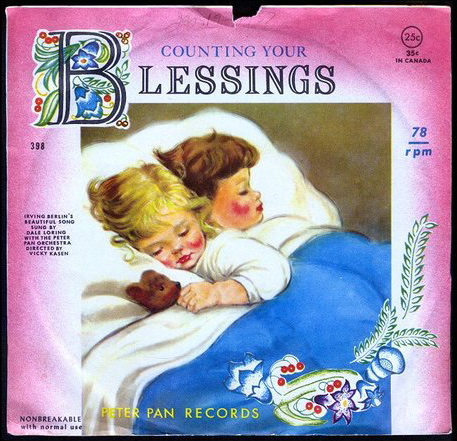
If you're worried and you can't sleepImage courtesy of eBay
Just count your blessings instead of sheep
And you'll fall asleep counting your blessings
-- Irving Berlin
Wednesday, August 21, 2013
Words To Live By
I have recently returned to my regular, workaday life after spending two supremely pleasant weeks on holiday on Nantucket lolling about and having a delightful time. It was a lovely, restful vacation, Dear Reader, with the added pleasure of meeting new friends and reconnecting with ones of years gone by.
While on Nantucket we rented a house that had a framed American flag hanging on one of its walls, that attracted my interest. It included an old black and white photograph of a young boy glued to the middle of the field of forty eight stars, and the following words written upon its white stripes in an old-fashioned cursive script:
Self Control
I will control my tongue, and will not allow it to speak mean, vulgar or profane words.
I will control my temper, and will not get angry when people or things displease me.
I will control my thoughts, and will not allow a foolish wish to spoil a wise purpose.
What was this about, I wondered? Upon closer inspection I saw that at the bottom of the flag was printed "Inspired by the National Institution of Moral Instruction. Washington, D.C., 1918" and was signed by a certain "Betsy Phmock" in the same handwriting that appeared on the flag.
So, what was the National Institution of Moral Instruction? After doing a bit of Internet research I found that it is alive and well today, and is now known as the Character Education Institute. Its mission is to "creatively use every phase of school, family, work and business life to teach and learn values," citing Theodore Roosevelt's statement as its inspiration that "To educate a person in mind and not in morals is to create a menace to society."
The moral instruction movement, I learned, is strongly associated with Horace Mann, the nineteenth-century champion of the common school, and was further popularized around the time the framed flag was made in the then-widely-read McGuffey Readers children's books that promoted virtues of thrift, honesty, piety, and punctuality, among others admirable traits.
As far as I'm concerned, Dear Reader, we as a people here in these United States would be far better off today if such "virtues" were as valued and promoted as they were one hundred years ago, when Betsy Phmock embellished the little flag that inspired this post . . .
Don't you think so, too?
Photograph by Reggie Darling
Subscribe to:
Posts (Atom)