Wednesday, February 16, 2011

Reggie Out & About: An Embarrassment of Book Signings

The other day, while idly sitting at my workaday desk and daydreaming when I should have been doing other more productive things, I realized that Boy and I had been to rather a lot of book signing parties this past autumn and winter.  Toting them up in my head, I counted that between the two of us we had attended six of them.


As far as I can tell, there was an explosion of new design and decorating books published in the months leading up to the holidays.  One hears dire stories that book publishing as we know it is on its last legs, under siege from the likes of the Kindle, downloads, and blogs.  While electronic media is, indeed, changing the way many of us gather and share information, I seriously doubt it will ever fully supplant physical books, and that glossy, picture-filled decorating and lifestyle books are probably the least vulnerable publishing category for inroads from same.  That is, if the avalanche of that type of book published in the latter part of 2010 is any indication.

Here's a tour of the books we acquired this winter while traversing Manhattan's book signing circuit:


The first party we attended was for Pauline Metcalfe's Syrie Maugham, Staging Glamorous Interiors, published by the Acanthus Press.  Held at Liz O'Brien's ultra-chic gallery on the UES it was an absolute crush.  Ms. O'Brien had gone the extra mile for the party, filling the rooms with gorgeous flower arrangements inspired by those of the English plantswoman extraordinaire, Constance Spry, whose arrangements filled the houses and smart apartments Mrs. Maugham decorated in the day.  Ms. Metcalfe inscribed the book "For Reggie: How nice to meet a loyal fan" which is how I had rather tongue-in-cheekedly introduced myself to her, as I have another one of her books, Ogden Codman and the Decoration of Houses, in my collection and which I consult regularly.  I attended a book-signing party for that book, too, when it was first published, long ago, and also had it autographed (then) by its authoress.


The next book signing we went to was for Emily Evans Eerdmans' The World of Madeleine Castaing, published by Rizzoli Press.  It was a very swell, well-attended party full of fashionables, and was held at the International Antiques Show at the Park Avenue Armory, where the party was sublimely—and lavishly—catered by Glorious Foods.  Fabulous!  EEE looked particularly glamorous that evening and was wearing her signature—or is it trademark?—green gloves when graciously receiving her adoring public and signing copies of her hotly-awaited monograph of the highly-influential, bewigged French antiquaire.  Our copy joins the other autographed books we own by Ms. Eerdmans, including her delightful Regency Redux, which was a publishing sensation when it came out in 2008.


I missed the book signing for Alexa Hampton's Alexa Hampton, the Language of Interior Design, published by Clarkson Potter.  Held at John Roselli's antiques-packed galleries—in the same building as Liz O'Brien's gallery—Boy attended the party with his assistant Clarissa Montgomery.  Boy said that Ms. Hampton was charming and gracious, which is just how I remember her from when I met and spoke with her at a cocktail party half a dozen years ago.  Reggie is quite pleased that she inscribed the book to him, and notes with appreciation Ms. Hampton's beautiful handwriting.


As I wrote in my earlier post featuring cookbook author, chef, and bon vivant Gail Monaghan, Boy attended a book signing celebrating the publication of her newest cook book The Entrees: Remembered Favorites From the Past: Recipes From Legendary Chefs and Restaurants.  I was, unfortunately, not able to attend the gathering, held at the Rizzoli flagship store on 57th Street, as business had called me away to South America the day of the party.  Fortunately, Gail was willing to inscribe our copy to the both of us, even though I was absent.


And absent I was, again, I am afraid, at the book signing party for Thomas Jayne's The Finest Rooms In America, published by the Monacelli Press.  The book signing was held at the dangerously tempting Archivia Books on the UES, and was—I understand—very well attended.  I first met Mr. Jayne more than a decade ago when we both attended an Antiques Forum held at Williamsburg, and he is a particularly charming fellow.  And he's a rather tall fellow, too!


Fortunately, I was able to attend the book signing party held in December for Suzanne Rheinstein's At Home: A Style For Today With Things From the Past.  The party was held, again, at the John Rozelli antiques gallery where the Alexa Hampton party took place earlier in the season, and in the same building as Liz O'Brien's gallery.  The party was packed with what I have come to appreciate as all the usual suspects, plus many friends and acquaintances of the book's charming author, who—I was delighted to learn when speaking with her—is a sometime reader of this blog!  I particularly liked her inscription, "Restraint is worth it!" a view we share in common as it turns out.


But there is one book signing party that eluded Reggie this season, which was for Peter Pennoyer Architects: Apartments, Townhouses, Country Houses.  Published by Vendome Press and written by Anne Walker, Mr. Pennoyer's co-author with several other books on architecture, this is a lavish celebration of the architect's gorgeous, classically-inspired creations, and a book that I have spent many delighted hours pouring over.  There were several parties held to celebrate its publication that Reggie was invited to in the city, but neither he nor Boy were able to attend any of them, due to rather tiresome conflicts, and Reggie's copy of the monograph remains uninscribed by its distinguished subject.  Reggie does hope to find himself in such close proximity to Mr. Pennoyer one day as to have the book inscribed, or at least autographed.  But for now, at least, it remains an unsullied tome amongst his more besmirched volumes.

Tell me, do you—like Reggie—seek to have your books inscribed by their authors, or do you prefer to leave them clean of such scribbles?

All photographs by Boy Fenwick

Sunday, February 13, 2011

Last Chance: The Balenciaga Show at the Queen Sofia Spanish Institute

For those of my discerning readers who live in the tri-state area, Reggie recommends that you hightail it to New York City by Saturday, February 19th, to see the show Balenciaga: Spanish Master at the Queen Sofia Spanish Institute on Park Avenue.  That is, if you haven't seen it yet—which Reggie hadn't, until yesterday afternoon.  On display since November 19th, the exhibit closes in New York on February 19th.  So now is your last chance to see it.  Hours have been extended until the show closes, with the galleries open until 6 p. m. on Monday and Tuesday, and until 8 p. m. Wednesday through Saturday.

The cover of the exhibition brochure

Lots of other bloggers and media have already profiled the show, so I'm not going to review it in any detail here.  Suffice it to say, the clothes are stunningly beautiful, and seeing them provides a rare glimpse into the most rarified world of Balenciaga's couture patrons.

Christóbal Balenciaga as a young man
Image courtesy of the Spanish Institute

Cristóbal Balenciaga (1895-1972) began his career as an apprentice to a tailor at the age of thirteen in his native Spain, where he learned dressmaking skills and eventually opened couture salons in Madrid, Barcelona, and San Sebastián.  He moved to Paris in 1937 during the Spanish Revolution and practiced couture there until 1968, when he closed his business.  Supposedly the shock of the news was so great for Mona Bismarck that she took to her bed for three days, devastated by it.  Poor thing, it must have been just awful for her.

The clothes are displayed against backdrops of
Spanish interiors and locations
Image courtesy of the Spanish Institute

The exhibit at the Spanish Institute displays Balenciaga's clothing dating primarily from the 1940s through the 1960s, and the outfits range in style from frothy confections of sheer feminine elegance to severe, architectural ones reminiscent of ecclesiastical robes.

A later, monastic outfit
Collection of the Metropolitan Museum, New York
Image courtesy of same

While Reggie certainly appreciates the mastery of all of the clothing on display in the exhibit, he prefers the prettier party frocks, which in some cases took his breath away.  So lovely and ladylike.

A lovely Balenciaga dress from the 1960s
Collection of the Metropolitan Museum, New York
Image courtesy of same

Reggie likes to attend such exhibits when he can because he is a student of social history of the world inhabited by the likes of the great couturiers' patrons.  Seeing what these ladies wore is a window into their (mostly) private world.  It's one thing to read about Thelma Chrysler Foy, it is another thing altogether to see the dress she actually wore.

The Institute's building on Park Avenue
Image courtesy of Wikipedia

Another reason to see the Balenciaga exhibit, aside from the clothes that is, is that it is mounted in the Spanish Institute's lovely neo-Federal townhouse on Park Avenue.  Designed in 1926 by McKim, Mead & White for the Oliver D. Filleys, it was given to the Spanish Institute in 1965 by Margaret Rockefeller Strong de Larrain, Marquesa de Cuevas (now that's a mouthful!).  The building is a fitting venue for the show, as it is the type of house that Balenciaga's patrons very well could have lived in when they frequented his salon and commissioned his elegant frocks.

For those of my readers who are fortunate to live on the West Coast, an expanded version of the show will reopen as Balenciaga and Spain at the de Young Museum in San Francisco, where it will run from March 26 through July 4. 

Balenciaga: Spanish Master
Queen Sofia Institute
684 Park Avenue
New York, New York 10065
(212) 628-0420
www.queensofiaspanishinstitute.org

Thursday, February 10, 2011

Dinner at Keens Steakhouse

It should come as no surprise to Reggie's readers that he is a steak lover.  Yes, Reggie adores tucking into a juicy, perfectly cooked steak—preferably a thick New York strip cooked medium rare—and he is a happy man, indeed, when the subject of the meal is beef.  For Reggie loves not only steak, but also beef tenderloin, prime rib, pot roast, and a great hamburger, too.  Among these beefy choices, though, it is steak that really gets his juices flowing and his stomach growling.  There have been times in Reggie's life that he would have happily dined on steak (or at least beef) at every dinner of the week.  But he didn't, and he doesn't, for all the reasons that are all too well known by his patient readers for him to (tediously) enumerate here.  No, this post is about the pleasures of eating steak, and not about why one shouldn't make it the centerpiece of one's daily diet.

Keens Chophouse around 1915
Image courtesy of Keens Steakhouse

These days Reggie tries to limit his consumption of beef to no more than once a week.  And that means that when he does eat beef, he is choosey about the quality that he consumes—no measly supermarket-bought, shrink-wrapped, styrofoam-packaged steaks for Reggie.  If he's going to limit his consumption of steak to only a sometime thing, it had better be for one worth waiting for: a thick, butcher-bought, paper-wrapped, dry-aged slab of marbled beef blisteringly seared over a hellishly high heat and then finished roasting to juicy perfection in a furnace-like oven.  That is how the best steakhouses here in New York do it, and how my friend and fellow blogger Lindaraxa instructs her readers to prepare it on her blog.  As far as Reggie is concerned, Lindaraxa nails how to perfectly cook a steak at home.  He encourages you to check out her method for doing so (along with the rest of her blog, which is full of excellent, mouth-watering recipes, among other things).

The main floor dining room at Keens
(Note the pipes hanging from the ceiling)

Image courtesy of same

Over the years Reggie has eaten his way through most of the great—and not so great—steakhouses in New York City.  He's braved the testosterone-fueled brawl at Sparks, where the hideous Gay '90s whorehouse decor and gruff-beyond-belief service is part of the fun.  He's eaten at the bare-bones, charming-as-a-bus-station Smith & Wollensky (also known as Smith & Expensky) and its more refined, uptown sister, the Post House.  He's tried Wolfgang's, the Bull & Bear, Bobby Van's, and many of the more recent additions to the city's steakhouse scene, including Porter House, BLT Steak, and Quality Meats.  The first steakhouse he remembers eating at in New York was the venerable Palm, where his older brother Frecky took him when he first moved to the city in the early 1980s.  There are only a few old-line steakhouses in New York that he hasn't tried over the years, most notably Peter Luger's (which requires a treck to Brooklyn and where the cash only/no reservations policies puts a damper on one's enthusiasm for trying it), Gallagher's, and the Old Homestead.  Those, too, shall come in good time, he suspects.

The upstairs Lambs Room private dining room
(Note the pipes hanging . . . )
Image courtesy of same

But there is one steakhouse that Reggie used to eat in long ago that he has only recently returned to for the first time in many years and where it was such a pleasing rediscovery that he intends to return to it regularly going forward.  For it may have become, after only just one (re)visit, his new favorite steakhouse in all of New York.  It is Keens Steakhouse, just off of Herald Square, around the corner from Macy's immense, and storied, flagship store.

That little fellow on the far right looks suspiciously
like my dear Pompey . . .

Keens is New York's oldest steakhouse, having first opened its doors 125 years ago.  Originally part of the private Lamb's Club, the restaurant opened to the public in 1885 and has been going strong ever since, serving generous portions of chops, seafood, and steaks to its happy patrons, which have included the likes of Teddy Roosevelt, Lilly Langtry (who sued the then all-men's restaurant in 1905 to admit women and won), J. P. Morgan, Stanford White, Babe Ruth, Will Rogers, and, more recently, Reggie.

Once known as Keens Chophouse, the restaurant changed its name to Keens Steakhouse in the 1990s in an effort to attract a broader clientele who supposedly didn't know what a chophouse was (!).  Needless to say, Reggie doesn't approve of the name change, but he forgives the restaurant for doing so nonetheless, despite his mild exasperation that they felt compelled to.

Matches from Keens, showing "Miss Keens"
from a painting in the restaurant's bar

Keens has been in the same building on West 36th Street since it first opened, and its rooms are a fantasy of late-nineteenth-century paneling and decorations, with every square inch of its walls covered with paintings, stuffed animal trophies, flags, memorabilia, and bibelot.  But what makes Keens' decor particularly noteworthy is that every inch of its ceilings are covered with rows and rows of old clay churchwarden pipes, hanging on hooks and ready to take down for a smoke.

The type of clay pipe that hangs from Keens' ceilings
Image courtesy of Antiquity Period Designs, Ltd.

Well, once upon a time, that is.  For not only is smoking in restaurants now illegal in New York (and has been since 2002), but the practice of pipe smoking has pretty much gone the way of the Dodo bird.  Keens was once a place where its patrons not only smoked, but were encouraged to.  Customers were able to buy inexpensive, long-stemmed, clay churchwarden (or tavern) pipes at the restaurant, which would then number and register the pipe and log it into a book that listed the customer by name and where their pipe could be found hanging from the ceiling, waiting for them when they returned.  There are over ninety thousand clay pipes hanging today from Keens' ceilings that once belonged to former patrons.  Entering the restaurant one feels as if one is crossing through Alice's looking glass and stepping back into a colorful nineteenth-century ragtime world of robber barons, Boss Tweed politicians, theatrical impresarios, and the likes of Diamond Jim Brady.

Keens patrons smoking pipes, ca. 1924
Image courtesy of Keens Steakhouse

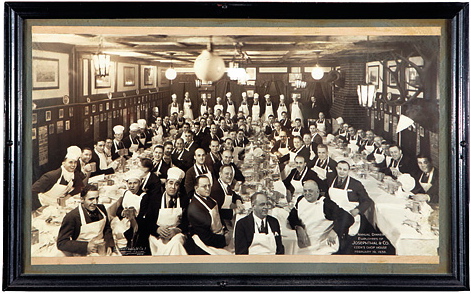
I first went to Keens in the mid 1980s when I attended bachelor parties and "smokers" there.  For those of my readers who are not familiar with the term "smoker," it refers to the pastime, now largely extinct, of men getting together for a stag evening of drinking, victuals, and smokes (be they cigars, cigarettes, or pipes), and, in the case of the ones Reggie attended, a capella singing.  For Reggie was for several years of his early tenure in New York a member of the University Glee Club, America's oldest all-male post-collegiate glee club.  Reggie would join friends and comrades of the Glee Club in Keens' private dining rooms, often in black tie, where we would wile away the evening singing Glee Club favorites, smoking, drinking, horsing around, and eating ridiculous amounts of the restaurant's signature beef.  It was a lot of fun, and I have many fond memories of it.

A beefsteak banquet held in the Lambs Room at Keens in 1938
Image courtesy of same

But once I left the Glee Club I no longer had much reason to go to Keens anymore, except for an occasional bachelor party or an evening spent dining there with friends in the restaurant's public rooms.   Not long ago, though, I decided to give Keens a try once again, since I figured it would likely be a worthy subject of a Reggie Review of the type of authentic, old-line restaurants that I have written about previously on this blog, including the '21' Club, Jack's Oyster House, and the Pine Club.  So I called up my friend Magnus and arranged for Boy and me to meet him and his partner Michael there one night.

We all loved our dinner at Keens!

A postcard of the upstairs Lincoln Room at Keens
This is where we ate during our visit
(Note the pipes . . . )

The restaurant attracts a more varied crowd than I remember or am accustomed to seeing in other steakhouses around town.  Of course there were the expected tables of six or more men gleefully digging into plates piled high with beef and all the trimmings that one sees in every expense account steakhouse in the city.  But there were also plenty of tables of couples out for the evening, and I'd say that around at least thirty to forty percent of the restaurant's patrons the night we were there were women, which is pretty high as far as these types of places go.  Also, Keens has a fairly high quotient of female waiters on staff, at least relatively speaking.  So, for the beef-lovin' ladies among my readers who haven't been to Keens yet, head on down, as you'll feel more than welcome and at home there, unlike in some of the more aggressively manly joints in this town.

The upstairs Moose Room private dining room at Keens
Reggie attended numerous "smokers" and bachelor parties in this room
(Note the . . . )
Image courtesy of same

We started our dinner with a round of delicious, icy cold Martinis (well, Boy and I did; Magnus and Michael were more restrained) while tucking into the house's signature (and complimentary) old-fashioned relish plate and basket of hot rolls.  I ordered a plate of shucked oysters (perfect) for a first course, followed by a sixteen-ounce New York strip steak, and we had sides of french fries, roasted brussels sprouts, and escarole for the table.  My steak was one of the best that I can remember eating in New York in recent years: thick, juicy, flavorful, and cooked to perfection.  Try as I might, I couldn't finish it, as I am not accustomed to eating so much beef in one sitting.  At least it wasn't the usual grotesquely large, twenty-something-plus-ounce rib eye that one sees on most steakhouse menus in these parts.  Boy was able to polish off his more appropriately sized eight-ounce filet mignon.  In other words, while the portions are generous at Keens, they are not absurdly so.  We finished our dinner by sharing an order of tiramisu, which was the only disappointment of the evening, but not so much of one that we didn't finish it, nor did it diminish our pleasure in the meal.  However, I should have known better than to suggest ordering this dessert at Keens, which is not the sort of place that comes to mind when daydreaming of Italian cuisine—by a long shot.  No, I should have ordered something more expected for such an establishment as Keens, where I would be confident that the house would excel in it, such as cheesecake.  I'll remember that for the next time I go there.

The lovely "Miss Keens" hanging in the bar
Image courtesy of same

All in all, the four of us were very happy with our dinner at Keens, and each of us agreed as we got our coats and prepared to leave that we had a great time there and looked forward to returning again soon.  Even though dinner at Keens is on the expensive side (count on spending at least one hundred dollars a head), it is well worth it.

Mints are thoughtfully
provided as one leaves Keens

Reggie recommends that you try Keens Steakhouse when you are in New York and hungering for a memorable steak dinner.  Not only is it a terrific destination for such a meal, but Reggie understands that it is also a popular place to go for dinner before attending a game or an event at nearby Madison Square Garden.  While you are unlikely to ever see Reggie darken the doors of that particular venue (with the exception, perhaps, for the Westminster Kennel Club dog show), you are more than likely to find him again at Keens one night soon, delightedly tucking into a steak dinner.

Tell me, what is your favorite steakhouse?

Keens Steakhouse
72 West 36th Street
New York, New York 10018
(212) 947-3636
www.keens.com

Please note, Reggie has not received anything in return for this review, nor does he expect to.  He is writing it solely for the pleasure and edification of his readers.

Sunday, February 6, 2011

New York Antiques Week, Part IV

Our next stop at the New York Ceramics Fair, and the one where Reggie truly lost his head, was the booth of Polly Latham, a dealer in Chinese export porcelain hailing from Boston, Massachusetts.  I have enjoyed visiting Ms. Latham's shop on Chestnut Street in that fair city over the years, and I had heretofore been able to resist the temptation to leave her establishment with one of her treasures under my arms . . . and a freshly signed cheque behind me in exchange for it.

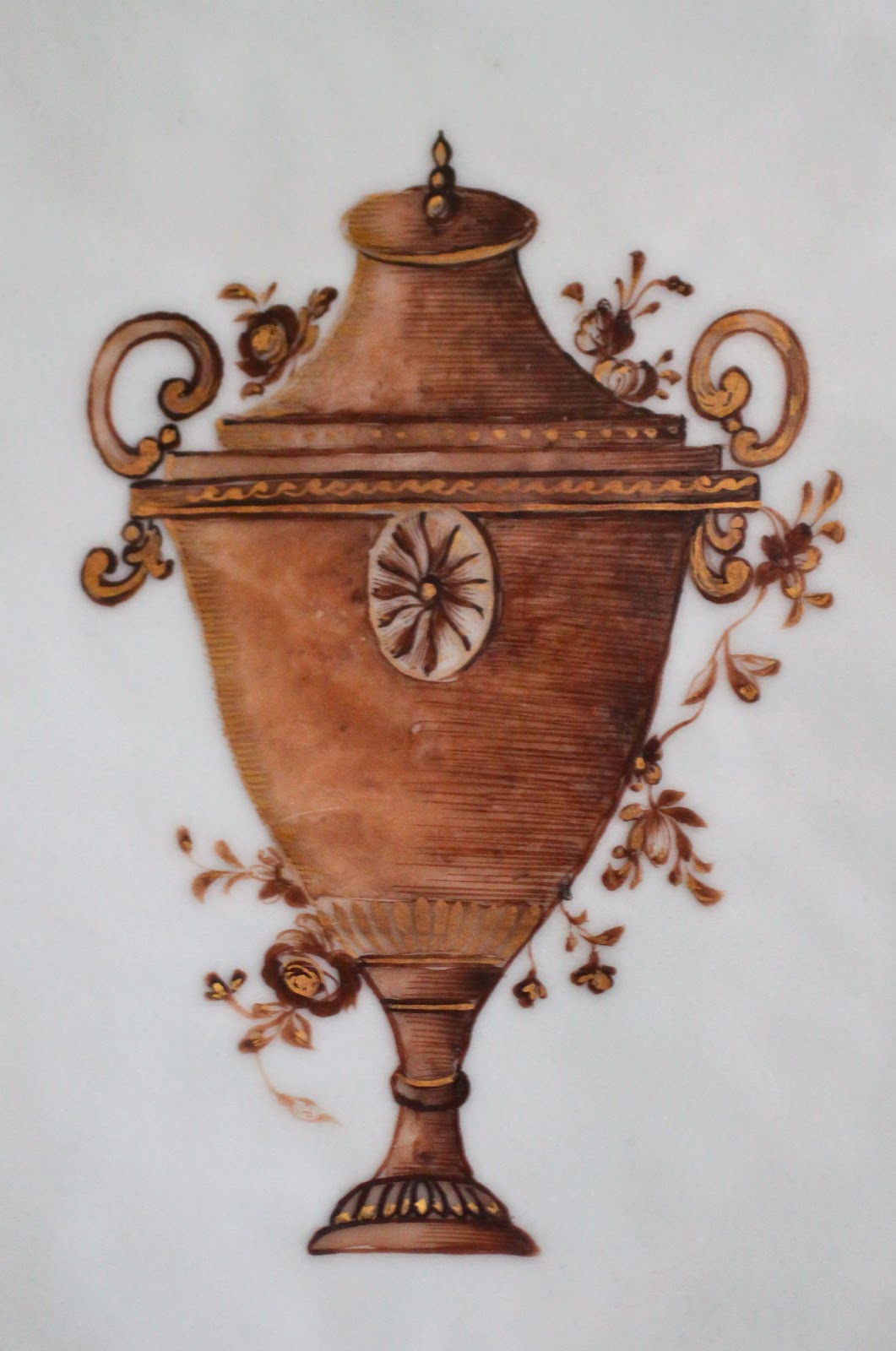
Detail of the central medallion
of the plates I bought at the fair

Not so, I admit, at the Ceramics Fair.  Even though our household bank account had suffered depletion at the previous two dealers we visited at the fair, out came the cheque book, again, when I espied these beautiful tobacco-and-gilt-decorated plates.  I had to have them, Dear Reader.

These are the three beauties I could not resist

As I have made known in previous posts, I have a particular weakness for Chinese export porcelain made for the American markets, and I have collected it—sparingly, I admit, given its rarity and cost—since I was a teenager, when I first heeded its siren call.  I have been a devotee of it ever since.

The Hongs at Canton, attributed to Lam Qua, ca. 1830-1835
Collection of the Peabody Museum, Salem
Image from
The Decorative Arts of the China Trade by Carl Crossman 

The first examples of Chinese export porcelain I purchased were ones I unearthed years ago while rooting through stacks of discarded, dusty plates at group antiques shops, thrift stores, and yard sales, where the purveyors knew not what they had.  I was able to buy the examples I found in such places at a only few dollars a piece, which was all that I could afford at the time.  I once even found a half dozen export saucers at the Salvation Army, for only fifty cents apiece.

One of our plates

But that was thirty years ago.  Today my purchases are found in loftier places and at loftier prices.  These days I'm lucky to find a good piece of Chinese export porcelain to add to our collection that costs less than a thousand dollars.  For, as I wrote earlier, my taste in china (and other things generally, for that matter) has become more catholic and expensive as I have grown older.  And what would have been shocking to me in my twenties seems entirely reasonable today.  For, as Oscar Wilde (another appreciator of fine china) wrote, "The more depraved I become, the more normal it seems."

A less decorated, but related example of Chinese export in sepia, ca. 1800,
showing a view of and inscribed "Monticello" and "Thomas Jefferson"
Collection of Dr. Wesley Gallup
Image from
Chinese Export Porcelain in North America by Jean McClure Mudge

So what, exactly, is Chinese export porcelain, you may ask, and why do I collect it?

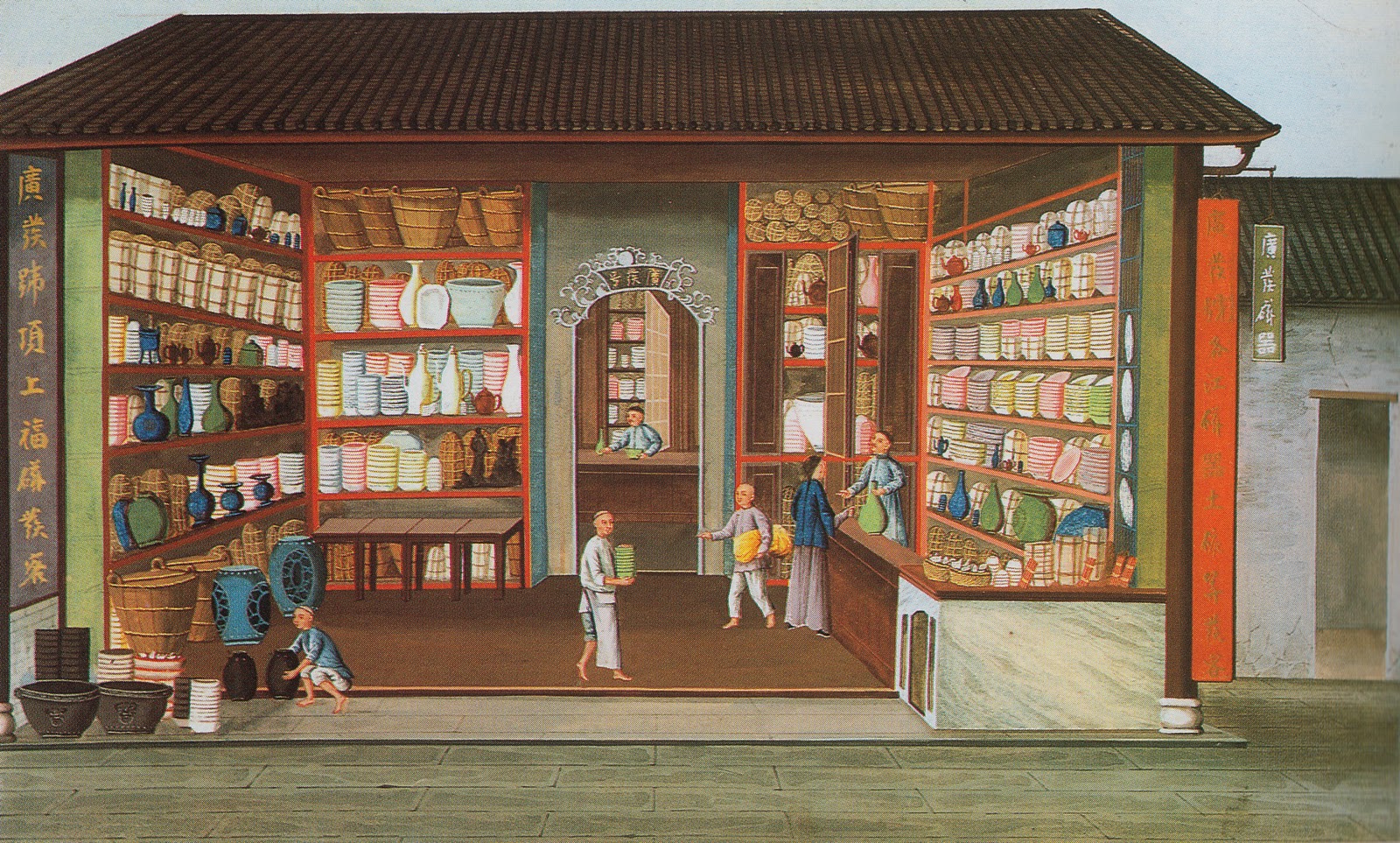
Interior of a Chinese porcelain shop, artist unknown, ca. 1820-1830
Collection of the Peabody Museum, Salem
Image from
The Decorative Arts of the China Trade by Carl Crossman

The United States entered into trade with China in 1784, when the first ship since the revolution set sail from New York Harbor on February 22nd, George Washington's birthday.  Known as the Empress of China, the ship was bound for Canton, now known as Guangzhou, with its hold full of Spanish gold bullion, the primary currency of exchange that initially fueled trade between the two countries.  Trade expanded rapidly thereafter, and demand in the new republic for Chinese tea, silks, porcelain and other luxuries was virtually insatiable.  In return, the U. S. supplied bullion, furs, rum, cheese, grains, and opium.

A detail of the decoration at the rim of the platter
Note the gilding and the desired "orange peel"
surface of the dish

One of the most desired items of trade from China was porcelain, a form of hard, brilliantly white china that was far superior to the earthenware goods then produced in Europe and in America.  But porcelain was expensive and only affordable by the elite in this country, and ranked a distant fourth behind the much larger shipments of teas, fabrics, and spices imported to these shores.  Nonetheless, a lot of Chinese porcelain was imported, often in sets specially ordered and decorated with monograms, coats of arms, and insignia. 

Decorating porcelain, from a large set of the street trades
of Canton, artist unknown, ca. 1840
Private collection
Image from
The Decorative Arts of the China Trade
by Carl Crossman

Much of the trade between the U. S. and China initially originated in New England, where vast fortunes were made buying goods in China and selling them here, often at great profit.  The first American millionaires in this country made their fortunes in trading with China.  The China Trade (as it was called) flourished from the 1780s until it ended with the Opium Wars of the 1840s.  Its "golden age" was from 1790 to 1820, the period that we concentrate our collecting on at Darlington House.

The labels affixed to the back
of the plates

The porcelain plates that we bought from Ms. Latham at the Ceramics Fair were commissioned by Thomas Willing (1731-1821) of Philadelphia, and date to approximately 1800.  Willing was one of the richest men in America at the time the plates were made, having made his fortune as a merchant in partnership with Robert Morris (1736-1804), one of the original investors in the Empress of China.

The barque Cynthia Off Lin Tin, by Sunqua, ca. 1840
Typical of vessels that plied the China Trade

In addition to his mercantile activities, Willing was at various times throughout his illustrious career the mayor of Philadelphia, a justice of the Pennsylvania Supreme Court, a member of the Continental Congress, and the president of the Bank of North America.  In short, he was one of this nation's most illustrious citizens during his accomplished life.

Thomas Willing, 1782
painted by Charles Wilson Peale
Collection of the Metropolitan Museum, New York
Image courtesy of same

While the provenance of our plates certainly adds to their value and desirability, it is not what attracted me to them, and it is entirely incidental to my enjoyment of them.  No, I had to own them because I found them beautiful, finely made, and exquisitely decorated.  I had a visceral reaction when I first saw them.  They grabbed me in the middle of my stomach and said, "You must own us. You must!"

I was helpless.  I had to have them.  So I got out my battered cheque book, and I bought them.

And that, Dear Reader, concludes my tour of (most of) what we bought at this year's New York Ceramics Fair.

All photographs by Boy Fenwick

Wednesday, February 2, 2011

New York Antiques Week, Part III

Our second stop at the Ceramics Fair was the booth of Philip Carrol of North Yorkshire, England, where Boy wanted to show me a mid-Victorian period Staffordshire figure of an elephant that he had admired several days before when previewing the show with his assistant, Clarissa Montgomery.

Our Staffordshire figure of an elephant, ca. 1860-1880
Photograph by Boy Fenwick

I was interested in seeing the elephant because, in addition to collecting early-nineteenth century pearlware figures, we also collect mid-nineteenth century Staffordshire figures.  We display our earlier pearlware figures in our drawing room at Darlington House, where much of the furniture is formal and dates from the first quarter of the nineteenth century.  We display our later Staffordshire figures in our cozier bedroom where the furniture is largely from the second quarter of the nineteenth century.  In other words, we place our figures in rooms where the furnishings are from similar eras.  Context.

A colorful Staffordshire elephant spill vase, ca. 1860
Image courtesy of worthpoint.com

In collecting Staffordshire figures* we concentrate on ones made in the middle of the nineteenth century, before their production quality had become degraded, as they did over time.  We prefer ones that are neither too colorful nor heavily painted, and where the subjects are either animals—such as dogs, sheep, or cows—or humans engaged in bucolic or sentimental pursuits.

So what is Staffordshire, exactly, you may ask, and why do we collect it?

An early-Staffordshire reference book
by Bernard Rackham, C. B.
Formerly Keeper of the Dep't. of Ceramics
Victoria and Albert Museum, London

Staffordshire is the name given to glazed earthenware pottery made in the English county of the same name that first appeared in around 1720, and which has remained in continuous production to this day, except for a brief interruption during WWII.  For purposes of this essay, however, I am using the term "Staffordshire" to describe pottery figures made during the lengthy reign of Queen Victoria, from 1837 to 1901, which is when they enjoyed their peak popularity.

A very early and rare Whieldon ware underglazed elephant, ca. 1755
Collection of the British Museum, London

Staffordshire figures were produced inexpensively and in vast quantities in the second half of the nineteenth century both for domestic consumption and for export, and were sold at reasonable prices to middle-class buyers; they were not figures for the most elite customers of the day.  Although less popular with collectors today than thirty years ago, Victorian-era Staffordshire figures remain sought after and are generally affordable, with prices for most figures less than $1,000.

An early and rare Wood family elephant, ca. 1780
Ex John Howard (from whom we bought Minerva)

The variety of subjects for Staffordshire figures virtually knows no bounds.  The most popular forms are pairs of animals, especially dogs; figures also depict solitary animals, both wild and domesticated; human figures—often depicting famous personalities, politicians, and members of the royal families of England and Europe; groups of figures engaged in pastoral pursuits; spill vases, watch stands, pastille burner cottages, and more.

The press molding method of casting figures (19th century)
Image courtesy of English Earthenware Figures, 1740-1840
by Pat Halfpenny

The slip casting method of molding figures (20th century)
Image courtesy of same

Staffordshire figures were produced using molds and decorated with both underglazes and painted overglazes, along with gilding.  Early figures are usually more colorful than later ones and are often of a better quality, with crisper molding and sharper detailing.  Later figures are cruder and less decorated than earlier ones, since over time the potteries' production became more streamlined, and labor-intensive steps were eliminated to cut costs.  Not surprisingly, later figures are also less desirable to collectors.  Production quality declined throughout the twentieth century, and the figures produced today are by and large mostly cheap gift shoppe junk.  They are to be avoided.

Pages from a catalogue of Old Staffordshire Pottery
in production by William Kent of Burslem as of 1955
Images courtesy of same

The elephant that Boy showed me at the Ceramics Fair is pictured at the top of this post.  It is of a substantial size, measuring ten inches tall and eleven and a quarter inches long, and is therefore larger than is typical for such pieces.  It is decorated with painted overglaze enamel to the animal's body and gilt banding around the base.  We both found it appealing not just for its size and subject matter but also because of its muted, limited color palette of gray and white.

Philip Carrol's advertisement in
the Ceramics Fair dealer's directory

Mr. Carrol said that he believed the elephant was made around 1860, but my research since then leads me to believe it could have been made anywhere from then until 1880.  Regardless, I loved it on sight and had to own it when I found out its price, which was very reasonable as these things go.  The elephant looks marvelous standing on the mantle in our bedroom, where he takes center stage, surrounded by a dozen or so other mid-nineteenth-century Staffordshire figures.  I'm thrilled to have him.

A later and more cursorily decorated version of our
Staffordshire elephant (note discolored repaired trunk)
Image courtesy of worthpoint.com

I like to think that our elephant might just possibly be the mighty and beloved Jumbo, the most heralded elephant in modern history.  For those of my readers who may not be aware of him, Jumbo was a large African bush elephant acquired by the London Zoological Gardens in 1865.  He became wildly popular among the English people and foreign visitors, many of whom had never seen an elephant before.  Jumbo's popularity triggered an avalanche of commemorative products, including trading cards, prints, hats, and other paraphernalia known at the time as "Jumbomania."

A Staffordshire elephant, nearly identical to the one we bought
Sold at auction in Texas in May 2010
Image courtesy of liveauctions.com

In 1882, over the outraged protests of many in England, including Queen Victoria and John Ruskin, Jumbo was sold to P. T. Barnum and taken to America, where he lived for only several more years before being tragically crushed to death by a locomotive in a heartbreaking accident that prompted an outburst of national mourning, both here in North America and in England.  Barnum had the unfortunate Jumbo stuffed and then toured with him for several more years before donating him to Tufts University in 1889.  Jumbo became the university's mascot and stood in Barnum Hall until 1975, when the building—along with Jumbo—burned to the ground!  Poor, dear Jumbo.

A carte photograph of Jumbo, ca. 1880
Image courtesy of worthpoint.com

If our figure is of Jumbo, it is from his younger and happier days, when he was the toast of England and a worthy subject for the Staffordshire potteries.  Regardless of whether he is Jumbo or not, I'm glad that Boy pointed him out to me at the Fair and that we now have him in our collection at Darlington House, where he is safe and sound.

* Note: Dear Reader, just as one never refers to curtains as "drapes," Reggie insists that one must never refer to figures as "figurines," at least within his earshot.  It is simply not done.  Of course one may break such a rule when using the term ironically when referring to cheap dime-store figures, which are—quite rightly—often called "figurines."  But then you knew that, didn't you?

Next: A trio of Chinese export porcelain plates with an august provenance . . .

Monday, January 31, 2011

New York Antiques Week, Part II

Our first stop at the New York Ceramics Fair was the booth of John Howard, a specialist dealer in Staffordshire, creamware, lustreware, and pearlware ceramics based in Oxfordshire, England.  We've bought from Mr. Howard at previous shows, and we always make a point of stopping by his booth at the Ceramics Fair because he usually has one or two pieces of pearlware that we are interested in.

Our pearlware bust of the goddess Minerva, ca. 1810-1820
  
Photograph by Boy Fenwick

So, what is pearlware, you might ask, and why would I consider collecting it, as I do?

Pearlware is a type of English creamware, made whiter by the inclusion of china clay, and covered with a glaze containing a small amount of cobalt that gives it a bluish cast.  The generally accepted view is that pearlware was invented by Josiah Wedgwood in 1779.  Sometimes called "Prattware," and originally called "china glazed" or "pearl white," it was produced in quantity by Wedgwood and other potteries, such as Enoch Wood & Sons, in England from 1780 to around 1820, and remained in production, albeit in declining levels, until around 1840.

The Enoch Wood & Sons potteries, circa 1840
from Ward's
History of the Borough of Stoke-Upon-Trent

Given when pearlware was produced, at the height of the neo-classical revival, much of it is classically inspired in its form and decoration, taking its aesthetic inspiration from ancient Rome and Greece.  We collect pearlware figures of neo-classical deities and the Christian virtues, made 1800-1820, and have a dozen or so of them at Darlington House.  The pearlware figures we collect were made for domestic consumption in the English markets, and relatively few of them were exported to America, unlike later Staffordshire figures.  It is relatively rare to find pearlware figures for sale here in the United States.

 Two pages of pearlware figures, a number of which are in our collection at Darlington
 from English Earthenware Figures, 1740-1840 by Pat Halfpenny

At John Howard's booth at the fair we came across a pearlware bust of the goddess Minerva, circa 1810-1820.  Standing a robust twelve inches tall, the bust has painted enamel overglaze decoration, meaning that it was first glazed and fired in an undecorated state, then paint-decorated, and then fired again.  Typical of such figures, the paint decoration is in pretty pastel colors.

John Howard's advertisement in the
Ceramics Fair dealers directory

The base of the bust is painted to resemble marble, and the figure wears plum and lavender colored classical robes and a slate colored helmet surmounted by plumes of russet feathers.  It is stamped (twice) as being the goddess Minerva, the Roman equivalent of the Greek goddess Athena, the goddess of wisdom, war, art, and commerce.  Minerva was the daughter of the god Jupiter, whose image appears on the bust's peacock blue colored breastplate.
Given the bust's substantial scale it was an expensive piece when originally produced and it is a costly rarity today.  Despite the hefty—although eminently fair—price quoted to us by Mr. Howard, we decided to take the plunge and buy it to add to our collection at Darlington House, where it sits as the jewel in the crown of our pearlware figures collection.

I think our Minerva is really rather marvelous, and I am thrilled we have her.

Next: A piece of Staffordshire of elephantine proportions . . .
Related Posts with Thumbnails