Thursday, September 9, 2010

The Old Mill Hillians Rugby Football Club

While the majority of Reggie's ancestors came to America well before its War of Independence, his grandfather Darling emigrated to this country in 1905.  Born Francis Ambrose Longbottom Darling, Reggie's grandfather was a schoolboy of fourteen when he left England, the land of his forebears, to spend the rest of his days in America.


Francis A. L. Darling was not what one typically thinks of when considering the masses of humanity that emigrated to this country at the beginning of the last century.  He came from a comfortably off, upper-middle-class English family and arrived as a first-class passenger on the ship he sailed in on.  Francis was sent to live with relatives in Massachusetts because his father had been killed in a freak accident while riding in a hansom cab in London, and his mother was considered incapable of raising Francis and his sister Nanette on her own due to a propensity to dipsomania, which became chronic with the shock of her husband's untimely death.  Or so the story goes.  Interestingly, Francis' mother was also named Frances (pronounced identically but spelled differently), but was known as Fanny, which caused me and my siblings no end of amusement growing up, since her maiden name was Longbottom.

Prior to moving to this country, Grandfather Darling attended Mill Hill School in London, an all boy's public school (it has since gone co-ed).  He finished his secondary school education in America, where he attended the Mount Herman School for Boys (as it was then known), followed by Yale, and then the Union Theological Seminary.  As I have written in a previous post, Grandfather Darling was a man of the cloth and spent the better part of his career as a minister leading a large and robust congregation of the faithful in Grosse Pointe, Michigan.

Dr. and Mrs. Frank A. Darling, circa 1938

At some point after moving to America, Francis A. L. Darling legally changed his name to Frank A. Darling, masculinizing his first name and dropping his second middle name.  When I asked him as a boy why he did this, he told me that it was because it sounded more American to him, and he wanted to fit in in his adopted country.  However, given what I have subsequently learned about his rather tumultuous adult relationship with his mother, who ultimately went certifiably mad, I believe his real motive was to sever such a direct connection to the woman whom he believed to have abandoned him as a boy, when he was sent off to live in this country with no prospect of ever returning to England.  He clearly had issues with this, and with her.  And I think I would have issues, too, if I had been sent off as a boy of fourteen by my mother to live with distant relatives in a foreign land, never to return.

Frank Darling was a great clothes horse for most of his life and also a great pack rat.  It was a family joke that it was virtually impossible to get him to part with something once he had acquired it, clothing in particular.  When he died in the mid 1970s he left behind an astonishing amount of clothes and related accessories that he had accumulated over fifty or more years.  If I remember correctly, and it has been some time now, I think there were more than sixty suits in his closets, over forty sport jackets, and seventy or so pairs of trousers.  Plus there was an equally jaw-dropping number of shirts, ties, shoes, hats, etc.  Included in this mass of clothing were such oddities as a pith helmet (to our knowledge he had never been to such a place that required the use of one), his running shoes from when he was on the Yale track team, and a blazer from the Mill Hill School.

While most of my grandfather's clothing was sent to a nearby college's theater department, my mother--who was given the task of sorting through and packing up his clothes--put aside several of the more interesting pieces for me and my brother, Frecky.  The frock coat and collapsable silk top hat that I got are long gone, but I have managed to hold on to my grandfather's Mill Hill blazer.


Made out of chocolate brown wool with stitched binding in the same color, the blazer has silver buttons and the school's crest on the breast pocket, along with the letters OMRFC.  The maker's label is so frayed that it is impossible to read who made it.  Inside the blazer's breast pocket I found this card, written in my grandmother's handwriting, that explained what OMRFC stood for:


"Old Millhillians Rugby Football Club."  I have always found it amusing that my grandfather, who, according to my grandmother did not play rugby at Mill Hill, owned this blazer.  Clearly he had fond associations of the school, for he bought the blazer twenty or more years after he would have graduated from it, had he stayed in England.  But how is it that he came to own this particular one, with the OMRFC letters upon it?

When I inherited the blazer it did not fit me.  I was able to wear it for a time, though, after I had the body taken in and the sleeves lengthened.  However, with the thickening that middle age has brought upon me the blazer no longer fits me, and it mostly hangs in a closet.  That is, when Boy doesn't wear it, as the blazer fits his more youthful figure, and he goes about in it from time to time.  But it is a rather fragile garment, having been made over eighty years ago, and Boy only wears it infrequently, on special occasions.


My grandfather's blazer is a treasured possession of mine, and something that I will never part with so long as I remain sentient.  I value it because it is a vivid connection with him, and one that is intensified by knowing that he not only owned it, but wore it, too.  The blazer was something that my grandfather valued sufficiently to seek out and buy on a return trip to England, and then kept (along with a lot of other clothes) for more than fifty years.  While I also own a number of other things that I inherited from him (bits of silver, cufflinks, and such), none of them resonate with me in quite the same way.

Tell me, do you have something that you inherited that you also treasure?

Monday, September 6, 2010

The Urns of Darlington: Summer

As I have written in the past, we fill the metal urns at Darlington with new plantings every spring, summer, autumn, and winter.  And as I have also written, I plan on posting images of each of the seasons' plantings for your delectation, Dear Reader.  I've already published essays on our winter and spring urns.  Now I turn my attention to this summer's.


And it is a good thing that I do, since the summer is rapidly drawing to a close.  Even though we technically have more than two weeks to go before the autumnal equinox that marks the season's end, I, like many people, think of summer as drawing to a close at Labor Day.  Yes, the warm weather will linger for some time before the first heavy frost, but the rhythm of the school year beginning anew still lingers with me, even though it has been over three decades since I left the hallowed halls of academe.  And for me, the start of the new school year means that autumn has arrived.


Over time our gardening at Darlington has become more restrained than it was when we first acquired the property, and this summer we planted our urns with a more subdued palette than we have in years past.  As we usually do, we planted grasses in the two urns at the entry to the house.  But this summer we planted a type of grass that we haven't before.  Named Carex flagelliferra 'Toffee Twist', it is loopier and more subtle in its appearance than the grasses we've used previous summers, and reminiscent of the plumage of an exotic bird.  I'm mad for it.  In fact, I like it so much that I am reluctant to pull it out and replace it with something more autumnal in several weeks' time.  We just might leave it in the urns this fall.


Boy planted the larger urn on our terrace with a deep purple Coleus solenostemon 'Dark Star' and trailing Ipomoea batatas 'Sweet Caroline' vine for the summer.  It makes a handsome contrast to the green of the landscape surrounding it.  Fortunately the deer did not find their way to eating the vine this year, which they have done in summers past.


We planted a single Beschorneria yuccoides, commonly known as Mexican Lilly, in the large urn that stands at the front of the walkway to the house.  We generally choose to fill this urn for the summer with a hardy, heat-and-drought-tolerant plant, since it sits in full sun throughout the day, and its soil dries out easily.  This is a striking, noble plant, and I plan on repotting it to over-winter inside the house.  I've had good luck doing so in the past, and I hope this will flower during the winter, as several others have.

And with that, Dear Reader, you have Darlington's urns in all their summer finery.  Please stay tuned for the next installment in this series, the Urns of Darlington: Autumn.

Friday, September 3, 2010

Winning Bid: Silver for the Entertaining Household

This past weekend Boy and I attended a sale at an upstate New York auction house.  In addition to featuring an array of furniture and decorations, the auction included an extensive selection of tablewares up for sale, including china, glassware, and silver.  I am happy to report that we were the successful bidders on a number of pieces of silver that were of interest to us for use when entertaining at Darlington House.


As should be apparent to readers of this blog, we enjoy entertaining, both intimately and on a larger scale, and we do it with some frequency.  In addition to the expected drinks parties and dinner parties, we also throw luncheon and bruncheon parties, and we occasionally throw themed parties--we once gave a birthday party for Pompey where we invited thirty of our friends and their dogs for an afternoon's romp.  Although Darlington is a commodious house, it is not a large one, and we generally limit most of our parties to several dozen guests.  We've had as many as one hundred at a time, but that's the limit for what the house can hold, and even then it's rather a crush.

As our parties have grown larger and more elaborate over the years, so has our need grown for stocking Darlington House with the necessary goods to support the requirements of what I call "the Entertaining Household"--one that entertains at an advanced level and with sufficient frequency to merit the provisioning of its cabinets, chests, and closets with an abundance of china, silver, glassware, and linens to amply support such an establishment's varied and extensive entertaining needs.  And although we are well provisioned at Darlington House with such goods (some of our friends think astonishingly so), we are always looking for interesting and more specialized pieces to add to our collections.

And that is where the beauty of buying at auction comes in.  I'm not referring to serious, catalogued sales of important, rare, or pedigreed offerings, such as those found at Sotheby's or Christie's, but rather sales at local and regional auction houses where good quality, decorative, and useful household goods are sold, often as part of an estate's disposition.  Such auction houses are a particularly good source for the sets of tablewares, linens, and serving pieces that are necessary when throwing larger-scale parties.  Although goods sold at auction are in "as-is" condition, oftentimes all they need is a good cleaning or polishing when brought home to have them gleam anew.  But the best part of buying at auction is that the offerings sold at such venues are often hammered down at prices well below what one would have to pay once said goods have swum upstream and into a dealer's inventory.  Bargains are to be had at auctions for the lucky, eagle-eyed bidder.  

In previewing the lots at the sale we attended last weekend, I identified three silver serving pieces that I thought would be useful to add to our store of entertaining goods at Darlington House.  We were pleased to find ourselves the winning bidders on each piece and especially pleased that we were able to acquire them at what Reggie believes to be very reasonable prices.

Here's what we brought home:

A Good-Size Silver Bowl

We have many bowls suitable for use during parties at Darlington House, in many sizes, most of which are--not surprisingly--made of ceramic or glass.  Our bowls range from perfectly good, modern-day ones found in department and specialty stores to delicate and difficult-to-replace ones bought in antiques stores and shows.  While I am more than happy to put out most of our bowls at parties, I am reluctant to use our early nineteenth century Chinese Export, Coalport, or similar antique bowls at our larger parties for fear of them being chipped or broken--either by a guest or by the person in the kitchen responsible for washing up.  Although we own half a dozen small silver bowls suitable for scattering about tables filled with nuts and candies, we did not have a good-sized silver bowl, useful for holding larger amounts of food.


That is, until we were the winning bidder on this one.  Made by Georg Jensen, the Danish jeweler and silversmith (in business 1904 to the present), of sterling silver in the "Dublin" pattern for the American market, it is a flared and melon-round footed serving bowl of a good, medium size, measuring 8½ inches diameter and 4½ inches tall.  It is more than sufficient to hold several large bunches of grapes, a mound of ice cream scoops, or an abundance of nuts in their shells ready for cracking open.  Unlike our more delicate antique porcelain bowls, however, I have no reason to be concerned that a guest's overzealous clattering of a serving utensil (such as grape shears or a nut cracker) will damage it, nor is there any risk that it will shatter should it be dropped in the kitchen.  A good-size, medium silver bowl is a useful addition to the Entertaining Household, and I am quite happy to now have one.

A Medium-Size Silver Tray

Over the years we have accumulated rather a lot of trays suitable for use at parties.  Initially we concentrated on acquiring large trays, most useful for serving and clearing up, but in the last five years or so we have concentrated on buying smaller trays suitable for use by staff in the passing of hors d'œuvres and for serving drinks during cocktails.  As our parties have gotten larger, the number of staff and serving rotations has increased, as has the need for additional trays.  Although we already had half a dozen medium-size silver trays suitable for such purposes, we found during our last large party that we could have used at least one more.


And that's what we found at the auction.  Made by the Frank W. Smith Silver Company of Gardner, Massachusetts, (in business 1886-1958) of sterling silver in the "Chippendale" pattern, the tray measures just shy of 12 inches across.  It is perfect for holding two or three glasses, or a dozen hors d'œuvres.  Admittedly not as fine as the Jensen bowl, it is nonetheless a perfectly serviceable, handsome tray and suitable for parties.  An assortment of such trays is a must-have in the Entertaining Household, and one really cannot have too many of them in such an establishment.

A Commodious Silver Chafing Dish

When having a dozen or more guests for cocktails or a buffet-style luncheon or dinner party, one often serves at least one dish that benefits from being served piping hot.  That means having a serving dish that has a heat source in it, such as burner or an electrical heating element.  But we didn't own any such vessels at Darlington House, and relied on our caterer(s) to supply them.  That can be a tricky proposition, however, as one is relying on what said caterer has in their inventory, or is able to rent for the occasion from a party supply company.  And that usually means industrial quality stainless steel.  While that's fine in a corporate setting, or for a public gathering, it is less than desirable for those of us who are as careful in our presentation as we are at Darlington House.  We prefer something finer and more comme il faut for our antiques-filled dining room.  And for us that means silver.


Well, in this case, silver plate.  At the sale we were the successful bidder on a generously scaled chafing dish.  Manufactured by Israel Freeman & Son, Ltd. of London (in business from 1928 until only recently), the dish we acquired measures 16½ inches by 11 inches and stands 8 inches high.  It has two burners to keep its contents hot.  It is perfect for use at large parties, for serving such dishes as my dear Aunt Joanna's Swedish meatball recipe, a particular favorite, as well as other comestibles that benefit from being served hot, hot, hot!  Such a chafing dish is a useful addition to the Entertaining Household, and is well worth owning in such an establishment.

And that is why Reggie goes to auctions.  For it is at auction that he is able to acquire such pieces at a very reasonable price, often for far less than what he would have to pay otherwise.  He understands that buying well at auction requires an educated and informed eye, otherwise mistakes can be made, and he knows that not all possess his level of knowledge in these matters.  But that is one of the reasons why Reggie writes this blog, so that he may pass along to you, Dear Reader, what he has learned.

All photographs by Boy Fenwick

Wednesday, September 1, 2010

You May Call It Eggplant, But I Call It Aubergine

Last weekend Boy and I stopped by the local farmers' market in the town near Darlington, as we usually do most Saturdays when the weather is nice.  Ours is a vibrant, thriving farmers' market and a terrific source for locally grown vegetables, fruits, flowers, meats, and eggs, as well as locally made cheeses, baked goods, and delicious organic foods not found in mass-market supermarkets.  We are lucky to have such a good farmers' market nearby, and we enjoy supporting it.


Now, I know that such markets are all the rage these days and that everyone is mad for locally raised food and all that, but Reggie isn't exactly new to this particular party, for he has shopped at farmers' markets since the one at Manhattan's Union Square--the granddaddy of all such things here in New York--opened in the early 1980s.  Reggie, of course, more than approves of the locavore movement in this country, and he strives to support whenever possible purveyors of locally sourced, raised, and grown, organic, non-industrial-food-complex comestibles.  And Reggie is thrilled with the success and momentum of the food revolution that continues to take place in this country.


Our local farmers' market was founded but a few years ago and has grown to become a truly excellent one in the short time it has been in business.  One of the more recent additions to the market's vendors includes a seller of heirloom vegetables who last weekend offered a mound of glossy, round, deep-purple aubergine displayed on her table, the likes of which neither Boy nor I had seen before.  She said it was Sicilian eggplant, particularly good for grilling.  Of course, Boy and I call this vegetable (well, fruit, actually) aubergine, as we find it amusing and rather recherché to refer to vegetables (or in this case fruit) by the names more commonly used for them in England (one's mother country, after all), instead of on this side of the pond.  Wouldn't you much rather eat courgette instead of zucchini?  I would.  And I do.


Anyway, we decided this aubergine was so gorgeous that we had to give it a try.  So we brought one home with us, sliced its creamy-white, sweet, and meaty flesh--remarkably low in seeds and moisture, I might add--brushed it with extra-virgin olive oil, and browned it on a sizzling-hot grill.  After we took it off the heat we drizzled it with just a bit more olive oil and seasoned it with a grinding of pepper and a dash of fleur de sel, and served it with several sprigs of curly purple basil, grown in pots at Darlington, that added a delicious licorice element to the dish.

I say, Dear Reader, I don't care what one calls it, I thought it was perfectly mahvelous.

All photographs (and cooking) by Boy Fenwick

Saturday, August 28, 2010

The Fireboards of Darlington House

When Darlington House was built in 1817, burning wood in fireplaces was the primary method for heating houses in this country.  Not surprisingly, there are a lot of fireplaces at Darlington--six of them inside the house, and another one in an outbuilding.  Within a decade from when the house was built, iron stoves supplanted fireplaces as the preferred source of heating in America, and all of Darlington's fireplaces were refitted with stoves.  It was not until 1931, when the Proctors bought the house, that central heating was installed.

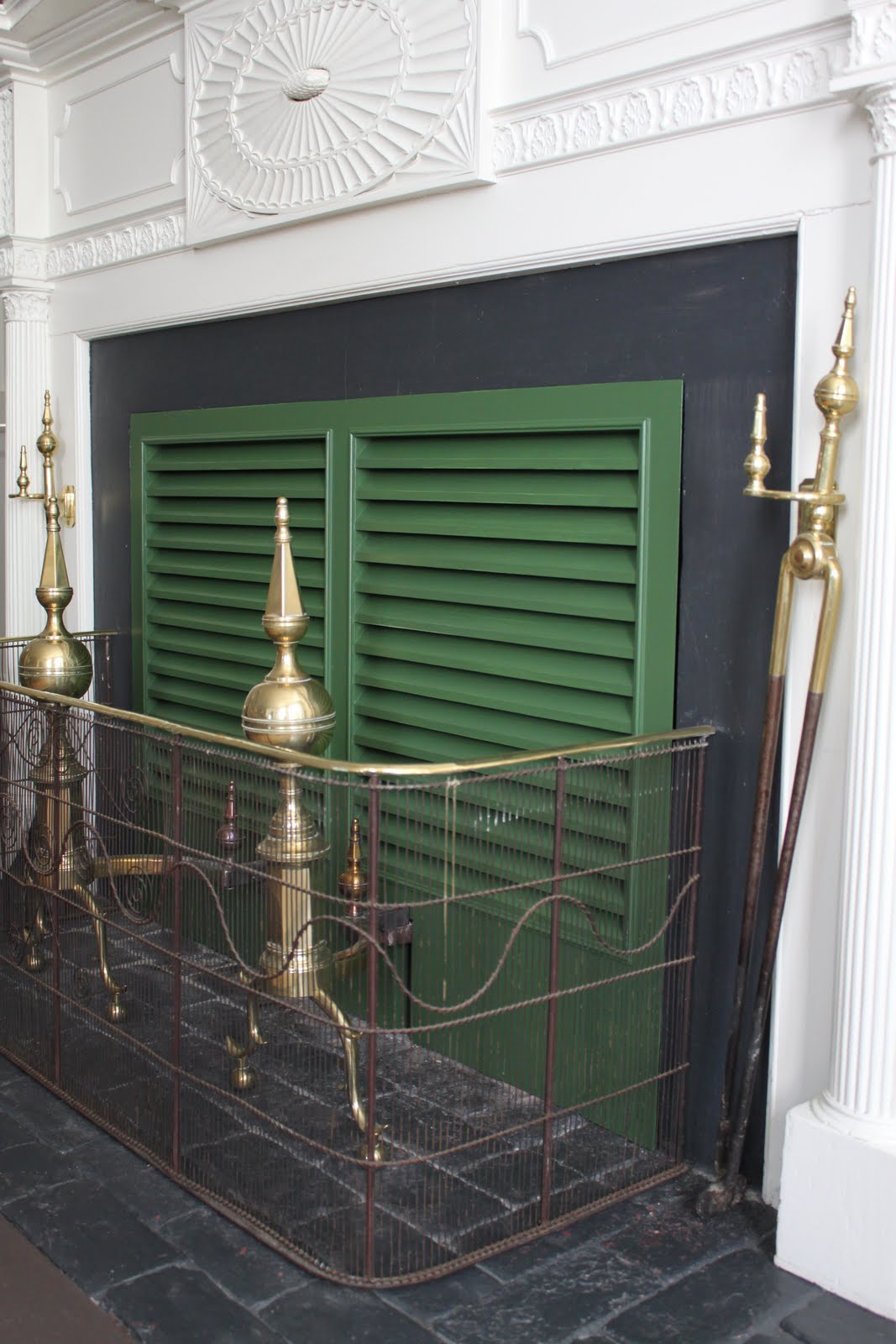
One of Darlington's fireplaces, with fireboard

When we bought Darlington in the late 1990s, only three of its fireplaces were operable, and only one of them was safe to use.  We have since opened up and lined all six of the fireplaces' chimneys, and today all of them are in working order and up to code.  It was a monumental, lengthy, dirty, and very expensive undertaking.  But now we have the pleasure of six working fireplaces.  And we use them when the weather is cold, as can be seen here, here, and here.

One of Darlington's chimneys, open and awaiting
its new clay tile lining and damper, circa 2003

While a fireplace is attractive when a fire is burning within it, or dressed with logs when one is not, it is not so fair when it is empty.  During the winter we lay logs in the fireplaces when they are not in use, to be ready for the next time we light a fire, but during warmer weather we leave our fireplaces empty and swept clean of ashes.

But our bare hearths and empty andirons looked rather forlorn during the summer months, so I thought it would be a good idea to cover them during the off-season with fireboards, as was customary when Darlington House was built.  The question was, what kind?

This antique American fireboard sold at auction for $82,250
Image courtesy of Skinner Auctions

I wasn't of the mind to have ones made and painted with naive scenes of country villages or hunters on horseback.  While I like living in an antique house, furnished sympathetically, I don't aspire to living in a folk-art collection or a house museum, which is what such fireboards bring to mind, at least to me.  Furthermore, modern-day painted fireboards done in a naive, folk-art manner can very quickly devolve into the realm of country cute.  Far better to have one's fireboards painted in the more modern, albeit classic, manner of Graham Rust, the very talented English artist:

A Graham Rust rendering of a painted chimney board
Image from The Painted House, by Graham Rust

But such talent is not easy to come by, and is very dear, and, besides, Reggie wasn't keen on introducing too much of a statement into the rooms at Darlington House.  It's one thing to cover one's upholstered furniture with smart summer slipcovers, as we do during the summer months, but it is another matter to also introduce a different painted scene into each room's fireplace opening.

But Reggie does admit that he wouldn't have minded having at least one fireboard covered with antique scenic wallpaper, which was a popular decorative conceit in the early nineteenth century.  But antique wallpaper-covered fireboards are difficult to find, and maddeningly expensive when found.  And then there's the pesky issue of finding ones that actually fit one's fireboxes.

A fire surround with scenic wallpaper fireboard
Collection of the Baltimore Museum of Art
Image from Classical Taste in America, 1800-1840, by Wendy A. Cooper

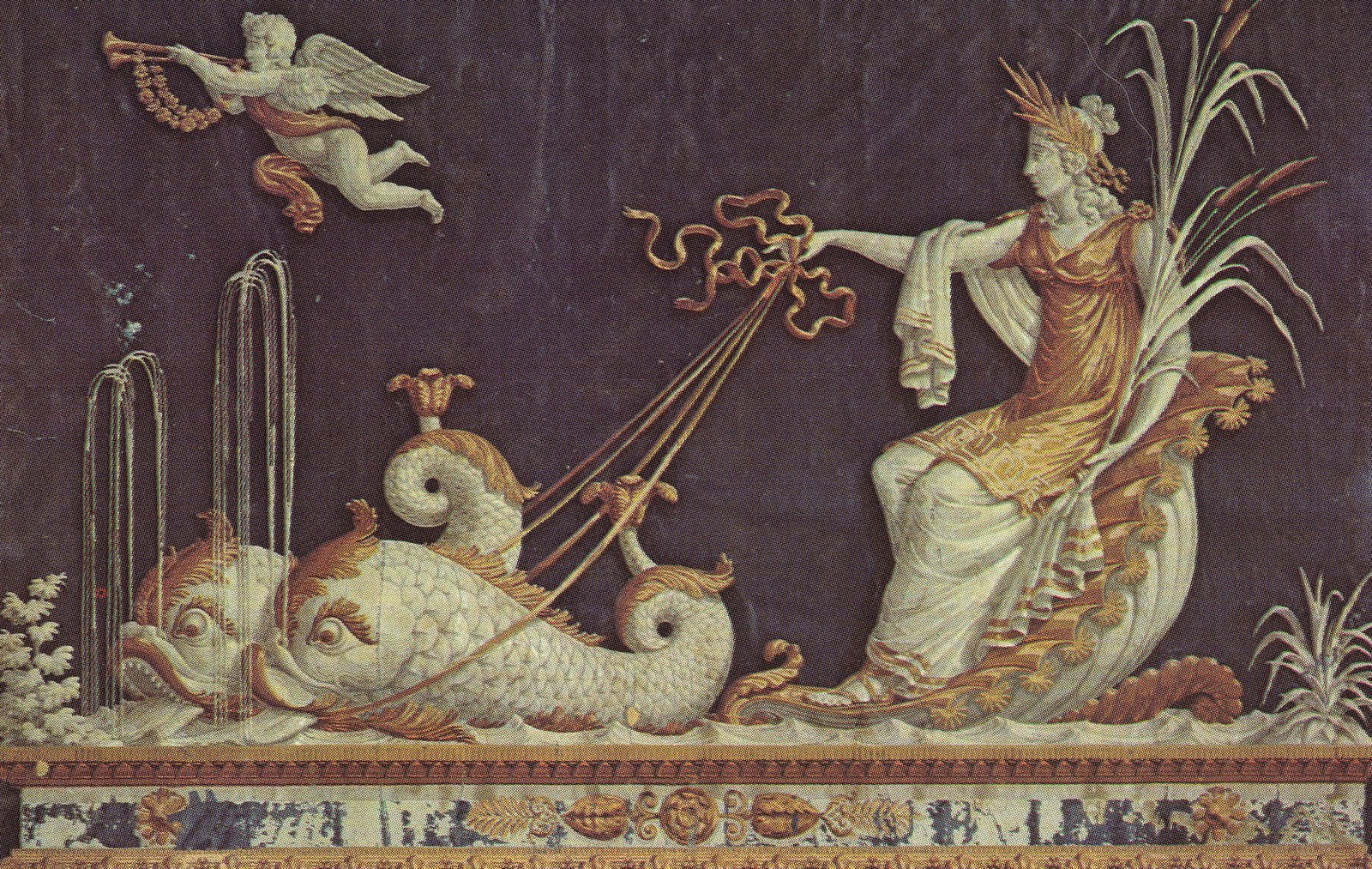
In the early nineteenth century, many of the papers used to cover fireboards in America were printed in France, and the panels were specifically made to use either on fireboards or as overdoor panels.

Antique wallpaper panel of Amphitrite born across the waves
Collection of the Cooper-Hewitt Museum, New York
Image from Wallpaper in America, by Catherine Lynn

The estimable Adelphi Paper Hangings recently introduced two wallpaper panels in a document pattern, Cupid and Psyche, circa 1795-1810, that may be used for papering fireboards.  However, that falls short of our needs, as we have six fireplaces at Darlington, not two, that beg for fireboards.

Adelphi's Cupid and Psyche wallpaper panel
Image courtesy of Adelphi Paper Hangings

Considering the number of fireplaces at Darlington, I reasoned it was best to wait until the perfect fireboard solution appeared, rather than rush into an unsatisfactory and costly custom fireboard project.

So the fireplaces of Darlington House sat empty during the warm-weather months for the better part of ten years, with narry a fireboard within them.  But Reggie was not exactly inconsolable in his grief, as there were other, more pressing claims on his resources at Darlington House, the list of which was so long as to defy imagination.

Our early fireboards

Several years ago, while visiting the Rhinebeck Antiques Fair, in Rhinebeck, New York, I came across two Federal-era, louvered shutter fireboards.  Made in the first quarter of the nineteenth century, when Darlington House was built, the fireboards were in their original green-paint finish.  It took me all of ten seconds to cry "Sold!"  I was thrilled, when we brought them home, to find that they required only minimal adjustments to fit two of our fireplaces.

One of our early-19th-century fireboards
in Darlington's original kitchen fireplace

But what to do about the other, empty fireplaces?

After much deliberation, research, and discussion, I decided that the best solution was to have the same type of louvered shutter fireboards made as we bought at the antiques fair.  That way, the fireboards of Darlington House would be consistent throughout the house and not call too much attention to themselves, yet still provide a pleasing architectural and decorative addition to the rooms during the warm weather months.

Three new fireboards, awaiting notching and painting

This past winter, during active fireplace season, I arranged with our architectural historian, Isaiah Cornini, to have three new louvered shutter fireboards made.  Isaiah used the shutters that hang on our exterior windows as the template for the new fireboards.


One of our early fireboards required some patching and extending to fit its designated fireplace more snuggly.

The extended and patched early fireboard

Once the panel was patched, Isaiah had a decorative painter inpaint the extensions on the fireboard to match the original paint.  We decided to paint all of the new fireboards the same grassy green that we used on the exterior shutters on Darlington.

The new fireboards have been notched for andirons
and have received their first coat of paint

I am quite pleased with the way the new fireboards came out and with how handsome they look in our rooms.  Here is one of them installed in our drawing room's fireplace.  I think it looks marvelous.


If you live in such a house as Darlington, or in any house or apartment with fireplaces, for that matter, I encourage you to have fireboards made for use during warm weather.  Not only do fireboards cover the fireplaces' unsightly empty openings when not in use, but they mark a pleasing seasonal change to one's interiors, particularly when done in concert with the covering of one's upholstered furniture with summer slipcovers, as we do at Darlington.

Tell me, how do you dress your fireplaces during the summer?

All photographs, except where noted, by Reggie Darling and Boy Fenwick

Thursday, August 26, 2010

By the Sea, By the Sea, By the Beautiful Sea

Well, no longer.  With our oceanside holiday but a fast-receding memory, I have refocused on my life in the City and at Darlington House.  I'm back at home, back at work, and back to writing a number of essays about recent projects and acquisitions, along with other Reggie subjects, which I shall be posting in the coming weeks.  I hope that you, Dear Reader, will find them of interest.


But before leaving the happy memories of the seaside altogether, I thought I'd share this photograph, taken one hundred years ago, of a jolly threesome by the shore.  I bought it more than twenty years ago at a used book store in upstate New York, where I found it while sifting through a shoebox of old photographs for sale.  I think I paid a dollar for it.  There's no identification on it of who these lads were, or where it was taken.  Given where I found it, I'm assuming they are American, and that their photograph was taken at a popular beach somewhere on the East coast.

I have always wondered, who are these men and how is it they came to be photographed?  Was it taken by a professional, roving photographer who strolled the beach, looking for customers, or was it taken by the fourth of their foursome with a newly available portable camera?  Are they straight, or gay, or a combination?  What accounts for their wildly differing physiques?  Whose umbrella is that?

These are such questions that one often ponders when studying photographs of unidentified people taken long ago.  One blogger who posts such pictures regularly, and whom I read regularly, is JCB.  I encourage you to look at her charming blog if you haven't already.  The photographs she posts, both old and new, are lovely and thought-provoking.

I believe my photograph is of three friends, enjoying each other's company at an outing at the beach.  Two of them appear to be athletes, or laborers, given their muscular physiques, while one is clearly a stranger to strenuous exercise.  I suspect the two fit ones are athletes as opposed to laborers.  Who knows if they are gay or straight?  I could talk my way into either conclusion.  The fact that one of them playfully holds a black silk umbrella argues that the photograph was taken by a fourth, more fully-dressed person who made up their foursome.  For I suspect the umbrella belongs to the photographer, whose hands would have been occupied by the task of taking the photograph.  And unless the person taking it was the wife of one of the subjects, it is unlikely that the photographer was a she, since it would been considered inappropriate at that time for a single woman to be unchaperoned under such circumstances.  Whatever the story may have been, this is a charming photograph of three young men enjoying themselves, and having a lovely time.  It is a favorite of mine.

Over the years I have collected several hundred old photographs of unknown sitters, unrelated to me.  I seek out photographs in which the subjects are interesting looking, or good looking, or have unusual or remarkable features, such as in the cabinet photographs I featured in my recent post on mustache cups.  I also look for ones, like this, where the subjects just might be gay, like I am.  While I have plenty of photographs of my actual ancestors, none of them--to the best of my knowledge--were gay.  If the men in this photograph were, then they are ancestors of mine of a different sort from those with whom I share an actual bloodline.

Tell me, do you collect old photographs of people long gone?  And, if so, why?

Sunday, August 22, 2010

Reggie, Lilly, Lilly, Boy*

There is rather a lot of Lilly Pulitzer to be seen on the island of Nantucket during the peak summer months.  It's everywhere.  When walking up the cobblestones of Main Street, in town, one sees armies of women, teenagers, children, and men, all sporting some Lilly.  There's a Lilly shop on the island that is a devotee's paradise, as it carries the complete line of Lilly for both women and men.  Everywhere I turn, I see someone dressed in Lilly.  And they come in all shapes and sizes, ranging from petite preteens to wide-bottomed gals in their sixties.  It's like a human parade of Easter baskets, all pink and green, and yellow and blue.  It is very summery, and mostly pretty.


Vintage Lilly Pulitzer fabric


And it would have driven Mummy Darling crazy.

MD was not a fan of Lilly.  In fact, she said she'd rather die than own any.  Couldn't stand it.  Hated it.  Always did and always would.  And that's because, in the 1960s, she was on the other, opposing team.  MD always considered herself to be something of a rebel.  She was much too cool to wear Lilly, which she dismissed as being the stuff of simpering blondes driving country-club station wagons.  Prissy.  Not her thing at all.  She considered herself to be a sophisticated, worldly brunette, and was proud of it.  And women like MD instead wore Marimekko, from the design house based in Finland, known for its boldly colored, highly graphic fabrics.


Lilly Pulitzer in her original shop in Palm Beach
Image courtesy of
The Preppy Princess


MD owned half a dozen Marimekko shifts in the late 1960s, that she treasured and wore in rotation during the summer, and she also had Marimekko scarves and tea towels, and even sheets.  She liked the bright colors and patterns of Marimekko, which she thought suited her to a tee.  Besides, there was something almost radical about wearing Marimekko at the time.  It was kicky and "now" and was from über-cool Scandinavia, like the furniture that was gradually replacing the antiques in our living room, that MD had inherited from her grandparents.

Vintage marimekko from the 1960s
Image courtesy of marimekko

But when Reggie was a boy in the 1960s he wanted MD to be a Lilly-wearing mother, like his friends' mothers who had blonde bouffant Kennedy hair, wore Lilly shifts and golfing skirts, and carried Bermuda bags.  He wanted to have a girlier mother, who would say "gosh" instead of "goddamit" and who didn't snort in disgust at the very idea of needlepoint pillows or Pappagallo flats.  When Reggie would ask MD "Why can't you be like the other mothers and wear those pretty dresses?" she'd say "Over my dead body!  I can't stand that Lilly Putziger crap!" which is how she referred to the designer's clothes.

Durie Desloge and Wendy Vanderbilt in Lilly, in 1964
Photographed by Slim Aarons


But only a year or two later, much to MD's indignation, she found that Lilly Pulitzer had been engaged to supply new school uniforms at the National Cathedral School for Girls, where my sister Hermione was a student.  And MD had to buy a set for her.  She didn't have a choice in the matter.  I still remember her fuming, "I can't believe it!  I said I'd never buy any of that Lilly Putziger crap, and now I have to!"

Slim Aarons' photographs of Lilly and her Palm Beach followers,
from Aarons' book 
Once Upon A Time


It was not until I went to Saint Grottlesex in the early 1970s that I thought about Lilly again.  Even though there weren't all that many girls at the school in those days (it had only just gone co-ed), a lot of them wore Lilly dresses and skirts, just like their mothers.  And they carried Lilly bags, too, and some of them even had Lilly patchwork quilts in their off-limits rooms.  It was actually kind of weird to see these teenage girls wearing what appeared to Reggie as rather matronly dresses in pretty pastels, when his own sisters were in the full throes of hippiedom.  But there was something quite attractive about it, too, and Reggie liked it.  And it wasn't just the girls at Saint Grottlesex who wore Lilly.  Quite a few of the boys did, too.  A number of Reggie's male friends at the school had shorts and long pants from Lilly, and swim trunks, as well.  And they looked really good in them.

Lilly-wearing Palm Beach residents, Mr. and Mrs. Donald Leas
Likely photographed by Slim Aarons
Image courtesy of
Dwellers Without Decorators


One year I stayed at Saint Grottlesex a couple of days beyond the usual departure date for the summer break, and I had the dormitory where I lived to myself.  While there, I came across a pair of Lilly shorts that one of the boys had left behind.  They were orange, with lions printed on them, and I was delighted to find that they fit me perfectly.  But I also remember feeling somewhat strange when I put them on, as if I was slipping my feet into the forbidden.  I knew what MD thought about Lilly, yet I was attracted to it.  Not just for the way it looked, all summery and Palm Beachy, but also for the pretty and attractive people I knew who wore it.  MD be damned, I thought, as I looked at myself in the mirror.  I'm going to keep these shorts.


Needless to say, after returning home, I was met with a snort of derision when I came downstairs one morning wearing my Lilly shorts. "Where did you get those ridiculous shorts?" MD asked me.  I told her, and she rolled her eyes and said that it was a good thing I'd paid nothing for them, since that was all they were worth.  I defiantly wore them almost every day until I left shortly thereafter to attend Colorado Outward Bound.  But I was perplexed, when I returned home at the end of the month-long program, that I couldn't find the shorts in my room.  And then I was incensed, when I learned that MD had donated them, along with my beloved childhood Lego collection, to a summer jumble sale at our parish church.  "You're too old for that stuff!" was MD's justification when I confronted her with her misdeed.  Not only was she unrepentant, but she categorically refused to replace the shorts (or the Leggo).  "Forget it!" she said.

My Lilly swim trunks


And I pretty much did, until the mid 1990s, when I saw a pair of Lilly swim trunks in the window of a store in Manhattan.  And I bought them, and wore them on Fire Island Pines, where the standard-issue bathing suit at the time was a far racier Speedo, or "banana hammock," as my preppy girlfriends called them, wrinkling their noses.  But I must admit, Reggie felt a bit of an imposter wearing his pink-and-green Lilly on the beach that summer, and the suit quickly found its way to the back of the drawer, never to be worn again.  I still have it, though.

A close-up of my trunks, showing the
"Lilly" that appears in all of her prints


Fast forward, to today on Nantucket.  


Last weekend, when our friends George Pinckney and Ford Waring were visiting us, we went into the Lilly shop in town to look around.  Neither George nor Ford, both of whom are old-line WASP southerners, are strangers to Lilly.  In fact, George once had a pair of Lilly shorts that he wore in the mid-1980s that I coveted and that he no longer owns, much to his regret.  We learned in the store that Lilly has discontinued, or at least drastically reduced, its menswear offerings, and what little they had left was aggressively marked down for an end-of-summer sale.

Boy's Lilly trunks, bought on Nantucket last summer


George walked out of the store with a colorful pair of trousers (seen in the center photograph, below) that he happily bought at a fraction of their original marked price.  Even though there was clothing there that fit me, I can't bring myself to wear today's Lilly, even ironically.  I guess that MD's influence over me remains strong, even from beyond the crematorium.

Current Lilly menswear offerings
Image courtesy of New York Magazine


But that doesn't apply to all Lilly.  I am okay with owning and wearing vintage Lilly, particularly if it's from the 1960s and 1970s, which is what I consider to be Lilly's heyday.  And, coincidentally, that's exactly what we found not more than a few minutes later while strolling through the streets of Nantucket.


Well, actually, it found us.  Here's how: As the four of us walked by a white clapboard building in town, a pretty young blonde standing by the doorway called out, "Hey, you guys!"  Once she got our attention she said, "We've got vintage Lilly inside, come check it out!"  I suppose the sight of us, all wearing some combination of Lacostes, khakis, madras, ribbon belts, white bucks, and Gucci loafers--plus George's shopping bag from the Lilly store, and Ford's and Boy's bags from other expected shops--just might have signaled to her that we were likely customers.  For it turned out she was a barker for a trunk show of vintage designer and couture clothing that Classic Collections, a Palm Beach dealer, had for sale inside.

Boy, in his vintage Lilly jacket
Photograph by Reggie Darling


Tucked away among the rooms of women's clothing and accessories was a yard-wide rack of men's Lilly sport jackets from the 1960s through 1980s for sale.  Both Ford and Boy tried them on, but only one of them fit Boy.  Like a glove.  Supposedly dating from the 1970s, the jacket is made out of a Lilly fabric of green, yellow, blue, and white in a fish-and-seashell design.  The buttons and label have Lilly's classic menswear lion-head logo from that era.


And I had to buy it for Boy as a very early birthday present.  You would have, too, if you had seen the look on his face when he tried it on and saw himself in the mirror . . .


* With apologies to John Singer Sargent


Related Posts with Thumbnails