Sunday, December 1, 2013

A Reggie Roadtrip: Atlanta, Part II

Today's post is the second part of my two-part series on Reggie and Boy's whirlwind visit to Atlanta, the Biggest, Boomingest City of the South.  You can read the first part here.


After an evening spent engaged in imbibulous shenanigans at Reggie's Bloggers & Bankers cocktail party, your sainted author was feeling a bit the worse for wear the next morning and needed to ease back into the land of the living.  And what better antidote is there for such an overindulgence than a Four Seasons room-service breakfast wheeled into one's chamber?

Ahh! Breakfast.

Fortified by our delicious breakfast (and several aspirin) we headed out the door to take in Atlanta's sights.  As we often do when on a Reggie Roadtrip, we began our day by visiting a number of the city's antiques stores.  Exploring such emporia is a requirement for us, not only because of our insatiable collecting instincts, but also because Boy's profession as a Fancy New York Decorator demands it.

Just one of the many aisles filled with antiques and accessories
at Atlanta's 14th Street Antiques Market

While Reggie came away from our antiques shopping expedition empty handed, Boy found a much sought-after object for a client's Park Avenue apartment, so our visit to the Atlanta's antiques district was not only entertaining, but also profitable.

The Atlanta Historical Society History Center
Image courtesy of ATL Intown Living

With obligatory antiquing behind us, we then turned to what brought us to Atlanta in the first place: to visit the city's museums and historic houses.  Our first stop was the Atlanta History Center, the home of the Swan House.  The Atlanta History Center is a handsome Art Moderne building in the swanky Buckhead district.  Reggie only learned afterwards, when researching this post, that it was originally known as the Atlanta Historical Society.  What is it, I ask, with this madness for renaming venerable cultural institutions with more modern, non-elite names?  I still wince whenever I see references to Historic New England, which I shall always consider to be more appropriately named the Society for the Preservation of New England Antiquities, its official name until its board of directors misguidedly decided to rename it, blandly, in an effort to make it sound more "relevant."

But I digress . . .  

The main house of the Smith Family Farm

After touring the Historical Society's History Center's lively exhibitions we made our way to see the two historic houses located on the Society's Center's grounds.

The first site we visited, a compound of buildings, was the Smith Family Farm, built in the 1840s by a slave-owning farming family that was moved to the Society's Center's property in the 1970s.  The Smith Farm is a fascinating window into the way the majority of slave-owning rural southerners lived in the days leading up to the Civil War and a helpful reminder that not all of the South's agricultural plantations were Spanish-moss-dripping, be-columned mansions.

This gives me ideas for when we finish renovating our
summer kitchen/work house at Darlington

I particularly liked the Smith Farm's separate kitchen building, kitted out in authentic period trappings.  We have a summer kitchen/work house at Darlington, ca. 1820, that we are slowly restoring.  One day I hope to be able to use it for something other than what we use it for today, which is to store large clay pots and our gas grill during the winter months.

The Swan House

In stark contrast to the Smith Family Farm stands the grand and justifiably celebrated Swan House, designed by Phillip Trammel Schutze (1890-1982), Atlanta's greatest architect of the twentieth century.  Built in 1928 for the Inman family, the house has been in the Society's Center's collection since 1966, and is maintained by the Society Center as it looked in the 1930s, complete with original furnishings and period-dressed interpreters.

The main hall at the Swan House
Image courtesy of the Devoted Classicist

I first toured the Swan House in the 1980s, but this was Boy's inaugural visit.  Decorated by the venerable Ruby Ross Wood in the grand English taste favored by the upper classes of the East Coast of America during the first half of the twentieth century, the Swan House is as interesting a window into its occupants as the Smith Family Farm is, albeit at a very different level and under very different circumstances.

A vintage postcard view of the Swan House's dining room
Image courtesy of Passion For Postcards

Even though the Swan House was well attended by other visitors the day we toured it, I suspect that its attendance would be dwarfed by the crowds that would flock to Tara, should it actually exist, except in the mind of Margaret Mitchell, the authoress of Gone With the Wind.

Tara!
Image courtesy of Selznick International Pictures/MGM

Atlanta (and other cities throughout the South) has more than its fair share of houses built to resemble the film-set version of Scarlett O'Hara's girlhood home that stood (in the book, at least) only twenty-five miles from downtown Atlanta.

A first-edition copy of Gone With the Wind
Image courtesy of The Everyday and Beyond

Speaking of Gone With the Wind, I reread it before, during, and after my visit to the city Scarlett moved to during the war.  I first read Mrs. Mitchell's best-selling novel in my twenties, and I remembered it as being a rip-snortin', can't-put-it-down, hefty page turner.  I'm happy to report, Dear Reader, that it still is, thirty years later.  Mrs. Mitchell is a marvelous storyteller, and her characters are vivid and memorable.  And funny, too.  Although Gone With the Wind deals with weighty subjects, it is at times very amusing.  I highly recommend it.

"I ain't noticed Mist' Ashley askin' for to marry you!"
Image courtesy of Selznick International Pictures/MGM

With our tour of the Swan House complete, our thoughts turned to lunch.  My friend Elizabeth Tallmadge recommended that we try the Society's Center's Swan Coach House restaurant for its old-fashioned, ladylike Southern fare.  After we stopped by it, though, Boy and I decided that we couldn't bring ourselves to go inside, as we were practically trampled by an avalanche of bridal-shower-attending girls and ladies tumbling out of the restaurant, flowers and gift bags in hand.  We decided that something a bit more, uh, manly was in order.

The Swan Coach House restaurant
Image courtesy of Tales of Bloggeritaville

After driving around Buckhead (in the pouring rain, which continued all day) we finally settled on a Houston's restaurant, closer into town, mainly because it had ample parking right in front of its entrance, a decided plus in a downpour.  I had never been to a Houston's before (it is a popular chain, I understand), and I was pleasantly impressed by the one we visited.  The food there was quite tasty, the surroundings suitable, and the service very good.  The young woman who waited on us couldn't have been nicer or more professional.
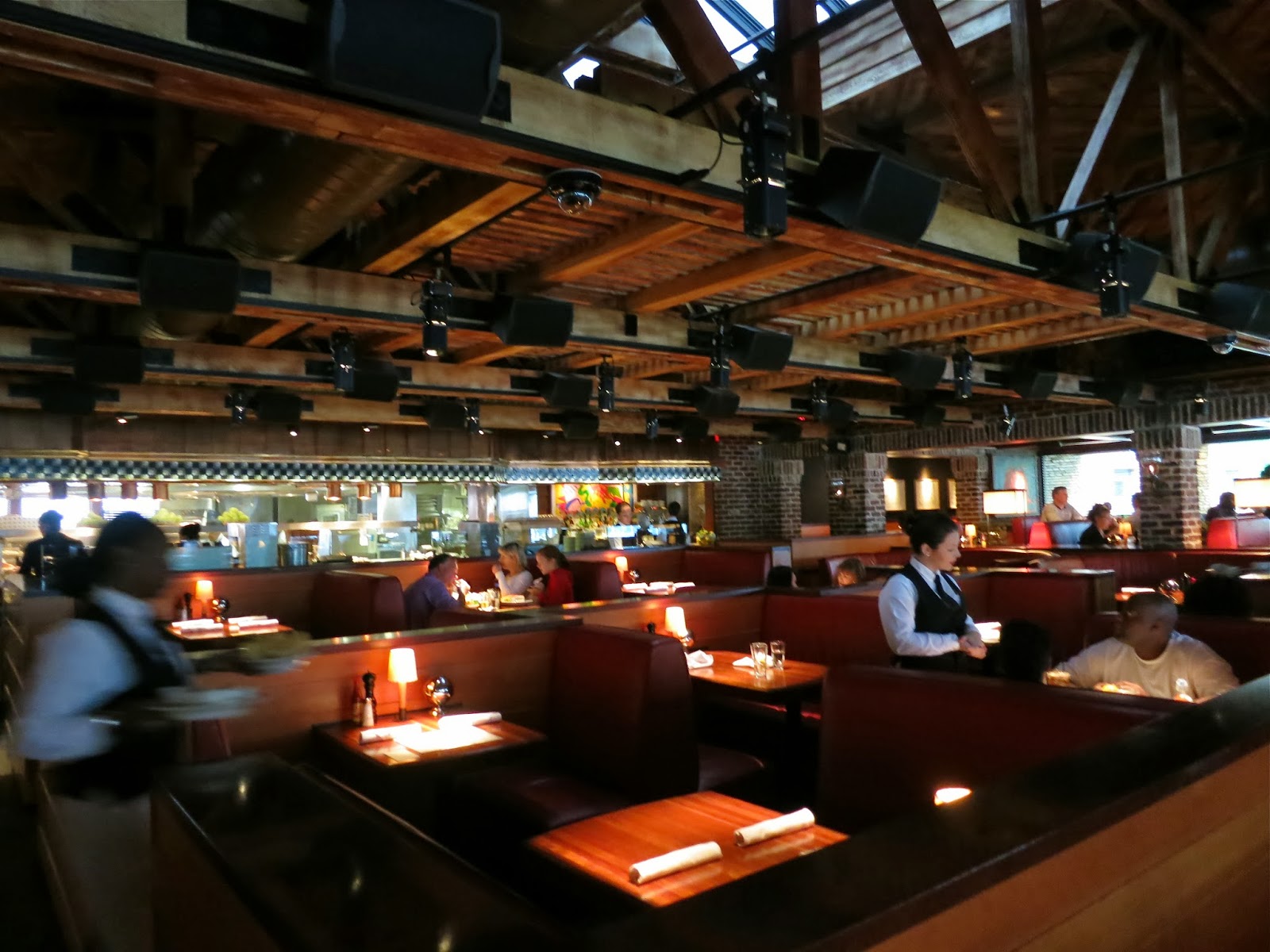
The welcoming man-cave interior of Houston's Restaurant

Another one of our reasons for visiting Atlanta was to spend an afternoon at the High Museum of Art.  Neither Boy nor I had ever been to it.  I was curious to see it, both for its celebrated architecture and its noteworthy collection of art.


Our first attempt to visit the High Museum was not successful, however, as the museum's parking garage was full and the wait to get into nearby parking lots was long.  That's because the High Museum was hosting a traveling exhibition of Vermeer's paintings that was attracting record crowds.  So we decided to drive around Atlanta for a while to see what we could of the city through our rain-splattered car windows.

I loved the ceilings of the High Museum's
modern art galleries

Returning to the museum, we were fortunate to gain entry to its parking garage and tour its collections.  We opted not to see the blockbuster Vermeer show, bypassing its crowds and lines.  As I've written in other posts, when visiting regional museums I generally prefer to skip traveling exhibitions and concentrate my viewing on the permanent collections.

A gallery full of Alex Katz's serene landscapes was most pleasing

Navigating one's way through the High Museum of Art can be somewhat challenging, as the architecture of the complex takes center stage, relegating the art on display to a secondary note.  The galleries containing modern art are the most successful, in my view.  The spaces displaying the museum's excellent collection of pre-twentieth century art and decorative arts?  Less so.

Looking down upon an artists' drawing event 
hosted by the museum the day of our visit

Don't get me wrong, Dear Reader.  I enjoyed visiting the High Museum of Art.  And so did the thousands of other people who did so the day we were there.  The place was hopping!

The two little girls in pink playing hide and seek were adorable

With the "closing-time" gong ringing, Boy and I took our leave of the High Museum and headed out the door with a few hours to kill before meeting up with friends for dinner.  So what did we do?  We went back to Sid Mashburn so that Boy could buy a pair of double monk-strap shoes that had caught his fancy the previous day.

"Get thee behind me, Satan!"

Needless to say, Boy found one or two more must-haves to add to his shopping bag during our second visit at Sid Mashburn . . .

Reggie is most grateful, Dear Reader, that there is not (yet) an outpost of Mr. Mashburn's divine men's clothing store in Manhattan, as he is sure it would hasten the financial ruin of the Darlington household.  Albeit a very well-dressed household!

The Iberian Pig restaurant in trendy Decatur

Dinner that evening was at the very popular Iberian Pig in downtown Decatur.  Organized by our friend Paula Mueller, a group of us gathered there to dig into the restaurant's signature pork-inspired offerings.  "The Pig," as it is known by its regulars, attracts a diverse group of Atlantans, ranging from young professionals to the more-pierced-than-thou crowd.  The night we ate at the Pig it was absolutely packed and the noise level positively ear-splitting.

The happening scene at the Iberian Pig

While I enjoyed the Iberian Pig's delicious, hearty fare, I could barely hear my dinner companions, what with the shrieks and shouting of the surrounding tables of revelers that brought our own table's conversation to a virtual standstill.  Nonetheless, I am glad I ate there, as I am fond of the people with whom I shared our table, and the food was quite tasty.

Even though we left the restaurant after midnight, I was surprised to find ourselves (yet again) stuck in parking-lot-like traffic all the way back to our hotel.  The congestion was due, in part, to crowds of hipsters leaving a huge music festival that took place during the weekend of our visit.  While sitting in our idling car, stuck in traffic, it was most entertaining to watch the antics of the music festival's departing attendees, many of whom were lurching about the streets and crosswalks, visibly bombed.

Stuck in jammed traffic, again!

The next morning, our last in Atlanta, we decided to explore the city's downtown.  We had spent the bulk of our visit in newer parts of the city and wanted to see what we could find of Atlanta's older, original business and shopping districts.  Where it all began, so to speak.

Downtown Atlanta in the 1940s
Image courtesy of Pat Sabin

The business district of old downtown Atlanta is largely comprised of office, municipal, and government buildings, a smattering of hotels, and remnants of what had once been a thriving retail district.

Downtown Atlanta today
Image courtesy of dayka robinson design

As is unfortunately the case with many American cities these days, downtown Atlanta is rather gritty and somewhat forlorn, as are many of the people one sees on its streets on a Sunday morning.  One is not inclined to get out of one's car and stroll around in downtown Atlanta, taking in the sights.

A vintage postcard of the Georgia State Capitol
Image courtesy of Playle

That is particularly so in the blocks immediately surrounding the city's majestic Georgia State Capitol, an area sadly hit with blight, bisected by immense highways and scarred by misguided urban "renewal" in the mid-twentieth century.  I would love to have seen this part of Atlanta in the 1930s and 1940s, when it was still in all its City Beautiful glory.  I'm sorry that much of it is lost to us today except in photographs and old postcards, such as the ones I am showing here.

"Would you make that a double, please?"

Somewhat sobered by our last few hours touring downtown Atlanta we drove our Cadillac ATS rental car back to the Hartsfield-Jackson Airport to catch our flight to New York.  Over preflight cocktails in the Delta Sky Lounge we agreed that we had thoroughly enjoyed our all-too-brief visit to Atlanta, a sprawling, complex, vibrant, and ever-changing metropolis with all the attractions and challenges that large cities in America have today.  I look forward to returning to the capitol of the Peach Tree State again and seeing more of what this wonderful city has to offer.

Tell me, Dear Reader, do you have any particular favorite places or things to do in Atlanta that you might recommend?

All photographs, unless noted, by Reggie Darling

Thursday, November 28, 2013

Thanksgiving at Darlington House

I have much to be thankful for, Dear Reader.  Every moment of every day.

Sometimes in the rushed and frenzied world of obligations and deadlines that I live in, though, I forget to take a moment to pause and ponder just how fortunate and blessed I am, and to be grateful for it.

Today I shall endeavour to do so, throughout the day.


I've never been to a Thanksgiving service at the church I sometimes attend, but I'm planning on going today.  One of the things I enjoy about our little congregation is that it draws people from all walks of life, some of whom live in very different circumstances than my own.  I have much to learn from them.  Attending services there helps me keep things in perspective, and I am thankful for that.

A tradition I observe at every Thanksgiving meal I attend, whether in my own house or another's, is to ask each person at the table to share what it is they are most thankful for this year.  I'm always intrigued with the window this provides into my table companions' lives.  More often than not, what people share provokes murmurs of agreement from those of us at the table.  Sometimes we respond with laughter, and sometimes we respond with tears.

So, what am I most thankful for this year, you may ask?  That my dear sister Camilla, who has lived in pain for many years, is now mending.  I am grateful that modern healthcare is making that possible for her.  I do so love my darling Sister.

This year it is just the two of us at Darlington for Thanksgiving, by choice.  I've been on a mad dash for much of the autumn, and the prospect of four days of quiet home life is something I have looked forward to, if not yearned for.

Times of unhurried reflection are some of the most regenerative and nourishing ones, I find.

Happy Thanksgiving, Dear Reader.

photograph by Boy Fenwick

Sunday, November 24, 2013

Reggie Throws a Dinner Party, Part I

Today's post, the first of two, discusses the planning and preparations for a dinner party that Boy and I hosted at Darlington House last weekend.  I thought it might be of interest—at least to one or two of my Dear Readers—for me to share just how we do it here at Darlington.

One afternoon a month or so ago I said to Boy that I was itching to have a dinner party to celebrate the arrival of autumn, and to entertain a group of friends—some of whom we knew well and others we'd like to know better—to an evening of pleasant conversation, flowing libations, and delicious, hearty fare of the season.

Boy and Basil at the Hudson Farmers Market in Hudson, N.Y., the week
before our party, to meet with our beloved caterer and also our flower lady

Throwing a successful party, in Reggie's view, requires planning, forethought, teamwork, and effort.  Although a party can be a casual affair, where guests freely mingle and help themselves to drink and food laid out at a buffet, one must never confuse "casual" with "effortless."  The term "effortless entertaining" is a particular pet peeve of Reggie's, and it sets his jaw on edge whenever he all too frequently comes across it in magazines breathlessly describing the entertaining styles of certain social animals.  Believe me, Dear Reader, "effortless entertaining" is a fantasy concept, indeed.  For a party worth attending doesn't just happen.  It requires work.  And why shouldn't it?  Anything worthwhile requires effort to achieve.  Fortunately Reggie enjoys all the preparations and planning that go into a creating a successful party.  He finds it fun.

One's enjoyment in undertaking such efforts is helped, though, when one is able to share said labors with others, at minimum with one's spouse, and—when possible—with one or more professionals employed to assist in making said event a well-run affair.

Christine Jones of the Red Barn
at her stand at the Hudson Farmers Market
Baker, caterer, restaurateur, and friend

When Boy and I entertain at Darlington House, we gauge the level of assistance we require by the number of guests invited and the type of entertainment provided.  When we have another couple over for cozy supper of four, we take care of it entirely by ourselves, setting the table, cooking and serving the meal, and washing up afterwards.  When there are six of us, though, we hire someone to help us out with the final food preparations in the kitchen, serve at table, and clean up afterwards.  When there are eight or more we surrender the cooking entirely to a chef, who is usually supported by an assistant and where the guests are attended to by at least one, and sometimes more, servers.

That way we get to enjoy our own party, rather than be enslaved by it.

The Cedar Farm stand at the Hudson Farmers Market
I ask you, who needs Manhattan's flower district when the good ladies
of Cedar Farm are so close to home?

Since we determined that there would be a total of ten of us at table for this dinner party, our first step was to contact our beloved caterers, Christine Jones and Bert Goldfinger of the Red Barn, who've helped us out with many parties, to see if they were available (and willing) to cook for us.  Once we determined that they were (Hooray!), we enlisted the help of a woman who helps us serving at parties, to see if she was available to attend to our guests, and were delighted that she was.

Marilyn Cederoth of Cedar Farm Wholesale
Plants-woman extraordinaire

Once we had the staffing of the evening in hand, we turned to assembling our guest list.  We invited a number of people who had entertained us who we liked and wished to return the favor to (see Reggie's Rules of Social Reciprocity), and we also invited some people we had never entertained before (two recent arrivals in the area, one of whom I first met twenty or more years ago), with the end result being a mix of singles and couples.

With guest list in hand, I picked up the telephone and started calling my hoped-for guests to invite them.  Please note, Dear Reader, I did not impersonally email or text my invitations, I telephoned them.  For when throwing a dinner party one should always strive to invite one's guests telephonically, in order to personalize said invitation.  Of course when throwing larger parties, say cocktails for fifty, it is understood that one sends out invitations via the post office (or, increasingly these days, by Paperless Post).

Olde Hudson on Warren Street in Hudson, N.Y.,
is a regular stop for us for specialty foods, and
where we stocked up on last-minute treats for our party

Once our guests had accepted, I then sent them reminder cards (in the mail) one week ahead of the party with the requested arrival time noted, as well as the dress.  For this dinner party we asked the men to wear jacket and tie.  It seemed a bit too early in the season to force ask our guests to haul out their formal wear for a country dinner party.

The marvelous Hudson Wine Merchants
on Warren Street in Hudson, N.Y.,
was the source of all of our party potables

On a parallel path with assembling our guest list we met with and had any number of telephone and email exchanges with our caterer to come up with a menu for the evening that was appropriately autumnal, and decidedly delicious.  As I've written elsewhere, Boy and I are of the school of entertainers who shy away from serving over-handled and fancified food at dinner parties.  We and our friends eat out in restaurants all the time, to the point that it really isn't all that special.  But it is special to be invited into someone's home for a dinner party these days, since so few people have them anymore (or at least invite us to them when they do!).  When I either give or go to a dinner party, what I really want to eat is what has come to be known as "comfort food."  And that's what we serve at Darlington House dinner parties—unfussified "home-style" cooking made with care and from the best available (ideally local) ingredients.  Not one's mother's plain, everyday get-it-on-the-table cooking, mind you, Dear Reader, but rather dressed up comfort food.

While we were planning the menu with our caterers we also contacted Marilyn Cederoth of Cedar Farm Wholesale.  Marilyn helps us with flowers at Darlington House.  We arranged for her to come by the house the day of the party to fill the Chinese urns in our drawing room with autumnal branches and to provide arrangements for the dining room table and the table in our entry.

Rural Residence on Warren Street in Hudson, N.Y., is an
invaluable source for candles for parties, among other things

The day before the party our groundsman/handyman/all-around godsend, Rich, brought in a crew and did a thorough leaf clean up and tidying of the property, so it would be in tip-top, manicured shape for the party.  We also contacted our favorite wine merchant in the area, Michael Albin of Hudson Wine Merchants, to put aside cases of white and red wine, and also one of champagne, and a replenishment of the bottled liquor we like to have on hand at parties.  Reggie also stopped by a specialty food court near his office in midtown Manhattan to pick up some before-and-after-dinner treats to augment the already planned food and drink.

Cases of champagne and wine, delivered and ready to be chilled for the party

With these and other advanced arrangements taken care of, we then drove up to Darlington from the city on Friday night, ready to embark on the preparations the next morning in order to be ready for our guests when they arrived on Saturday evening.

Next: It's Show Time!

All photographs by Reggie Darling

Friday, November 8, 2013

Reggie Out & About: Brian McCarthy Book Signing Party and the Irish Georgian Society Dinner

Reggie is a social animal.  He likes gadding about town and country, meeting up with friends and making new acquaintances.  He finds it stimulating and, more often than not, amusing.  And it is a pleasing diversion from the more mundane daily rhythm of one's workaday life.  "All work and no play . . ." as the old saying goes.

New York's Fuller Building, lit up at night

We have been on rather a whirlwind of social activity of late.  It is now the "season" here in Manhattan, and there are parties, openings, and benefits galore every evening of the week.  We generally try to limit our running about to no more than two nights during the week, and certainly never more than three.  For, Dear Reader, a too-steady diet of parties and dinners out can be like anything else when overindulged—too much of a good thing.  Several quiet evenings a week at home with the company of a good book or a little bit of television is a requirement of mine for recharging my batteries.

The crowd at the Brian McCarthy
book-signing party

This week is one of those out-three-nights-of-the-week weeks that we rarely find ourselves indulging in.  But we had compelling reasons to agree to such a frenzied social schedule, Dear Reader, including the wish to celebrate friends' accomplishments and also meet up with out-of-town pals visiting the city.  On Tuesday we attended two parties, and I took my trusty Canon point-and-shoot camera along with me to snap some pictures for this post.

Mr. Brian J. McCarthy, hard at work

Our first stop was the city's magnificent Art Deco Fuller Building where Beauvais Carpets was hosting a book-signing party for Mr. Brian J. McCarthy's hot-off-the-presses first book, Luminous Interiors, published by Stewart, Taboori & Chang.  As many of you know, Mr. McCarthy is the principal of the celebrated, eponymously named interior design firm Brian J. McCarthy, Inc.  I've known Mr. McCarthy's partner, Danny Sager, for many years, and Boy and I wanted to attend the party to help celebrate Brian's accomplishment.

Brian had his work cut out for him . . .

The party was an absolute madhouse crush, with over five hundred people crowding Beauvais' showrooms, all having what appeared to be a lovely time.  And why not?  Even though it was, at times, difficult to navigate one's way across the floor, there were many familiar faces among the crowd to jabber with by simply turning around (including the lovely Lyle Vivolo of Beauvais, Boy's longtime and most-adored rep).  The party was beautifully supplied with what seemed to be an endless army of waiters carrying trays of well-filled wine glasses and platters loaded with yummy hors d'oeuvres.  Reggie particularly liked the mini latkes with crème fraîche and salmon roe that were among the many nibbles offered—they reminded him of one of his favorite appetizers at Swifty's.

A brief respite from inscribing books

What with the long line of attendees queued up to have Mr. McCarthy sign copies of Luminous Interiors, Reggie decided to wait for another day to have his own copy autographed.  I did get to say a quick "Hello" to Brian (only by elbowing my way through the scrum of admirers clustering around him, though) and snap his picture before Boy and I scooted out the door for our next engagement.  I look forward to having Brian inscribe my copy of his book soon, under more leisurely circumstances.

The cocktail hour at the Irish Georgian Society party

Our next stop was one of New York's legendary private clubs, where Reggie was once a member but gave it up because the food and drink there is so delicious and plentiful that he gained five pounds every time he darkened its doors.  For those of us with a tendency to put on weight, such as dear old Reggie, ready access to such temptation is a dangerous proposition indeed.

Boy looking around the room to find our host . . .

The party was held in honor of the very worthy Irish Georgian Society, and we were the guests of Mr. Steven Stolman, man about town extraordinaire and president of Scalamandre.

. . . Ah, there he is!  Mr. Steven Stolman!

Unlike the book-signing party we had just come from, one was able to maneuver one's way around the Irish Georgian Society party with ease and stop and chat with the numerous friends and acquaintances that one pleasantly came across there.

Lots of face kissing was to be observed

Among the party guests were Mr. Mitch Owens of Architectural Digest, who wrote the article about our house that appeared in the magazine's June issue.  I like him immensely.  Mr. Angus Wilkie of Cove Landing and his charming partner, Mr. Len Morgan, were also there.  Reggie had an amusing conversation with Mr. James Andrew of What Is James Wearing, who was there with his partner, Mr. Scott McBee.

Dinner is served!

The party's dinner was held in a handsome, wood-paneled room.  One of the speakers during the meal was the actor Jeremy Irons, who spoke at length about the restoration of his castle in West Cork, Ireland.  The castle's restoration was a huge undertaking, we learned, as it was a near ruin when Mr. Irons acquired it.

Mr. Jeremy Irons at the podium

Although one's mind did wander during the speeches at dinner, it didn't really matter to me that Mr. Irons went on as long as he did because he has one of the most beautiful speaking voices imaginable, and I could happily listen to him recite the pages of a telephone book.


Besides, there was lots to look at during the speeches, including the tables' pretty flowers and decorations.

The place card of our host and dinner partner

Adding to the fun was that I was seated next to Mr. Stolman, an amusing bon vivant who had me in stitches for much of the evening.

Mr. Richard Wilkie

Mr. Stolman was joined by his partner, Mr. Richard Wilkie, who was also seated at our table.  Also at the table were a number of their Palm Beach friends, who were jolly good company.  After spending the evening with this lively crew I'm thinking that Boy and I just may need to schedule a return trip to the home of The Shiny Sheet sometime this winter.

It was difficult to tear one's self away from this, believe me!

After dinner we returned to the room where cocktails had been served to find it generously laid out with tables covered with silver platters of exquisite petit fours, and the full bar still open.  While I'm not exactly sure, I think I had to be pulled away from it all by Boy, who claims that I was gobbling pastries and demanding more drink when it was obvious to him (and most likely others, too) that I had been thoroughly, if not over, served by that point in the evening.

Ah well.  My hangover the next morning, Dear Reader, was but a small price for me to pay for all the merriment I had that evening.  Thank you Messers McCarthy and Sager, and Stolman and Wilkie, for including us in the fun!

All photographs by Reggie Darling

Saturday, November 2, 2013

Salted Butter, Please!

Yes, Dear Reader, I use salted butter.  Because I like it.


When I was growing up we didn't use unsalted butter in the Darling household.  It would have never occurred to MD to use anything but salted butter.

Then Julia Child came on the scene and woke up the American upper middle classes to the joys of French cooking, and people started to replace salted butter with unsalted.  If you needed salt to flavor food—either when preparing it or eating it—the thought was that you could always add it.  Besides, unsalted butter was so European, so it had to be better!

Well, that's fine, but that's not where it stopped . . .

Because in some culinary circles people lost sight of the fact that there are times when the use of salted butter is actually preferable to unsalted butter.  And it became verboten to even consider using salted butter. For anything!  Only cretins used salted butter!


Reggie, being a gullible chap, and with an admitted tendency to snobbery—whether it be social or culinary—got swept up in the anti-salted-butter hysteria, and he stopped buying or using salted butter at home.  That's because he thought he wasn't supposed to like salted butter.

But he never could quite understand why it was that the toast he buttered in the morning just wasn't as yummy as he remembered it as being when he was a boy.  Nor could he understand why the contents of the bread baskets that arrived in (most of) the restaurants he frequented tasted so delicious when he liberally spread said bread with the butter that accompanied it.  He assumed it was because he was a bad, willpowerless person who couldn't stop eating bread (also vilified in certain circles these days—but that's a story for another day).  Why was it so good, he wondered?


Because, Dear Reader, he has finally figured it out that it is far preferable to butter one's bread with salted butter—which is what most restaurants serve with bread (with the exception of Italian ones, which provide olive oil).  If you haven't done so, Dear Reader, I suggest you try this little butter taste test:  Buy a package of salted butter and one of unsalted butter, and see which tastes better on your morning toast, or English muffin, or whatever bread you choose to spread it on.


Not only is Reggie convinced that you will find the salted-buttered bread tastes better, but he believes you'll be surprised that the unsalted-buttered bread, in comparison, tastes as if it is has been coated with a mildly sweet, practically tasteless shortening spread.

Salted butter tastes better!

Now, I have a confession to make.  Dear old Reggie didn't figure this out all on his very own.  He owes a debt of gratitude to Mr. Alex Hitz, who debunks the salted-versus-unsalted-butter myth in his highly entertaining, chock-full-of-mouth-watering-recipes cookbook My Beverly Hills Kitchen.  Reading what Mr. Hitz writes on the matter was a Eureka! moment for Reggie:
"Always use salted butter . . . sneering purists will have you believe that if you use salted butter you might, perhaps, better control the salt in a dish by putting it in yourself.  The result inevitably ends up tasteless.  I have never yet tasted a dish whose salty taste came from salted butter."
And that applies to when one butters one's bread, too!

I now exclusively use salted butter when I butter my morning toast, or when buttering other breakfast treats such as pancakes, french toast, or waffles (which I eat only very rarely).  I do, though, still (mostly) use unsalted butter when I'm cooking.  I may come around to Mr. Hitz's admonition on that score, but I'm not there . . . yet.

Tell me, Dear Reader, what kind of butter do you use?

Please note: While the photogenic packages of butter that illustrate this post do appear regularly in our kitchen at Darlington House, you would not be surprised also to find packages of Land O'Lakes butter in our refrigerator, should you chance to peek inside it.

All photographs by Boy Fenwick
Related Posts with Thumbnails