Showing posts with label at long last. Show all posts

Saturday, May 25, 2013

Reggie Revealed . . .

"Who is that man behind the curtain?

Wait a second—could that be Reggie Darling at the controls?
Image courtesy of Metro-Goldwyn-Mayer

"Is his name really Reggie Darling?  What kind of name is that?

"And who is this Boy Fenwick person?  And that adorable pug that Reggie sometimes shows on his blog—is his name really Pompey?

I suspect they'd be able to figure out who Reggie really is pretty quickly . . .
Image courtesy of CBS Television

"Where is Darlington House?  Is that its actual name?  Who names their houses, anyway?  Why is it that they never show full rooms, only vignettes?  Do you think they even live there?

"And all those stories about Reggie's family, do you think they really happened?

Same with this crew.  I'll bet that Reggie couldn't fool them, either!
Image courtesy of CBS Television

"How much of this stuff is made up?

"I can't find out anything about these guys when I Google them.  That's pretty strange, I think.  You can almost always find something about someone these days with a simple Internet search.  Not these two, though.  Except that blog—there are lots of links to that . . . but not to them.

"It all sounds kind of fishy to me . . ."

Well, Dear Reader, it has come time for me to answer some of these questions.  For, you see, Reggie has been revealed.  There is a certain design magazine on the newsstands now that spills the beans.  Reggie has been outed.

The magazine in which all is revealed . . .

And that's just fine with him.  Because, Reggie actually outed himself.  He agreed to use his "real" name in the story in the magazine because a lot of people already knew that Reggie wasn't the name he was born with, but rather a nom de plume.

Darlington House, as seen in the June 2013 issue of AD

Besides, he was quite pleased to have Darlington House featured in the magazine, and he thought it would be silly not to have his "real" name associated with it.  He's very proud of Boy Fenwick for appearing in Architectural Digest's pages, a coup for any decorator.  It doesn't get any better than that, Dear Reader.

Mr. Boy Fenwick standing at the front door
of Darlington House

"So," you may ask, "If you use made up names in your blog, Reggie, is everything else made up, too?"

Won't you please come into the front hall?

No.  Well, not really.  Other than coming up with playfully Wodehouse-ian names, most everything Reggie writes about is true, and actually happened.  From time to time, though, he does admit to playing around with some of the minor details (such as writing that MD drank scotch when in reality she drank Canadian Club).  But he does so mostly to perfect the voice in his stories.

Do make yourself comfortable in the drawing room.
Would you like something to drink?  A cocktail, perhaps?

"But why, Reggie, do you use a nom de plume?"

Because, Dear Reader, I prefer to keep this blog—a lifestyle one—separate from my very busy and demanding professional life in the financial services industry.  I have a whole "other" life that I prefer not to co-mingle with what I do here in my off hours, for fun.

Reggie is upstairs in the master bedroom straightening his tie
at the moment.  He'll be right down to meet you!

And I plan to keep it that way, too, Dear Reader, even though Reggie's secret it out.

Won't you please play along with me?

Photographs: Unless noted otherwise, all images courtesy of Architectural Digest magazine

Saturday, May 4, 2013

The Simple Pleasure of a Chiming Clock In One's Bed Chamber

As readers of this blog well know, Reggie is a somewhat old-fashioned fellow.  While he appreciates the conveniences and advances of the modern world, when it comes to how he lives his daily life his feet are inclined to be planted in an earlier time of rotary telephones, winding clocks, and monthly calendars.  In England he might be considered a Young Fogey, except that he has long since passed beyond what anyone (except for those of a very advanced age) might consider to still be young.  Sad, Dear Reader, but true.

Reggie's carriage clock
sitting on a chest of drawers at Darlington House

As a boy I had a fascination with carriage clocks, which I first came across in the houses of my little friends and also those of our neighbors.  Developed in France around 1810 by master clock-maker Abraham Louis Breguet (1747-1823), carriage clocks (also known as "officer's clocks," or pendules de voyage) are compact traveling timepieces that were fashionable among well-to-do Europeans and Americans throughout much of the nineteenth century.  Their appeal was both visual (they are pleasing to look at) and practical, as the clocks' mechanisms were cleverly designed to keep ticking (and thus telling accurate time) on bumpy carriage and train rides.

An early French carriage clock, with its original leather carrying case
Image courtesy of the Clock Workshop, Winchester, England

As I grew into adulthood I considered buying myself an antique carriage clock, but refrained from doing so (even though sorely tempted in several instances) because of a (perhaps unfounded) concern that finding someone to skillfully refurbish said clock to modern timekeeping standards would be challenging and expensive.  In other words, I was concerned that the purchase price of the clock would merely be the entry ticket to a long and costly project that might not, in the end, produce the desired result: a well regulated clock that keeps accurate time.

"The London to Bath Coach" by John Charles Maggs (1819-1896)
Image courtesy of Wikimedia

But that all changed a decade or so ago when I was fortunate to find myself on holiday in London.  I had recently received a substantial bonus at the Investment Bank where I work, and—as they say—money was burning a hole in my pocket.  (I note that this was back in the days when Investment Banks still paid handsome bonuses, which is today but a sad (albeit sweet) and (increasingly) distant memory for those of us who remain employed in what is left of that industry.)

"The New Steam Carriage" by George Morton
Image courtesy of Wikimedia

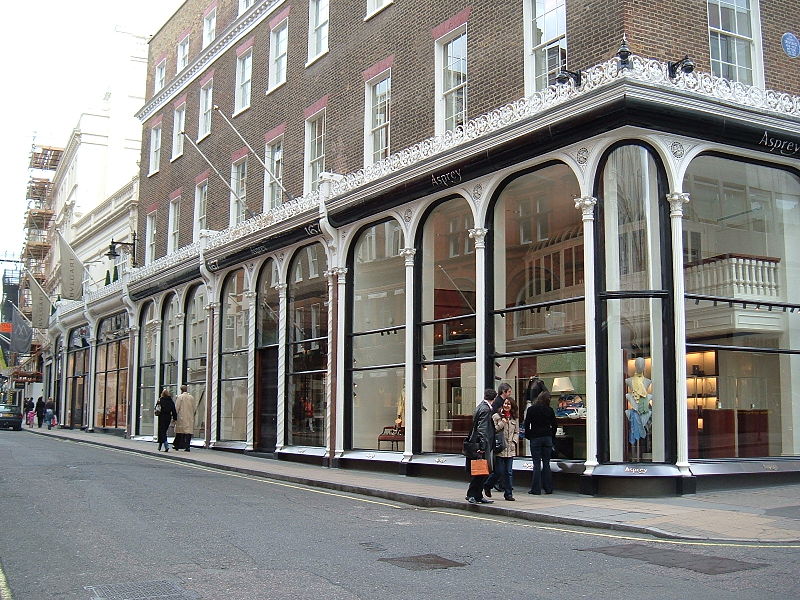
In any event, Reggie was in a shopping mood on that particular trip, so where do you think he made his way to in order to indulge his desire to spend?  Asprey!  Yes, the august English bespoke jeweler, silversmith, leather goods and timepiece purveyor to royals, aristocrats, and moneybags the world over.


I didn't go to Asprey to buy a carriage clock, mind you, but it was there that I serendipitously chanced upon the perfect one to bring home with me to Darlington House, as a souvenir (well, a trophy, really) of our trip to London.  While strolling through Asprey's New Bond Street store I came across a display of handsome clocks in a room that included a modern gilt brass carriage clock made in the traditional form.  I wondered: "Could this be the fulfillment of my desire (finally) to own a carriage clock that actually works?"  After giving the glittering timepiece a look over, and having the saleslady demonstrate its features to me, I decided to buy it.  Yes, it was rather costly, Dear Reader—I was shopping at Asprey, after all.

Asprey's store on New Bond Street in London
Image courtesy of Wikimedia

The carriage clock I acquired that day has stood ever since on a chest of drawers in our bedroom at Darlington House, where it pleases me whenever I see it, or hear it.  For, you see, Dear Reader, my little clock softly and mellifluously chimes the number of hours at every hour and a single note at every half hour, so it is not only a visual reminder of the passing of time, but a gently aural one too.

The clock's works are a marvel
of elegant engineering

I had never before known the pleasure of a chiming clock in one's bedroom, and I have come to be a great appreciator of mine as the years have passed.  There is something quietly reassuring of hearing its chime strike softly as one wakens, either during the night or in the morning, and to learn what time it is.  When one has such a clock in one's bedroom one needn't grope for one's bedside clock to find out the hour, but rather one's clock sweetly and quietly announces it from across the room.

There's no place like home, Dear Reader.

Photographs of Reggie's carriage clock by Boy Fenwick

Thursday, October 14, 2010

At Long Last, a Washington Clock

Among the most iconic and desired objects for serious collectors of American antique furniture and related decorative arts are gilt bronze clocks memorializing George Washington, made in France in the first decades of the nineteenth century.  The clocks' cases were fabricated in the workshop of Jean-Baptiste Dubuc (1743-1819), a bronzier whose career spanned the Bourbons and later regimes, with works supplied by various clockmakers, also French.  Examples of these clocks are found in the collections of the Metropolitan Museum of Art, the White House, and the diplomatic reception rooms at the Department of State.  They are also found in the collections at Winterthur, Yale University, and Homewood House, among other places.


Gilt bronze Washington clock with eagle motif, ca. 1815-1820
Case by Jean-Baptiste Dubuc (France)
Metropolitan Museum of Art, New York

George Washington's legacy as the hero of the Revolution and this nation's first president acquired epic status after his death in 1799 and prompted the production of an enormous quantity of objects memorializing him.  There was a veritable explosion of china, silver, jewelry, and textiles produced in this country commemorating his life and achievements, and also in England and France, where enterprising manufacturers churned out objects for export to America.  At the very pinnacle of these commemorative objects, known as "Washingtonia," stand the elegant gilt bronze clocks made in France.  Relatively few of them were produced, and the ones that were made were among the most expensive Washington memorial objects made at the time, affordable only by the very well-to-do. 

Washington clock on mantle at Homewood House
Baltimore, Maryland
Image courtesy of
The Magazine Antiques
Not all of the known Washington clocks are in museums or on display in public collections.  There are examples in private collections, too, and in the homes of people fortunate to have inherited them.  One such person appeared on Antiques Roadshow ten years ago carrying a Washington clock that had been passed down to him through the generations, and was astonished to learn of its importance and value.

General George Washington at the Battle of Trenton
Painted by John Trumbull in 1792
Yale University Art Gallery, New Haven, Connecticut


The figure of Washington that appears on the clocks is generally believed to have been modeled after the pose that appears in John Trumbull's full-length portrait of Washington at the revolutionary war's Battle of Trenton.  Painted in 1792, it has been in the collection of Yale University since the early nineteenth century.


The Trumbull Gallery at Yale University (demolished 1901)
Yale University Library, New Haven, Connecticut


Not surprisingly, Dubuc's Washington clocks are very valuable, and they are very costly when they come on the market.  Not only are they rare, but since many of the known ones are already in museums or collections, they command stratospheric prices when they become available.  Ones that are in a compromised condition--either missing elements or where the gilding has worn off--start in the mid-five figures, and ones that are in pristine condition have sold well into the six figures.


The Green Room at the White House in 1904
President Theodore Roosevelt administration
Image courtesy of the White House Association


The Washington clock in the collection of the White House has sat on the fireplace mantle in the Green Room since the room was redesigned by McKim, Mead and White for President Theodore Roosevelt at the turn of the last century.  It can be seen sitting on the same mantle over one hundred years later:


The Green Room at the White House in 2008
Image courtesy of
Architectural Digest


I must admit I rather prefer the way the Green Room looked under Teddy Roosevelt to how it has appeared under the last several administrations.  I think the public or state rooms at the White House have come to look rather ossified in recent years, if not almost dead.  But that's a subject of a different post than this one, I suppose.


Gilt bronze Washington clock with All-Seeing Eye motif, ca. 1810
Case by Jean-Baptiste Dubuc (France)
Image courtesy of Jonathan Snellenburg Antiques, Ltd.


Getting back to the subject at hand . . .


There are several variations to the Washington clock known today.  They come in two sizes: one approximately fifteen inches tall and another around twenty inches.  The decorations, or elements, on the clocks vary, too.  Some of them include eagles on top of the clock, and others show the All-Seeing Eye motif found in the Great Seal of the United States.  All of the Dubuc clocks include the standing figure of Washington.


General George Washington at the Battle of Trenton
Engraved by Thomas Cheeseman (England) in 1795
After the painting by John Trumbull
Yale University Art Gallery, New Haven, Connecticut


It is likely that the figure of Washington used as the basis for the one on the Washington clocks was taken from an engraving of Trumbull's painting, rather than the painting itself.  The engraving was widely circulated at the end of the eighteenth century, when it was struck, and would have been available in France to use as the basis for the figure of Washington standing on the clock's base.


Gilt bronze Washington clock, elaborate format, ca. 1815
Case by Jean-Baptiste Dubuc (France)
Image courtesy of Israel Sack, Inc.


An even more elaborate version of the Washington clock, one that includes a mounted globe along with other elements, once passed through the hands of Israel Sack, Inc., one of the greatest and most legendary dealers of Americana in the twentieth century.  I do not know of its current whereabouts.


Which brings me to why I'm writing this essay . . .


It should come as no surprise that Reggie has wanted to own a Washington clock since he first remembers seeing one.  But such is the stuff of fantasy, for even though Reggie is comfortable, he is not rich, and it would be lunatic madness for him to attempt to buy such a clock were he to find one available for sale or at auction.  That is, unless he won the lottery, which--despite occasionally buying tickets for it--he has not done so, yet.


Reggie's gilt bronze Washington clock


But just the other day fate smiled upon Reggie, and he came across a diminutive, related version of Dubuc's Washington clock at an antiques show at the Park Avenue Armory, in New York City, that he was able to buy for but a tiny fraction of what one of Monsieur Dubuc's clocks goes for.  And that's because Reggie's clock has some--well, a lot--of condition and attribution issues.


The bust of Washington that sits on top of Reggie's clock


For one thing, it is clearly not of the same series as the famous Washington clocks.  It is much smaller, measuring only seven and a half inches high; it only has a bust of Washington upon it and not the full figure modeled after Trumbull's portrait; it has relatively little ornament applied to the clock's case; and it is missing an important decorative element.  On top of that, the clock's works were made in England, and not in France.  Oh, and it doesn't work, either.


A later "make-do" finial, where the missing element was once attached


But Reggie nonetheless feels rather fortunate to have found it, and to have it now in his collection at Darlington House.


The back of the clock, showing the clock works


I've been able to date the clock's mechanism, since it is signed, and I was able to find out a bit about who the clockmaker was by doing some basic Internet sleuthing.  Richard Durrant (1786-1866) was an English clockmaker, silversmith, jeweler, and optometrist with a shop in Beccles, England, about 100 miles northeast of London.  He was active 1815-1855.


The clock's works, showing Durrant's mark


Based on that, it is not too much of a stretch to posit that Reggie's clock was made around the same time as when Dubuc's clocks were made, or shortly thereafter, to capitalize on the craze for Washington memorabilia in this country.  But there is also part of Reggie that suspects the case could have been made later, in the 1880s or 1890s during the post-Centennial colonial revival period, and that an earlier clock mechanism might have been put into it in order to make it appear to be older than it really is.


A Washington memorial bandana, ca. 1799
Image courtesy of
Antiques Roadshow


And then there is the issue of the missing element.  I suspect it could have been an eagle, an urn, an obelisk, a weeping willow, or a recumbent figure in mourning, similar to ones seen in memorial pictures that were popular in the early nineteenth century.


Memorial picture (Folwell School), 1803
The Metropolitan Museum of Art, New York


Even with the condition issues that Reggie is well aware of, he is quite happy to have his little Washington clock.  He looks forward to hunting down an appropriate decorative element to add to the case, and he will be sure to share an image of his clock when it is happily united with said element, once he has had the great good fortune to find it.


The back of the bust's head, showing Washington's queue wig


Tell me, have you ever seen a version of Reggie's Washington clock?  What do you think the missing decorative element was?


Unless noted, all photographs by Boy Fenwick

Sunday, April 11, 2010

At Long Last, A Frame for Mr. Hackett

On Saturday afternoon Boy and I found ourselves in the nearby town where last weekend we had the good fortune to find the mirror for our drawing room, and we decided to test our luck and drop in on the same dealers to see what new inventory they had.  While there we found a pristine Sully frame from the 1830s that the dealers said they had purchased only the previous day at a country auction.

The Sully frame at the dealers where we found it
photo by Boy Fenwick

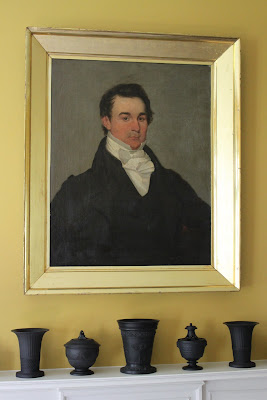
Our interest was peaked when we saw the frame because Boy and I have been looking for a more appropriate one for an ill-framed portrait that hangs over the fireplace in our dining room at Darlington House.  Our portrait, which was painted circa 1825, is supposedly of the Honorable Jacob Hotaling (1799-1873), who lived in the town where Darlington House is located, and who later became a prominent judge in New York State.  We bought the portrait from an antiques dealer in the nearby town a decade ago, framed in a later and somewhat bland looking frame, circa 1850-1860.

The Honorable Jacob Hotaling
artist unknown
photo by Boy Fenwick

We have always thought that the young Judge Hotaling's portrait would benefit from a more gutsy, period-appropriate frame, and have been on the lookout for one for the past several years.  The frame that we saw at the dealer on Saturday appeared to be just the ticket, and we put a "hold" on it so that we could go back to Darlington to see if it would fit our portrait, and also to determine whether it would look good in our dining room.

The hand written label on the back of our painting
photo by Boy Fenwick

Not only did we determine that the frame was perfectly sized for our portrait, and needed no alteration, but we also thought it would look perfect in our dining room with our other furnishings.

The Sully frame in our dining room
photo by Boy Fenwick

The frame we found is known in the trade as a Sully frame, named after the American artist Thomas Sully (1783-1872), and was popular in this country from 1820-1840.  Characterized by wide, inward slanting profiles and smooth gilded surfaces, Sully frames are most often seen on large, formal portraits.  According to the dealers where we found it, ours is an original, first-period Sully frame, and it retains its original lemon-yellow water gilding.

The Lady With Harp, Eliza Ridgely
painted by Thomas Sully, 1818
The National Gallery of Art, Washington, D.C.

When we got it back to Darlington, the first thing that we did was take our portrait of Judge Hotaling off of the chinmney breast and prop it against one of the doors in our dining room.  We then rested the Sully frame on top of it to see how it looked.  Don't you think it is an improvement?  We think so--it enhances the painting better than the one that it had been framed with since we owned it.

The Honorable Jacob Hotaling, side by side
photographs by Boy Fenwick

Once we decided that the Sully frame was an improvement, we took the Judge's portrait out of its old frame and fitted it into the Sully frame. We then hung the painting above our dining room fireplace.  Don't you agree that it looks much better?

The reframed and rehung portrait
photo by Boy Fenwick

You may ask, why does the title of this essay refer to a Mr. Hackett?  It's because we think our Judge bears a strong resemblance to the Hollywood comedic actor Buddy Hackett (1924-2003).  In fact, we refer to our portrait as "Buddy", instead of as the Honorable Jacob Hotaling.

Separated at birth?
photo of the Honorable Jacob Hotaling by Boy Fenwick
unknown photographer of Buddy Hackett

And so I leave you with this image of the chimney breast in our dining room at Darlington, showing Judge Hotaling--I mean Buddy Hackett--in his new-and-much-improved frame.

photo by Boy Fenwick

Sunday, March 28, 2010

At Long Last, A Looking Glass!

In the many years that Boy and I have owned Darlington House, we had not found something to hang over the fireplace in our drawing room.  Although I have enjoyed the asperity of the bare wall, I also looked forward to the day when we would find the proper adornment for the empty space.  In biding our time we debated the merits of hanging a painting or a mirror, and agreed that we preferred the latter.  As I have written in earlier posts, Darlington was built in the Federal era, and its drawing room is the most fully-realized neoclassical interior in the house, fitted out with moldings and carvings copied from pattern books of the day.  The ideal mirror to hang over the drawing room's fireplace requires a lightness and delicacy appropriate for the room, but not such a dainty-ness as to not be able to stand up to the classical orders employed.  While we found numerous candidates over the years, they were either the wrong size or too expensive, often carrying five figure price tags.  But we've never given up our search, hoping that we would find the perfect mirror to hang at a price we were willing to pay.

The mirror in the shop we found it, photographed by Boy on his BlackBerry

Yesterday, Boy and I spent several hours in the nearby town trolling through the antiques shops.  While doing so I found this mirror in a shop owned by pickers.  We always stop in to see what they have, as we've been successful in finding wallet-friendly things there.  When I saw the mirror I turned to Boy and said "What do you think about this for our drawing room?" and he agreed that it looked promising.  We examined it and determined that it still had its original gilding and ornaments, but likely had later (but still old) glass.  We also agreed that it required only a modest amount of restoration in order to bring it up to the snuff of the other, far more expensive mirrors we have passed on over the years.  Once we learned what they were asking for it our hearts raced, and we put it on "hold" so that we could go to our house and measure to see if it would fit.

The mirror in the back of Isaiah Cornini's truck
Photo by Reggie Darling

We sped back to Darlington and were excited to find that the mirror was, in fact, well-scaled for the space above our drawing room fireplace.  We telephoned Isaiah Cornini, the architectural historian we work with at Darlington and whose opinion we rely on in such matters, and asked him to come over to look at the mirror to see if it met with his approval.  Not only was he free to stop by Darlington that afternoon, but he agreed to pick up the mirror from the dealers and bring it to our house in the back of his pickup truck.  Huzzah!

The mirror, propped up in our front hall, awaiting hanging
Photo by Reggie Darling

As it turned out, Isaiah not only approved of the mirror but he agreed to help us hang it then and there.  Here is a photograph of our drawing room chimney breast in its unadorned state.  This is the "before" picture.

The unadorned chimney breast
Photo by Boy Fenwick

And here is the "after" picture, showing the mirror in place. We've lighted the candles in the chandelier that hangs in the room to show its reflection in the glass.

The chimney breast, with mirror
Photo by Boy Fenwick

Here is another photograph of the drawing room, taken this evening, with the candles lighted and a fire in the fireplace.  Oh, and look -- there's Pompey, too!

Photo by Boy Fenwick

So, is the mirror the perfect size for the space?  Boy and I agree that it could be better if it were slightly wider, but we also agree that we are very happy to have it at the price we paid for it.  Yes, we'll need to put some money into it, and restore it.  But even so, we will still have a mirror that we would have had to pay much more for had we found it in a shop in Manhattan, or at one of the bigger antiques shows.  In other words, after it had swum well-upstream from where we feel very fortunate to have found it.
Related Posts with Thumbnails