Showing posts with label food. Show all posts

Saturday, April 19, 2014

The Great Marmalade Exchange

I grew up in a house where marmalade was a staple of the table.  My mother, MD, was mad for marmalade, and she would heap it on hot buttered toast at breakfast or at afternoon tea, or on crackers during cocktail hour.  She loved marmalade so much that she would dip a spoon into a jar and eat it straight, licking the spoon clean.

Two precious jars of Reggie's
Kumquat Marmie

It turns out the apple—or, rather the orange—didn't fall all that far from the tree, as Reggie is intensely fond of marmalade, too.

And he has been on a bit of a marmalade journey of late . . .

Until recently the only marmalade I ate or cared for was James Keiller & Son Ltd.'s Dundee Orange Marmalade, the world's first commercially made marmalade, which has been in continuous production since the company's founding in 1797.  Thick, intensely flavored, full of rind, and verging on bitter, Keiller's Dundee Orange Marmalade has always been the marmalade I reach for when stocking my pantry.

"Oh dear, bought marmalade.  Dear me, I call that very feeble."
Image courtesy of Shepperton Studios

When I was a boy Keiller's Dundee Marmalade was sold in stoneware crocks that we saved when emptied of their delicious contents.  We used the crocks to hold pencils and pens, which I still do to this day.  By the time I went to college, though, Keiller & Son had dispensed with their handsome crocks and substituted the far less aesthetically pleasing milk-glass jars that are still found today on the shelves in supermarkets the world over.  Keiller's old stoneware marmalade crocks are now considered to be collectibles and can be found for sale in Group Shoppes and on eBay.

Two of Reggie's Keiller & Son Ltd.
Dundee Marmalade stoneware crocks

Although I've tried other commercially available marmalades over the years, including small-batch artisinal alternatives, none have inspired me to forsake the familiar embrace of my old standby, Keiller & Son Ltd. Dundee Orange Marmalade.

That is, until I discovered the surpassing pleasures of homemade marmalade.  Once I had tasted it for the first time I vividly understood why the Countess of Trentham character—as brilliantly played by Dame Maggie Smith in Gosford Park—sat in her bed and sniffed "Oh dear" when confronted by a pot of "bought" marmalade on her breakfast tray.

It turns out Lady Trentham knew of what she spoke.

My friend Katherine's homemade
marmalade, liberally spread on English
muffins in our kitchen at Darlington

I found out exactly how sublime homemade marmalade is shortly before Christmas, when I received a jar of it in the mail.  It was a thank-you gift from my childhood friend Katherine, who had recently stayed with us at Darlington.  Katherine had made a batch of marmalade, her first ever.  Tasting Katherine's marmalade was a revelation!  Gorgeously orange in color, deliciously flavorful, packed with rind, and just sweet enough, it was infinitely better than my dear old Keiller's of Dundee.  I polished off Katherine's marmalade tout de suite.  And yes, Dear Reader, I even ate some of it with a spoon, just as MD used to do all those years ago.

One does so adore receiving a brown-paper
package tied up with string, particularly
when it is secured with sealing wax

Fast forward to the New Year.  In early February I was perusing one of my favorite new blogs, Chronica Domus, where I was delighted to read of the writer's fondness for marmalade and her experience in making batches of it annually with her husband.  I commented that I, too, adore marmalade.  We exchanged emails, and the next thing I knew a package containing several jars of Chronica Domus' homemade marmalade was delivered to my door.

What treasures can these be,
nestled in excelsior?

As I was about to leave for a week's holiday, and the package was delivered to my city apartment, I placed it in the refrigerator to preserve it while I was away.  I wanted to open it at Darlington and make a record of it to post here for your reading pleasure, Dear Reader.

Three jars of homemade marmalade!  What Heaven!
Blood orange, Seville orange, and grapefruit bergamot!

Coincidentally, I had been considering making my own batch of marmalade.  But I wanted to make it with kumquats instead of oranges, as we have a little kumquat tree at Darlington that bears fruit every January and February, and it had just produced a bumper crop of its tasty, zesty fruit.  Last year I preserved our kumquat harvest in syrup, but this year I wanted to do something else.  Having just received a jar of marmalade from my childhood friend Katherine, and now several more from Chronica Domus, I was inspired to try my hand at making kumquat marmalade.  "Eureka!"

Chronica Domus' three jars of marmalade,
appearing like stained glass windows in sunlight

So, in the days leading up to our leaving on holiday, Reggie made a batch of kumquat marmalade.  But he decided that he wouldn't call it marmalade, Dear Reader.  No, he decided to call it marmie, the same way our brethren down under in Australia refer to a barbecue as a barbie.  You get the idea . . .

Chronicus Domus' blood orange marmie
spooned atop crème fraîche on a cracker.
It's even better than caviar!

Since I had never made marmalade before, or jams or jellies for that matter, I had no idea how much work it would be to make my kumquat marmie, nor what a tiny amount of the treasured jam would result from all my labors.

I found the recipe for my kumquat marmie on David Lebovitz's marvelous blog about living and cooking and eating in Paris.  I've been following his blog for some time now, and I enjoyed reading his book The Sweet Life in Paris.  In making my batch of kumquat marmie I fiddled with his recipe a bit.  I had more kumquats than the recipe called for (our little tree is quite the producer of fruit), and I used a bit less sugar.

Reggie's kumquat marmie, with his potted
kumquat tree in the background

Being a complete neophyte at making preserves, Reggie was surprised to learn what a considerable undertaking it is to make a batch of marmalade.  It took him several days and many, many hours spent slicing, de-seeding, and cooking the mixture of kumquats, lemons, and sugar the recipe called for in order to produce his kumquat marmie.  It was hardly what I'd call drudgery, though, as I enjoyed the project from beginning to end, and making the marmie filled our city apartment (I made it during the week over several evenings after work) with a wonderful citrusy scent.  The resulting marmalade is marvelously tangy, tart, and puckery—much like a sourball candy.  Spreading it on a hot toasted and buttered English muffin, or on a cracker with cream cheese, one truly appreciates what the expression "food of the gods" means!

Reggie's kumquat marmie

My second surprise when making my kumquat marmie was how little of it all my efforts produced—just three diminutive six-ounce jars!  I had assumed that I'd have at least four or five jars of it, but sadly that was not the case.  Given all the time and labor involved, I consider those three jars to be as precious as if I had made them from platinum instead of kumquats!

Actually, there are now only two jars of it left.  I've already consumed one of them.

This weekend I am going to mail the two remaining jars of my kumquat marmie to my friends Katherine and Chronica Domus, returning the favor of their thoughtful gifts to me of their homemade marmalade, thus completing the Great Marmalade Exchange.

Tissued, bowed, and ready to mail

By the way, next year I plan on making a larger batch of kumquat marmie as I have others I'd like to send it to as well.  The first and foremost on my list is Ms. Meg Fielding of Pigtown Design blog fame, who has given Reggie two jars of her delicious homemade jams in the last year and who was supposed to get one of his kumquat marmies . . . at least when he assumed that he'd produce more than only three little jars of it.

Oh, and what about the marmalade I received from Chronica Domus?  So far I've only opened one of the three jars she sent, of blood orange marmalade, and it is absolutely out-of-this-world delicious!  I look forward to trying the the two other marmalades she sent, too, one made with Seville oranges and the other with grapefruit and bergamot.

Now that I'm officially smitten with homemade marmalade, I'm afraid that I'll never be able to look at dear old Keiller's Dundee with quite the same ardor as I had before . . .

Tell me, Dear Reader, do you like marmalade, too?  Have you ever made it?

Photographs by Boy Fenwick and Reggie Darling

Saturday, December 21, 2013

Christmas Traditions at Darlington

Every family, however you define it, has its own Christmas traditions.  At least those families who observe Christmas, which we do at Darlington House.  I celebrate Christmas for the enjoyment of the holiday, and also for the spiritual message that inspires it, and me.

Christmas just wouldn't be the same
without pots of paperwhites about the house

There are a number of Christmas traditions that we observe at Darlington that I brought with me from my birth family, and there are ones of a more recent vintage that we have made our own.

FD, Camilla, and MD
Christmas 1947

As I have written before, one tradition that I observe at Christmas is to adorn the grill of our Rover with a wreath.  My mother, MD, decorated her cars with a wreath when I was a boy.  I loved it then, and I love it still.  This year we ordered our Rover's wreath from the good ladies of Cedar Farm.  I think they did a lovely job of it (they also made the wreath shown in the background, hanging on a door of one of our barns).

This year's Rover Wreath

Another Christmas tradition I observe is to set out a crèche.  MD was mad for crèches, and collected more than a dozen of them over the years.  The one we have at Darlington is a dime store crèche made in Italy in the 1950s that I bought at a Groupe Shoppe years ago.  I've been adding figures to it ever since.  If you look closely at the photograph you'll see that there is a little pug, given to me by my sister Camilla, among the adoring throng.

Our not entirely tasteful Christmas crèche

I also have a collection of Black Forest bears that I put out at Christmas.  I inherited the nucleus of the collection from my mother, who inherited it from her father.  I've added to it over the years, and I put the bears on the mantel in our Snuggery, along with half a dozen or so little Steiff toy animals that I played with as a child.  I've had some of them for almost fifty years.

The mantel in our Snuggery, decorated for Christmas

When it comes to food and drink we have a number of traditions at Darlington.  I always make sure to have a box of Darling clementines on hand at Christmas.


Every Christmas Eve, before attending the evening festival service at the Episcopal church in the nearby town (assuming I can stay awake—and sober enough—to attend it), I make a simple oyster stew, a dish that my sister Hermione introduced me to as a Christmas Eve tradition many years ago.

I think I may try Alex Hitz's recipe for
oyster stew this year
Image courtesy of House Beautiful

On Christmas day we tuck into an old-fashioned English dinner of prime rib roast and Yorkshire pudding (recipes courtesy of my dear friend Lindaraxa), followed by Stilton cheese and Christmas pudding with hard sauce.  MD adored hard sauce.

Lindaraxa's English roast beef and Yorkshire pudding
Image courtesy of same

In years past, when Fauchon still had an outpost in Manhattan, we used to put in a store of their sublime pâtes de fruit and marron glacé to eat over the Christmas break.  Now we console ourselves with chocolates and other treats, including blinis heaped with caviar or salmon roe and crème fraîche.  Champagne is usually within easy reach.

A Darlington tradition of Christmases past
Image courtesy of Fauchon

Another tradition of ours during the Christmas break is to drive to Albany, New York State's capitol, and have a festive lunch at the city's venerable Jack's Oyster House.  It's been an Albany institution for one hundred years now.  Jack's is usually packed this time of year with tables of happy revelers out for a holiday lunch.  We heading there for ours today, in fact.

Jack's Oyster House's card

A more recent Christmas tradition that we've added to our repertoire at Darlington is dipping into the most delicious egg nog imaginable, made by our friend Ted Greenwood.  Ted makes a large batch of it from an old family recipe every year and distributes it on Christmas Eve to his lucky friends in Ball jars.  He calls it Ted Nog.  It is beyond yummy, particularly when adorned with a bourbon or rum floater on top.  Needless to say, Ted is very popular with his fortunate friends this time of year!

Our friend Ted "Nog" Greenwood at a
Darlington dinner party several years ago

Another tradition I look forward to every Christmas is listening to the Festival of Nine Lessons and Carols sung by the choir of King's College Cambridge, and broadcast on our local public radio station on Christmas Eve.

The choir of King's College Cambridge
Image courtesy of Zimbio

Of course we hang garlands and wreaths and put up a tree at Darlington, and we decorate the house festively for Christmas.  But, then, that's the subject of another post, soon to follow. . .

I found these little German wooden candles in
a hospital thrift store ten years ago.

I've put them out at Christmastime ever since

Tell me, Dear Reader, what are some of your Christmas traditions?

All photographs, unless noted, by Boy Fenwick or Reggie Darling

Sunday, December 1, 2013

A Reggie Roadtrip: Atlanta, Part II

Today's post is the second part of my two-part series on Reggie and Boy's whirlwind visit to Atlanta, the Biggest, Boomingest City of the South.  You can read the first part here.


After an evening spent engaged in imbibulous shenanigans at Reggie's Bloggers & Bankers cocktail party, your sainted author was feeling a bit the worse for wear the next morning and needed to ease back into the land of the living.  And what better antidote is there for such an overindulgence than a Four Seasons room-service breakfast wheeled into one's chamber?

Ahh! Breakfast.

Fortified by our delicious breakfast (and several aspirin) we headed out the door to take in Atlanta's sights.  As we often do when on a Reggie Roadtrip, we began our day by visiting a number of the city's antiques stores.  Exploring such emporia is a requirement for us, not only because of our insatiable collecting instincts, but also because Boy's profession as a Fancy New York Decorator demands it.

Just one of the many aisles filled with antiques and accessories
at Atlanta's 14th Street Antiques Market

While Reggie came away from our antiques shopping expedition empty handed, Boy found a much sought-after object for a client's Park Avenue apartment, so our visit to the Atlanta's antiques district was not only entertaining, but also profitable.

The Atlanta Historical Society History Center
Image courtesy of ATL Intown Living

With obligatory antiquing behind us, we then turned to what brought us to Atlanta in the first place: to visit the city's museums and historic houses.  Our first stop was the Atlanta History Center, the home of the Swan House.  The Atlanta History Center is a handsome Art Moderne building in the swanky Buckhead district.  Reggie only learned afterwards, when researching this post, that it was originally known as the Atlanta Historical Society.  What is it, I ask, with this madness for renaming venerable cultural institutions with more modern, non-elite names?  I still wince whenever I see references to Historic New England, which I shall always consider to be more appropriately named the Society for the Preservation of New England Antiquities, its official name until its board of directors misguidedly decided to rename it, blandly, in an effort to make it sound more "relevant."

But I digress . . .  

The main house of the Smith Family Farm

After touring the Historical Society's History Center's lively exhibitions we made our way to see the two historic houses located on the Society's Center's grounds.

The first site we visited, a compound of buildings, was the Smith Family Farm, built in the 1840s by a slave-owning farming family that was moved to the Society's Center's property in the 1970s.  The Smith Farm is a fascinating window into the way the majority of slave-owning rural southerners lived in the days leading up to the Civil War and a helpful reminder that not all of the South's agricultural plantations were Spanish-moss-dripping, be-columned mansions.

This gives me ideas for when we finish renovating our
summer kitchen/work house at Darlington

I particularly liked the Smith Farm's separate kitchen building, kitted out in authentic period trappings.  We have a summer kitchen/work house at Darlington, ca. 1820, that we are slowly restoring.  One day I hope to be able to use it for something other than what we use it for today, which is to store large clay pots and our gas grill during the winter months.

The Swan House

In stark contrast to the Smith Family Farm stands the grand and justifiably celebrated Swan House, designed by Phillip Trammel Schutze (1890-1982), Atlanta's greatest architect of the twentieth century.  Built in 1928 for the Inman family, the house has been in the Society's Center's collection since 1966, and is maintained by the Society Center as it looked in the 1930s, complete with original furnishings and period-dressed interpreters.

The main hall at the Swan House
Image courtesy of the Devoted Classicist

I first toured the Swan House in the 1980s, but this was Boy's inaugural visit.  Decorated by the venerable Ruby Ross Wood in the grand English taste favored by the upper classes of the East Coast of America during the first half of the twentieth century, the Swan House is as interesting a window into its occupants as the Smith Family Farm is, albeit at a very different level and under very different circumstances.

A vintage postcard view of the Swan House's dining room
Image courtesy of Passion For Postcards

Even though the Swan House was well attended by other visitors the day we toured it, I suspect that its attendance would be dwarfed by the crowds that would flock to Tara, should it actually exist, except in the mind of Margaret Mitchell, the authoress of Gone With the Wind.

Tara!
Image courtesy of Selznick International Pictures/MGM

Atlanta (and other cities throughout the South) has more than its fair share of houses built to resemble the film-set version of Scarlett O'Hara's girlhood home that stood (in the book, at least) only twenty-five miles from downtown Atlanta.

A first-edition copy of Gone With the Wind
Image courtesy of The Everyday and Beyond

Speaking of Gone With the Wind, I reread it before, during, and after my visit to the city Scarlett moved to during the war.  I first read Mrs. Mitchell's best-selling novel in my twenties, and I remembered it as being a rip-snortin', can't-put-it-down, hefty page turner.  I'm happy to report, Dear Reader, that it still is, thirty years later.  Mrs. Mitchell is a marvelous storyteller, and her characters are vivid and memorable.  And funny, too.  Although Gone With the Wind deals with weighty subjects, it is at times very amusing.  I highly recommend it.

"I ain't noticed Mist' Ashley askin' for to marry you!"
Image courtesy of Selznick International Pictures/MGM

With our tour of the Swan House complete, our thoughts turned to lunch.  My friend Elizabeth Tallmadge recommended that we try the Society's Center's Swan Coach House restaurant for its old-fashioned, ladylike Southern fare.  After we stopped by it, though, Boy and I decided that we couldn't bring ourselves to go inside, as we were practically trampled by an avalanche of bridal-shower-attending girls and ladies tumbling out of the restaurant, flowers and gift bags in hand.  We decided that something a bit more, uh, manly was in order.

The Swan Coach House restaurant
Image courtesy of Tales of Bloggeritaville

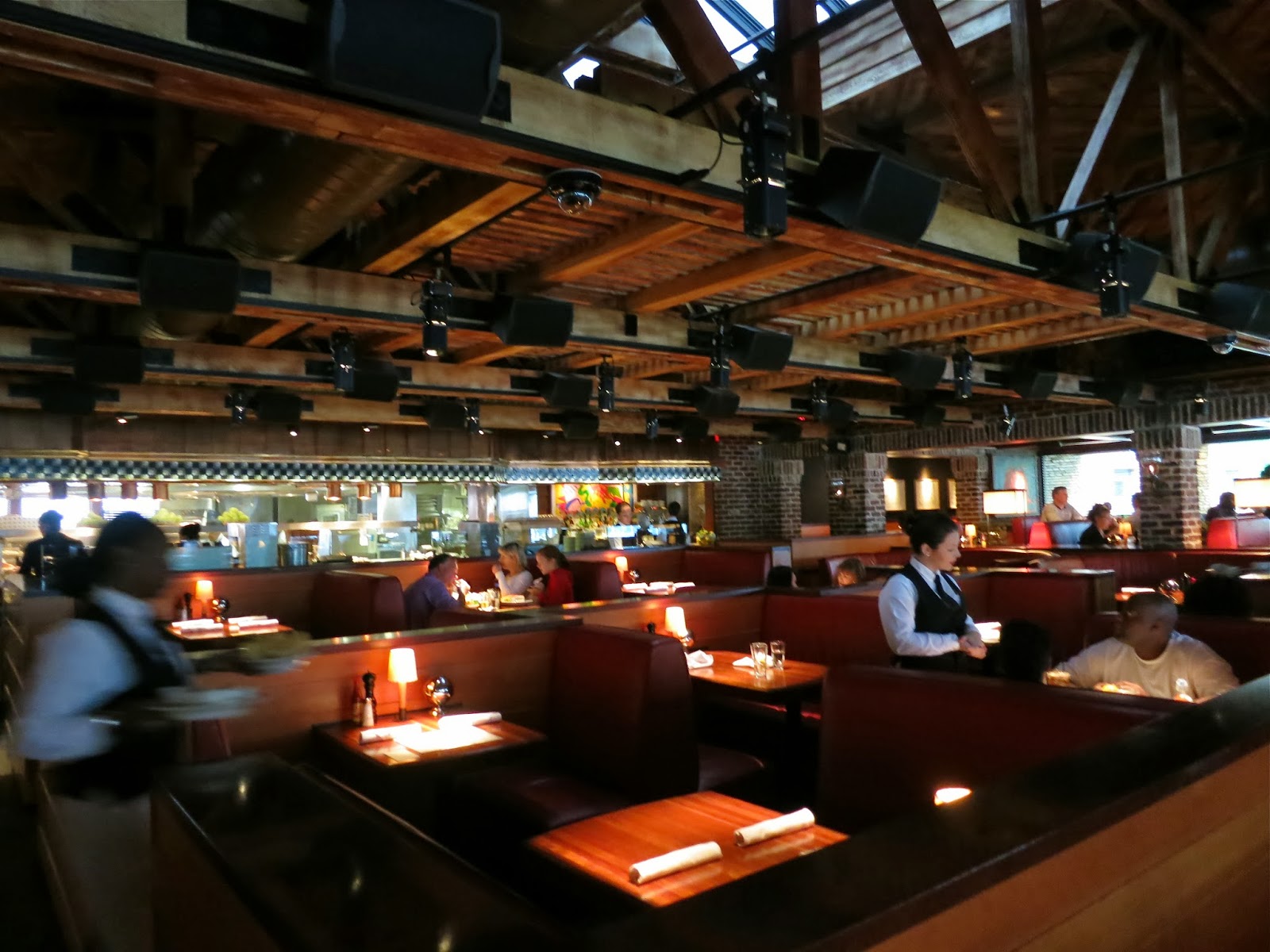
After driving around Buckhead (in the pouring rain, which continued all day) we finally settled on a Houston's restaurant, closer into town, mainly because it had ample parking right in front of its entrance, a decided plus in a downpour.  I had never been to a Houston's before (it is a popular chain, I understand), and I was pleasantly impressed by the one we visited.  The food there was quite tasty, the surroundings suitable, and the service very good.  The young woman who waited on us couldn't have been nicer or more professional.

The welcoming man-cave interior of Houston's Restaurant

Another one of our reasons for visiting Atlanta was to spend an afternoon at the High Museum of Art.  Neither Boy nor I had ever been to it.  I was curious to see it, both for its celebrated architecture and its noteworthy collection of art.


Our first attempt to visit the High Museum was not successful, however, as the museum's parking garage was full and the wait to get into nearby parking lots was long.  That's because the High Museum was hosting a traveling exhibition of Vermeer's paintings that was attracting record crowds.  So we decided to drive around Atlanta for a while to see what we could of the city through our rain-splattered car windows.

I loved the ceilings of the High Museum's
modern art galleries

Returning to the museum, we were fortunate to gain entry to its parking garage and tour its collections.  We opted not to see the blockbuster Vermeer show, bypassing its crowds and lines.  As I've written in other posts, when visiting regional museums I generally prefer to skip traveling exhibitions and concentrate my viewing on the permanent collections.

A gallery full of Alex Katz's serene landscapes was most pleasing

Navigating one's way through the High Museum of Art can be somewhat challenging, as the architecture of the complex takes center stage, relegating the art on display to a secondary note.  The galleries containing modern art are the most successful, in my view.  The spaces displaying the museum's excellent collection of pre-twentieth century art and decorative arts?  Less so.

Looking down upon an artists' drawing event 
hosted by the museum the day of our visit

Don't get me wrong, Dear Reader.  I enjoyed visiting the High Museum of Art.  And so did the thousands of other people who did so the day we were there.  The place was hopping!

The two little girls in pink playing hide and seek were adorable

With the "closing-time" gong ringing, Boy and I took our leave of the High Museum and headed out the door with a few hours to kill before meeting up with friends for dinner.  So what did we do?  We went back to Sid Mashburn so that Boy could buy a pair of double monk-strap shoes that had caught his fancy the previous day.

"Get thee behind me, Satan!"

Needless to say, Boy found one or two more must-haves to add to his shopping bag during our second visit at Sid Mashburn . . .

Reggie is most grateful, Dear Reader, that there is not (yet) an outpost of Mr. Mashburn's divine men's clothing store in Manhattan, as he is sure it would hasten the financial ruin of the Darlington household.  Albeit a very well-dressed household!

The Iberian Pig restaurant in trendy Decatur

Dinner that evening was at the very popular Iberian Pig in downtown Decatur.  Organized by our friend Paula Mueller, a group of us gathered there to dig into the restaurant's signature pork-inspired offerings.  "The Pig," as it is known by its regulars, attracts a diverse group of Atlantans, ranging from young professionals to the more-pierced-than-thou crowd.  The night we ate at the Pig it was absolutely packed and the noise level positively ear-splitting.

The happening scene at the Iberian Pig

While I enjoyed the Iberian Pig's delicious, hearty fare, I could barely hear my dinner companions, what with the shrieks and shouting of the surrounding tables of revelers that brought our own table's conversation to a virtual standstill.  Nonetheless, I am glad I ate there, as I am fond of the people with whom I shared our table, and the food was quite tasty.

Even though we left the restaurant after midnight, I was surprised to find ourselves (yet again) stuck in parking-lot-like traffic all the way back to our hotel.  The congestion was due, in part, to crowds of hipsters leaving a huge music festival that took place during the weekend of our visit.  While sitting in our idling car, stuck in traffic, it was most entertaining to watch the antics of the music festival's departing attendees, many of whom were lurching about the streets and crosswalks, visibly bombed.

Stuck in jammed traffic, again!

The next morning, our last in Atlanta, we decided to explore the city's downtown.  We had spent the bulk of our visit in newer parts of the city and wanted to see what we could find of Atlanta's older, original business and shopping districts.  Where it all began, so to speak.

Downtown Atlanta in the 1940s
Image courtesy of Pat Sabin

The business district of old downtown Atlanta is largely comprised of office, municipal, and government buildings, a smattering of hotels, and remnants of what had once been a thriving retail district.

Downtown Atlanta today
Image courtesy of dayka robinson design

As is unfortunately the case with many American cities these days, downtown Atlanta is rather gritty and somewhat forlorn, as are many of the people one sees on its streets on a Sunday morning.  One is not inclined to get out of one's car and stroll around in downtown Atlanta, taking in the sights.

A vintage postcard of the Georgia State Capitol
Image courtesy of Playle

That is particularly so in the blocks immediately surrounding the city's majestic Georgia State Capitol, an area sadly hit with blight, bisected by immense highways and scarred by misguided urban "renewal" in the mid-twentieth century.  I would love to have seen this part of Atlanta in the 1930s and 1940s, when it was still in all its City Beautiful glory.  I'm sorry that much of it is lost to us today except in photographs and old postcards, such as the ones I am showing here.

"Would you make that a double, please?"

Somewhat sobered by our last few hours touring downtown Atlanta we drove our Cadillac ATS rental car back to the Hartsfield-Jackson Airport to catch our flight to New York.  Over preflight cocktails in the Delta Sky Lounge we agreed that we had thoroughly enjoyed our all-too-brief visit to Atlanta, a sprawling, complex, vibrant, and ever-changing metropolis with all the attractions and challenges that large cities in America have today.  I look forward to returning to the capitol of the Peach Tree State again and seeing more of what this wonderful city has to offer.

Tell me, Dear Reader, do you have any particular favorite places or things to do in Atlanta that you might recommend?

All photographs, unless noted, by Reggie Darling

Related Posts with Thumbnails