Reggie grew up in a house where the children were expected to become proficient in playing a musical instrument, among other basic skills of the well-rounded life. When Reggie was a little boy, no more than six or seven years old, his mother, MD, asked him what instrument he would like to learn to play. He wasn't given the option of whether he wanted to learn to play an instrument, but rather which one. Fortunately, Reggie was more than agreeable to the prospect, despite having listened for years to his older siblings torture their way through practicing on various instruments for which they had little aptitude. Aside from enjoying singing and playing records, the Darlings weren't exactly what Reggie would describe as a musically gifted family.
 |
| A young Reggie at the piano with his teacher, Mrs. Lee |
Rather than follow in the footsteps of his older brother Frecky and take lessons on the French horn (a choice that to this day Reggie finds to be a peculiar one for his brother), Reggie asked to be given piano lessons. He was attracted to the piano for several reasons: he liked the way it sounded, one could sing along to it when playing tunes upon it, and one wasn't expected to cart it about from place to place, unlike more portable but often cumbersome options, such as the cello or bassoon.
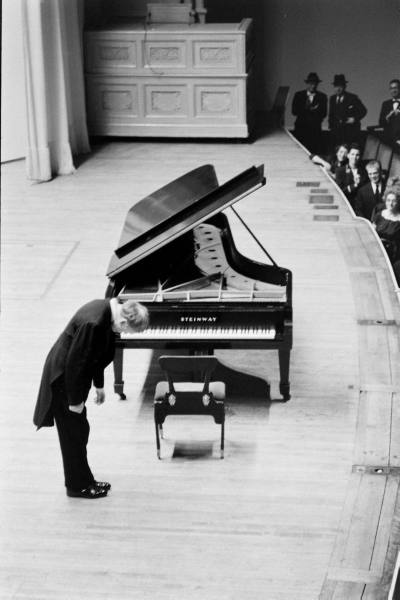 |
| Performing classical music in concert halls wasn't what attracted Reggie to the piano |
The prospect of learning to play Beethoven's sonatas and other serious music and then performing them one day in concert halls was not the reason Reggie wanted to play the piano. No, he was far more interested in learning to accompany himself and others while singing show tunes, popular songs, and Christmas carols in the comfort of fashionable drawing rooms. For Reggie is a sociable chap, and has been one since the get-go, and he liked the idea of being the lucky fellow sitting at the piano at the parties he imagined himself attending, at the center of all the fun.
 |
| Everyone enjoys singing show tunes around the piano! |
Yes, even at the age of seven Reggie was already a show tune lovin' laddie, which some may interpret as manifesting the propensity to be "that way," but which Reggie takes exception to since many of the composers of same were well-known for their prowess with the opposite sex—but that's a topic for another day, I suppose . . . . On a less flibbertigibbety note, Reggie also enjoyed then (and still does) a good hymn sing, at least from the 1940 edition of the Episcopal Hymnal that was then still found in the pews at the church we attended on Sunday mornings.
 |
| This is how I saw myself Photograph courtesy of Getty Images |
In short, Reggie was interested in learning to play the piano because he thought it would be his ticket to becoming the life of the party.
But it didn't work out that way.
My parents signed me up for piano lessons with a neighbor, named Mrs. Lee, who lived only two doors from our house and who had three pianos in her large living room where she gave lessons in the afternoon, when her husband, an editor at the Washington Post, was at the office. Mrs. Lee was a pleasant lady, and I liked her. She started me with the exercises that one would expect and was encouraging of the progress I initially made under her tutelage. I remember the pride I felt when I performed for the first time at the annual recital she held for her students, the highlight of which was—at least for little Reggie—the sweet and salty praline cookies she served at such gatherings. I remember those cookies vividly to this day.
 |
| Doesn't Every Good Boy Deserves Fudge? |
The problem was, after an initial spurt of facility at the piano, my progress slowed to a virtual standstill, and I barely advanced beyond rank beginner after several years of taking lessons. Part of the problem, I admit, is that after the first flush of excitement wore off I became less than enthralled with practicing for more than half an hour at a time, and I was frustrated that I was forced to learn the likes of Bartok's compositions for children when what I really wanted to play was "I Could Have Danced All Night" from My Fair Lady.
 |
| I played this album to death as a child |
It also didn't help that the piano we had at home was a rather pathetic upright one that MD had bought at a yard sale and painted cherry red (she had a thing for painting furniture with bright enamel colors at the time), and that was only rarely tuned, if ever. MD refused to consider buying a better piano for me to practice on, given my level of skill at the time. "Why should I buy you another piano when you can't even play the one we've got?" she would ask me when I would complain about the quality of the instrument I was expected to practice upon.
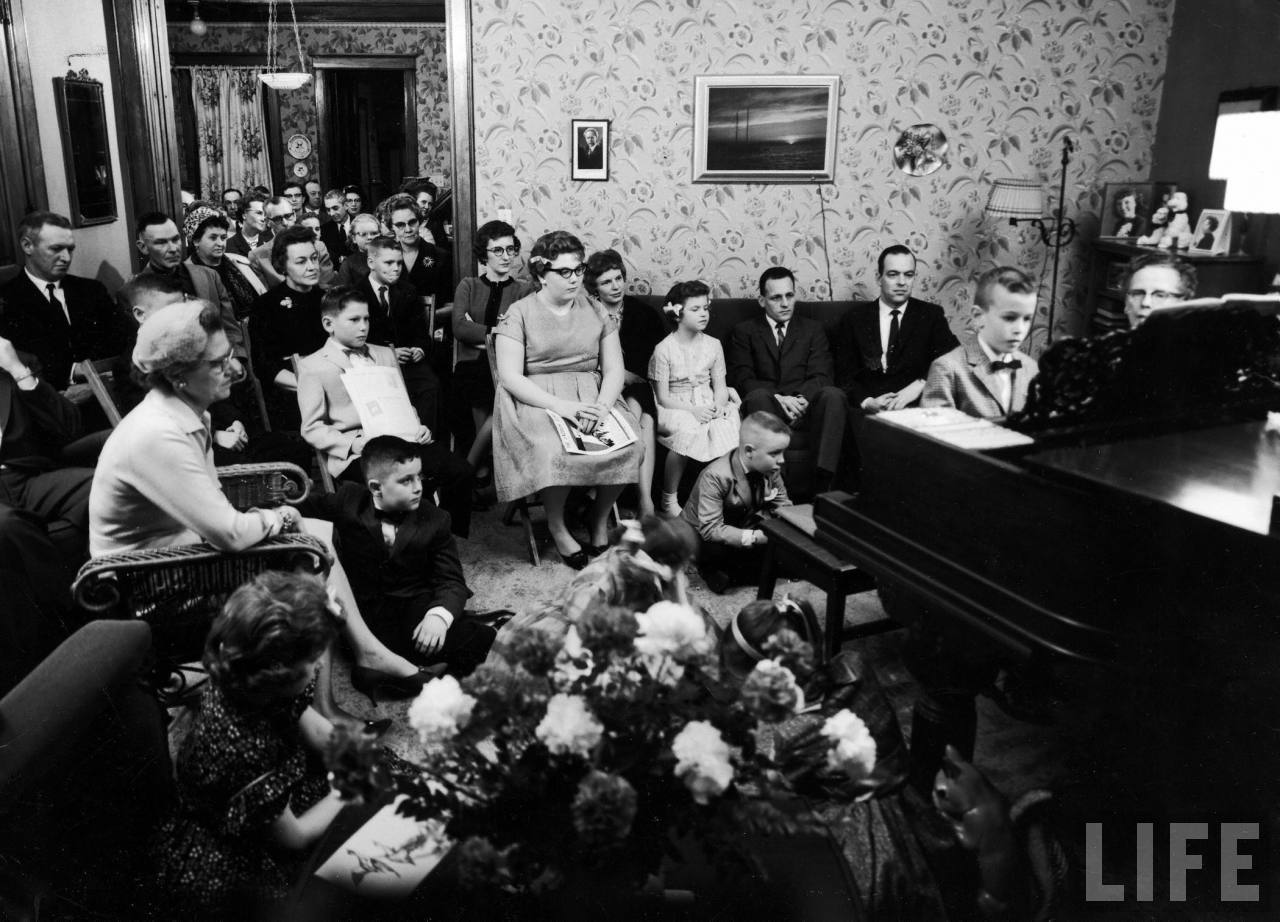 |
| The dreaded, and for Reggie embarrassing, piano recital |
 |
| My piano recital competition |
One day, when I was twelve years old, I arrived at Mrs. Lee's house for my weekly lesson. After several minutes she put her hand on mine as I was stumbling through the day's piece and said, "Stop."
I turned to her to see why. She had an odd expression on her face. She hesitated, as if building her courage, and said to me, "Reggie, you are a nice boy, and I like you, but I am afraid that I must tell you that you will never learn to play the piano. Of all the students I have taught over the years, and there have been many, I have never come across one who has as little talent for it as you do."
"Really?" I asked.
"Yes, really. There's simply no point in trying any more, because you will never learn to play the piano. You have no aptitude for it, and no matter how much you practice you will never learn to play it. I am sorry, but I can't teach you anymore. I simply cannot, in good conscience, accept any more money from your parents. Today is your last lesson. We are done."
"But what will I tell my parents?" I asked her.
"I will telephone your mother now and let her know."
It was with mixed feelings that I left Mrs. Lee's house that late afternoon and walked back to my parents' house. On one hand I was relieved that the burden I had endured for the last four years was now over, but on the other hand I was disappointed to learn—once and for all—that I had absolutely no talent for playing the piano and that I would never find myself the life of the party, tinkling ivories and singing show tunes to the delight of those gathered around me.
 |
| That's how I saw myself. Erroneously, as it turns out . . . |
When I got home MD was waiting for me. "Thank God that's over," she said with a smirk, letting me off the hook. She had the piano carted away the very next day.
 |
| Not for Reggie, as I learned . . . Photograph courtesy of Getty Images |
But it always rankled me that I had never learned to play the piano, and that I had been told that I never would, nor should I bother even trying to. I still, deep down inside of me, wanted to be that happy fellow sitting at the piano at the smart parties I imagined attending, singing and laughing away.
Half a decade later I got another chance . . .
During my final year at Saint Grottlesex I applied for and was the fortunate recipient of a scholarship to attend school in England for a year, with all of my expenses paid for. It was an exchange program between English and American boarding and secondary schools under the auspices of the English Speaking Union, an organization devoted to fostering good will among (or as they would say "amongst") the English speaking nations. I was not given a choice as to which school I would attend under the program, except to request one that was strong in music and where the students were largely drawn from within Great Britain, as opposed to from a broader, more international base.

The school that the E.S.U. selected for me was Sherborne School, a quintissentially English, all-boys public boarding school located in a bucolic market town of the same name in Dorset, a several-hour train ride west of London. Sherborne (pronounced "Shuh-bn") was founded in 1550 by Edward VI (the short-lived son of Henry VIII) on the site of a deconsecrated monastery. It was and remains a beautiful school with handsome buildings and grounds, and it was used as the location for the 1969 movie of Goodbye Mr. Chips starring Peter O'Toole.
 |
| Sherborne School, Dorset, England Image courtesy of same |
When I arrived at Sherborne I was given the opportunity to take music lessons on an instrument of my choice. I decided that I would—once again—attempt to take up the piano and show "them" that I really could learn to play the instrument that Mrs. Lee said I would never be able to master.
I was given as a teacher an elderly, archtypal English maiden-lady named Miss Whipple, who looked like a character right out of an "English Cosies" murder mystery of the type filled with village eccentrics, vicars on bicycles, and such. Miss Whipple, who was in her early seventies at the time, lived in a cottage not far from the school with her equally elderly spinster sister. Her sensible clothes were from another long-gone era, and she wore stout, sturdy shoes. I recall that she wore a pince-nez, too.
 |
| Miss Whipple looked remarkably like the writer Agatha Christie Photograph courtesy of ezdia.com |
I told Miss Whipple my story of how I had taken piano lessons as a boy, and that I regretted that I had been considered incapable of ever learning to play one. She responded encouragingly that she had had great success with her pupils, even ones with only modest innate talent, and that she was sure she would have success with me, too, so long as I promised to apply myself. With that agreed to, we set off.
 |
| Could this still be in my future, I wondered? Image courtesy of dorisday.net |
In the first several weeks under Miss Whipple's tutelage I made leaps and bounds of progress, and she was delighted with me and how quickly I proceeded. I practiced diligently, hours every day, and I was determined to make a success of learning to play the piano.
But after several months had passed I was no longer making any progress, and—no matter how much I practiced—I had once again become stuck at the very same place I had been when Mrs. Lee put her hand on mine. Whereas Miss Whipple had initially been pleased to see me and was quite enthusiastic about my progress, over time she became increasingly restless and fidgety during our lessons, which were no longer the pleasant fun they first had been. Despite my best efforts, she started to become impatient with me and at times quite short with me, clearly irritated by my incompetence. "No!" she would cry as I fumbled my way through a piece, "That's not how it is done!" She would then demonstrate once again, with mounting irritation, how I should play the section of music at hand and what technique I should use.
 |
| Sadly, no jolly shout-outs for Reggie with a happy gang of fellows gathering 'round him at the piano |
But I didn't make any more progress, and it became increasingly clear to me, as it certainly had to Miss Whipple by this time, that what Mrs. Lee had said to me all those years ago was, in fact, true—that I had absolutely no aptitude for playing the piano, and my attempting to learn to play one was futile and an utter waste of my (and others') time.
After several more painful weeks had passed, by which point Miss Whipple had grown openly hostile to me and was now sitting through our lessons in angry, stony silence, I decided to throw in the towel and put both of us out of our misery. Not surprisingly, Miss Whipple was more than pleased to let me go and agreed with alacrity that it was far better that I concentrate my efforts on activities where I had at least some chance for success. So, instead, I signed on for the school's choral society where I was able to happily sing away without unduly embarrassing myself or visibly annoying the conductor . . . or Miss Whipple.
And that, Dear Reader, is why Reggie cannot—nor will he ever be able to—play the piano.
All black and white photographs, unless noted, are courtesy of LIFE Images. Reggie had rather a lot of fun finding vintage photographs to illustrate his story. He makes no claims to actually appearing in any of them.


 Posts


