Showing posts with label historic houses. Show all posts

Sunday, December 1, 2013

A Reggie Roadtrip: Atlanta, Part II

Today's post is the second part of my two-part series on Reggie and Boy's whirlwind visit to Atlanta, the Biggest, Boomingest City of the South.  You can read the first part here.


After an evening spent engaged in imbibulous shenanigans at Reggie's Bloggers & Bankers cocktail party, your sainted author was feeling a bit the worse for wear the next morning and needed to ease back into the land of the living.  And what better antidote is there for such an overindulgence than a Four Seasons room-service breakfast wheeled into one's chamber?

Ahh! Breakfast.

Fortified by our delicious breakfast (and several aspirin) we headed out the door to take in Atlanta's sights.  As we often do when on a Reggie Roadtrip, we began our day by visiting a number of the city's antiques stores.  Exploring such emporia is a requirement for us, not only because of our insatiable collecting instincts, but also because Boy's profession as a Fancy New York Decorator demands it.

Just one of the many aisles filled with antiques and accessories
at Atlanta's 14th Street Antiques Market

While Reggie came away from our antiques shopping expedition empty handed, Boy found a much sought-after object for a client's Park Avenue apartment, so our visit to the Atlanta's antiques district was not only entertaining, but also profitable.

The Atlanta Historical Society History Center
Image courtesy of ATL Intown Living

With obligatory antiquing behind us, we then turned to what brought us to Atlanta in the first place: to visit the city's museums and historic houses.  Our first stop was the Atlanta History Center, the home of the Swan House.  The Atlanta History Center is a handsome Art Moderne building in the swanky Buckhead district.  Reggie only learned afterwards, when researching this post, that it was originally known as the Atlanta Historical Society.  What is it, I ask, with this madness for renaming venerable cultural institutions with more modern, non-elite names?  I still wince whenever I see references to Historic New England, which I shall always consider to be more appropriately named the Society for the Preservation of New England Antiquities, its official name until its board of directors misguidedly decided to rename it, blandly, in an effort to make it sound more "relevant."

But I digress . . .  

The main house of the Smith Family Farm

After touring the Historical Society's History Center's lively exhibitions we made our way to see the two historic houses located on the Society's Center's grounds.

The first site we visited, a compound of buildings, was the Smith Family Farm, built in the 1840s by a slave-owning farming family that was moved to the Society's Center's property in the 1970s.  The Smith Farm is a fascinating window into the way the majority of slave-owning rural southerners lived in the days leading up to the Civil War and a helpful reminder that not all of the South's agricultural plantations were Spanish-moss-dripping, be-columned mansions.

This gives me ideas for when we finish renovating our
summer kitchen/work house at Darlington

I particularly liked the Smith Farm's separate kitchen building, kitted out in authentic period trappings.  We have a summer kitchen/work house at Darlington, ca. 1820, that we are slowly restoring.  One day I hope to be able to use it for something other than what we use it for today, which is to store large clay pots and our gas grill during the winter months.

The Swan House

In stark contrast to the Smith Family Farm stands the grand and justifiably celebrated Swan House, designed by Phillip Trammel Schutze (1890-1982), Atlanta's greatest architect of the twentieth century.  Built in 1928 for the Inman family, the house has been in the Society's Center's collection since 1966, and is maintained by the Society Center as it looked in the 1930s, complete with original furnishings and period-dressed interpreters.

The main hall at the Swan House
Image courtesy of the Devoted Classicist

I first toured the Swan House in the 1980s, but this was Boy's inaugural visit.  Decorated by the venerable Ruby Ross Wood in the grand English taste favored by the upper classes of the East Coast of America during the first half of the twentieth century, the Swan House is as interesting a window into its occupants as the Smith Family Farm is, albeit at a very different level and under very different circumstances.

A vintage postcard view of the Swan House's dining room
Image courtesy of Passion For Postcards

Even though the Swan House was well attended by other visitors the day we toured it, I suspect that its attendance would be dwarfed by the crowds that would flock to Tara, should it actually exist, except in the mind of Margaret Mitchell, the authoress of Gone With the Wind.

Tara!
Image courtesy of Selznick International Pictures/MGM

Atlanta (and other cities throughout the South) has more than its fair share of houses built to resemble the film-set version of Scarlett O'Hara's girlhood home that stood (in the book, at least) only twenty-five miles from downtown Atlanta.

A first-edition copy of Gone With the Wind
Image courtesy of The Everyday and Beyond

Speaking of Gone With the Wind, I reread it before, during, and after my visit to the city Scarlett moved to during the war.  I first read Mrs. Mitchell's best-selling novel in my twenties, and I remembered it as being a rip-snortin', can't-put-it-down, hefty page turner.  I'm happy to report, Dear Reader, that it still is, thirty years later.  Mrs. Mitchell is a marvelous storyteller, and her characters are vivid and memorable.  And funny, too.  Although Gone With the Wind deals with weighty subjects, it is at times very amusing.  I highly recommend it.

"I ain't noticed Mist' Ashley askin' for to marry you!"
Image courtesy of Selznick International Pictures/MGM

With our tour of the Swan House complete, our thoughts turned to lunch.  My friend Elizabeth Tallmadge recommended that we try the Society's Center's Swan Coach House restaurant for its old-fashioned, ladylike Southern fare.  After we stopped by it, though, Boy and I decided that we couldn't bring ourselves to go inside, as we were practically trampled by an avalanche of bridal-shower-attending girls and ladies tumbling out of the restaurant, flowers and gift bags in hand.  We decided that something a bit more, uh, manly was in order.

The Swan Coach House restaurant
Image courtesy of Tales of Bloggeritaville

After driving around Buckhead (in the pouring rain, which continued all day) we finally settled on a Houston's restaurant, closer into town, mainly because it had ample parking right in front of its entrance, a decided plus in a downpour.  I had never been to a Houston's before (it is a popular chain, I understand), and I was pleasantly impressed by the one we visited.  The food there was quite tasty, the surroundings suitable, and the service very good.  The young woman who waited on us couldn't have been nicer or more professional.
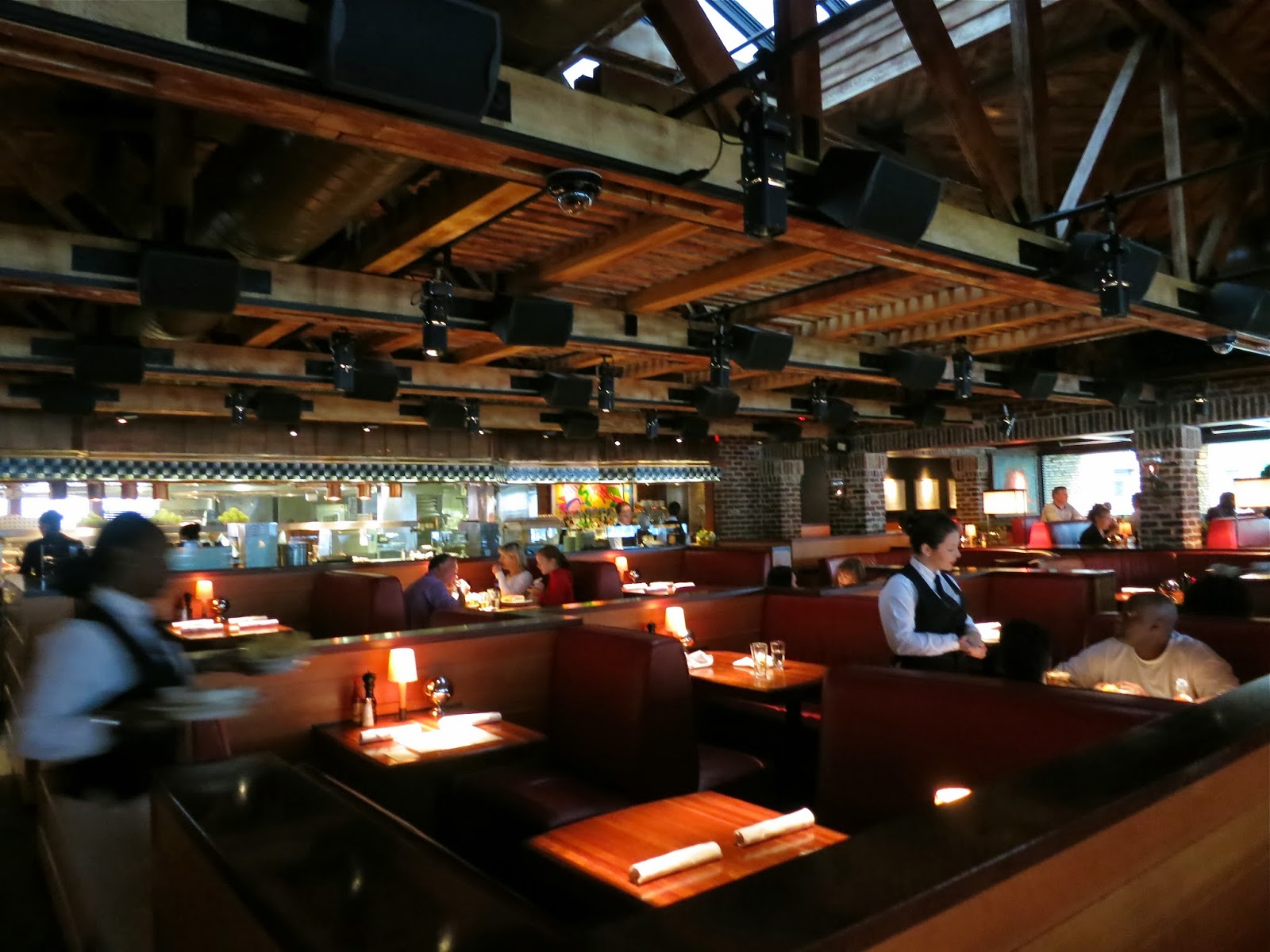
The welcoming man-cave interior of Houston's Restaurant

Another one of our reasons for visiting Atlanta was to spend an afternoon at the High Museum of Art.  Neither Boy nor I had ever been to it.  I was curious to see it, both for its celebrated architecture and its noteworthy collection of art.


Our first attempt to visit the High Museum was not successful, however, as the museum's parking garage was full and the wait to get into nearby parking lots was long.  That's because the High Museum was hosting a traveling exhibition of Vermeer's paintings that was attracting record crowds.  So we decided to drive around Atlanta for a while to see what we could of the city through our rain-splattered car windows.

I loved the ceilings of the High Museum's
modern art galleries

Returning to the museum, we were fortunate to gain entry to its parking garage and tour its collections.  We opted not to see the blockbuster Vermeer show, bypassing its crowds and lines.  As I've written in other posts, when visiting regional museums I generally prefer to skip traveling exhibitions and concentrate my viewing on the permanent collections.

A gallery full of Alex Katz's serene landscapes was most pleasing

Navigating one's way through the High Museum of Art can be somewhat challenging, as the architecture of the complex takes center stage, relegating the art on display to a secondary note.  The galleries containing modern art are the most successful, in my view.  The spaces displaying the museum's excellent collection of pre-twentieth century art and decorative arts?  Less so.

Looking down upon an artists' drawing event 
hosted by the museum the day of our visit

Don't get me wrong, Dear Reader.  I enjoyed visiting the High Museum of Art.  And so did the thousands of other people who did so the day we were there.  The place was hopping!

The two little girls in pink playing hide and seek were adorable

With the "closing-time" gong ringing, Boy and I took our leave of the High Museum and headed out the door with a few hours to kill before meeting up with friends for dinner.  So what did we do?  We went back to Sid Mashburn so that Boy could buy a pair of double monk-strap shoes that had caught his fancy the previous day.

"Get thee behind me, Satan!"

Needless to say, Boy found one or two more must-haves to add to his shopping bag during our second visit at Sid Mashburn . . .

Reggie is most grateful, Dear Reader, that there is not (yet) an outpost of Mr. Mashburn's divine men's clothing store in Manhattan, as he is sure it would hasten the financial ruin of the Darlington household.  Albeit a very well-dressed household!

The Iberian Pig restaurant in trendy Decatur

Dinner that evening was at the very popular Iberian Pig in downtown Decatur.  Organized by our friend Paula Mueller, a group of us gathered there to dig into the restaurant's signature pork-inspired offerings.  "The Pig," as it is known by its regulars, attracts a diverse group of Atlantans, ranging from young professionals to the more-pierced-than-thou crowd.  The night we ate at the Pig it was absolutely packed and the noise level positively ear-splitting.

The happening scene at the Iberian Pig

While I enjoyed the Iberian Pig's delicious, hearty fare, I could barely hear my dinner companions, what with the shrieks and shouting of the surrounding tables of revelers that brought our own table's conversation to a virtual standstill.  Nonetheless, I am glad I ate there, as I am fond of the people with whom I shared our table, and the food was quite tasty.

Even though we left the restaurant after midnight, I was surprised to find ourselves (yet again) stuck in parking-lot-like traffic all the way back to our hotel.  The congestion was due, in part, to crowds of hipsters leaving a huge music festival that took place during the weekend of our visit.  While sitting in our idling car, stuck in traffic, it was most entertaining to watch the antics of the music festival's departing attendees, many of whom were lurching about the streets and crosswalks, visibly bombed.

Stuck in jammed traffic, again!

The next morning, our last in Atlanta, we decided to explore the city's downtown.  We had spent the bulk of our visit in newer parts of the city and wanted to see what we could find of Atlanta's older, original business and shopping districts.  Where it all began, so to speak.

Downtown Atlanta in the 1940s
Image courtesy of Pat Sabin

The business district of old downtown Atlanta is largely comprised of office, municipal, and government buildings, a smattering of hotels, and remnants of what had once been a thriving retail district.

Downtown Atlanta today
Image courtesy of dayka robinson design

As is unfortunately the case with many American cities these days, downtown Atlanta is rather gritty and somewhat forlorn, as are many of the people one sees on its streets on a Sunday morning.  One is not inclined to get out of one's car and stroll around in downtown Atlanta, taking in the sights.

A vintage postcard of the Georgia State Capitol
Image courtesy of Playle

That is particularly so in the blocks immediately surrounding the city's majestic Georgia State Capitol, an area sadly hit with blight, bisected by immense highways and scarred by misguided urban "renewal" in the mid-twentieth century.  I would love to have seen this part of Atlanta in the 1930s and 1940s, when it was still in all its City Beautiful glory.  I'm sorry that much of it is lost to us today except in photographs and old postcards, such as the ones I am showing here.

"Would you make that a double, please?"

Somewhat sobered by our last few hours touring downtown Atlanta we drove our Cadillac ATS rental car back to the Hartsfield-Jackson Airport to catch our flight to New York.  Over preflight cocktails in the Delta Sky Lounge we agreed that we had thoroughly enjoyed our all-too-brief visit to Atlanta, a sprawling, complex, vibrant, and ever-changing metropolis with all the attractions and challenges that large cities in America have today.  I look forward to returning to the capitol of the Peach Tree State again and seeing more of what this wonderful city has to offer.

Tell me, Dear Reader, do you have any particular favorite places or things to do in Atlanta that you might recommend?

All photographs, unless noted, by Reggie Darling

Sunday, October 6, 2013

A Reggie Roadtrip: Atlanta, Part I

It's been some time, Dear Reader, since I've done a "Reggie Roadtrip" post, and—as a number of you have noted recently—it has been some time since I've posted anything.  Today's essay (the first of a two part series) remedies that deficiency with my reportage on a whirlwind trip that Boy and I took several weekends ago to Atlanta, a city that I hadn't visited in more than twenty years.  Our agenda there included meeting a number of the area's noteworthy bloggers, reconnecting with old friends, shopping, eating out, and visiting a smattering of sights in what is indisputably the South's biggest, boomingest city.


We began our journey in the Delta Sky Lounge at LaGuardia Airport where we fortified ourselves with several rounds of pre-flight cocktails and handfulls of Chex Mix.  Reggie is fortunate to have access to most of the airlines' members lounges when he travels.  It is one of the few remaining perquisites of being an Investment Banker, and a soothing antidote to the horrors of airport security lines—even for those of us with priority privileges.

"On second thought, Miss, please make that a double!"

Upon our arrival at Atlanta's mindboggle-ingly enormous Jackson-Hartsfield Airport I upgraded our rental car to a new Cadillac ATS, the brand's recent entry into the sporty, entry-level luxury car market dominated by Audi, Mercedes Benz, and BMW.  It had been some time since I'd driven a Cadillac, and I was curious to check it out.  Our ATS drove like a dream and had a lot of pep to it, but it was a bit cramped for those of us—such as Reggie—who stand at over six feet tall and carry a BMI that could use (ahem) some improvement.  Such minor complaint notwithstanding, I enjoyed test-driving the Cadillac ATS during our visit to Atlanta.

There's really nothing quite like a Cadillac, is there?

Our first destination in Atlanta was the city's Four Seasons Hotel, where we checked in and had a quick bite before heading out to see what the town had to offer.  As I have written many times before here on this blog, Reggie is a big fan of the Four Seasons chain, and he usually stays in one of their hotels whenever he has the good fortune to find himself in a city that has one.  I was interested to check out the Four Seasons' Atlanta outpost, as I had never stayed in it before.

The Atlanta Four Seasons Hotel in all its magnificence

The Atlanta Four Seasons is a monumental limestone tower, and its lobby is exhilaratingly, uh, garish.

Trump Tower red marble for miles and a
Phantom of the Opera crystal chandelier!

Not that it bothered Reggie one bit, mind you.  Reggie enjoys a bit of questionable taste every now and then.  The Atlanta Four Seasons' grand staircase reminded him of the one in Rhett and Scarlett's Atlanta mansion, the one that Rhett carries her up, kicking and screaming, and then ravishes her.

"This is one night you're not turning me out, Scarlett!"
Image courtesy of Selznick International Pictures/MGM

Just as Mrs. Butler apparently enjoyed herself that night, we had a lovely time at the Atlanta Four Seasons.  The service was superb, and the staff couldn't have been more accommodating, or nicer.

"I just love the beds at the Four Seasons.  They're so comfortable!"
Image courtesy of Selznick International Pictures/MGM

Our spacious and well-appointed room at the hotel was on a high floor, and had a terrific view out over Midtown Atlanta.

The view of Atlanta from our hotel room

Atlanta has come a long way since it was burned to the ground in 1864, Dear Reader, during what some in the South still refer to as the "War of Northern Aggression." Visiting Atlanta 150 years after the war's end it is (almost) unfathomable to me that our nation came to such blows then and that so many died for "the Cause."  It certainly seems very remote to this writer today.  But that was not the case as recently as my own parent's generation, many of whom knew people who remembered the Civil War, and some of whom experienced it first hand.  One of my mother MD's grandfathers, for instance, was a drummer boy in the Union Army.  I and my brother Frecky own swords that were carried by ancestors of ours who fought in the war, on both sides.

A view of downtown Atlanta in 1865, after Sherman had finished with it
Image courtesy of Cornell University Library

With but a few hours on our hands before our first commitment, Boy and I headed over to Sid Mashburn, an Atlanta-based men's clothing store that I first learned about from reading Maximinimus, one of my favorite blogs.  Dusty Grainger, who writes said blog, is a great appreciator of all things sartorial (among many other appealing attributes) and sang the praises of Sid Mashburn's emporium in one of his recent posts.  After reading Dusty's enthusiastic endorsement, I knew that Boy and I simply had to visit the store during our trip to Atlanta


The eponymously-named Sid Mashburn is, in this writer's humble opinion, worth a trip to Atlanta alone (and for you ladies, there's an equally-lovely store for the fairer sex right next door, named Ann Mashburn, after Sid's wife).

"Warning!  Danger Will Robinson!"
Image courtesy of Fox Television Studios

But be forewarned, Dear Reader!  Should you be so fortunate (or foolish) to darken (either) store's doors I assure you that you will be seduced by a powerful siren song, and will find yourself helplessly stumbling away with armloads of expensive, beautifully-made clothes and accessories and a decidedly emptier bank account.


At least that's what happened to Boy during our not-one-but-two visits to Sid Mashburn during our all-too-brief stay in Atlanta.  Reggie knew that we were in serious trouble when the very helpful and accommodating Brad, who assisted Boy during our visits at Sid Mashburn, greeted us with "What are you drinking?" and then obligingly (and repeatedly) supplied it to us to imbibe while we examined the store's delectable offerings.  As I watched Boy succumb to the heady charms of Sid Marshburn's inventory I couldn't help but recall the clothes shopping scene in one of my favorite movies, Sunset Boulevard:

"As long as the lady is paying for it, why not take the vicuna?"
Image courtesy of Paramount Pictures

But, unfortunately for dear Boy, I wasn't about to play the Norma Desmond character in Sunset Boulevard and pick up the tab for his shopping spree at Sid Mashburn—Boy was there on his own.

I must say, though, that our vist visits to Sid Mashburn were one of the highlights of our trip to Atlanta, and well-worth the financial damage done to Boy's bank account, as he came away with a splendid replenishment of his wardrobe.  There is a reason, Dear Reader, that the expressions "You only go around once" and "You must strike when the iron is hot" are clichés.  Because they are true!  Boy simply had to "bite the bullet" and "take the plunge" at Sid Mashburn—for when would we pass this way again?

On the other hand, I can just hear MD snorting if she were still alive and reading this, "Yes, and the same applies to 'A fool and his money,' too, young man!"  Ah, well . . .

Stuck in stalled traffic on Fourteenth Street

Realizing that we were in danger of running behind for our first commitment in Atlanta—a cocktail party that we were hosting at our hotel—we quickly wrapped up our visit at Sid Mashburn and jumped into the Cadillac ATS for (what we thought would be) a quick trip back to the Four Seasons.  But it didn't turn out that way, Dear Reader.  Traffic in Atlanta can be horrendous, particularly on the city's main thoroughfares.  What we assumed would be a five minute drive turned into a forty minute one, and we were late for our own party.  Fortunately everyone else was, too, given the congestion in the streets leading up to the hotel.

Reggie's Bloggers & Bankers Party, getting under way

So why did Reggie throw a party when he visited Atlanta, you might ask?  Because he could, that's why!  As I have explained elsewhere in this blog, Reggie is a party person, and he enjoys not only going to other people's parties, but throwing them, too.  As I was preparing for our trip to Atlanta, I realized that we knew enough people in the area that it would be fun to plan a party while we were there.  I invited a number of Atlanta's noteworthy lifestyle bloggers to it—some of whom I've met before and some of whom I hadn't—and also a handfull of my non-blogger friends.  Each were invited to bring "significant others" or a friend, and all-in we had around fifteen convivial souls assemble for the festivity.

Settling in for conversation, hooch, and tasty vittles

Because most of my non-blogging friends in Atlanta (coincidentally) work at Sun Trust (which is not all that surprising, since I got to know them when we overlapped at various financial firms in New York), I decided to call our cocktail party "Reggie's Bloggers & Bankers Party."  Needless to say, it was a super fun evening!  Liquor flowed, food was plentiful (and delicious), and talk (and laughter) was nonstop.

The Atlanta Four Seasons did a marvelous job at
making sure all of Reggie's guests were "well-served"
at his Bloggers & Bankers Party
Image courtesy of Super Stock

From the blogging world I was honored to have as my guests Jennifer Boles of The Peak of Chic, Julieta Cadenas of Lindaraxa, Barry Leach of The Blue Remembered Hills, and Terry Kearns of Architecture Tourist.  During the party I learned that Allin Tallmadge, the husband of a dear friend of mine from the banking world, has recently started a blog of his own focused on cheese (but I can't remember the name of it or I'd provide a link to it here).  Not surprisingly, Allin is passionate about his subject, and he owned the now much-missed Tallmadge Cheese Market in Montclair, New Jersey (the subject of a "Hot from the Kettle" YouTube video) before relocating to Atlanta with his wife several years ago.

By this point in the evening no one was feeling any pain . . .

Although the invitation for the cocktail party said it was from six to eight p.m., there was enough fuel, food, and fun being had by all (beautifully and deliciously supplied by the very solicitous staff at the Four Seasons' Park 75 Lounge) to keep Reggie's Bloggers & Bankers Party going well beyond eight pm, with the last guests not departing until after ten—despite our pleas for them to please, please stay for "just one more" before heading out into the night.

While I'm not exactly sure, I think Boy and I may have consoled ourselves with one last drink at the bar before heading upstairs, but I admit that by that point in the evening it all gets a wee bit blurry. . .

Next:  Rain, the Swan House, more rain, the High Museum, even more rain, a return visit to Sid Mashburn, pouring rain, and dinner at the Iberian Pig

All photographs, unless noted, by Reggie Darling 


Monday, April 29, 2013

An Afternoon at King Manor

After having spent a most enjoyable visit at the Bartow-Pell Mansion in the Bronx, Boy and I decided to fire up the family jalopy again and drive out to the far reaches of Jamaica, Queens, to explore King Manor, another one of New York City's historic house museums.

The approach to King Manor, located in Rufus King Park, Jamaica, Queens

King Manor is named after the Honorable Rufus King (1755-1827), a signer of the U.S. Constitution, a senator from the State of New York, the nation's first Ambassador to Great Britain, a land owner, and a gentleman farmer.  The house sits in Rufus King Park, an eleven-acre public space in what is today a working class residential and commercial stretch in Queens, New York.  The house is about a forty-minute drive from the UES.
   

Rufus King and his wife, Mary Alsop, purchased an eighteenth-century farmhouse with ninety acres in 1805, and they spent the next twenty years improving and enlarging the house and property, which today is known as King Manor.  The Kings also maintained a townhouse in Manhattan, where they lived during the colder months of the year, when they weren't in residence in Washington, D.C., or London.

An etching of the the Rufus King Manor
Jamaica, New York, ca. 1930
Image courtesy of Keith Sheridan Fine Art

By the time of Rufus King's death in 1827 the house had grown to twenty-nine rooms and sat in an estate of one hundred and twenty-two acres of gardens, fields, orchards, and forest.  Subsequent generations of the King family lived in the Manor until 1888, when the house and much of its contents, along with eleven acres of land, were sold to the city of Jamaica.  The property came under the jurisdiction of the New York City Department of Parks & Recreation in 1898.

King Manor in 1950
Image courtesy of N.Y. City Department of Parks & Recreation

Within several years of King Manor being sold, houses and apartment buildings were built around the park's periphery.  Today the surrounding area is a combination of small apartment buildings and two-family houses, and large municipal buildings.  

The view across Jamaica Avenue, looking to the west

The entry to King Manor is from Jamaica Avenue, a busy thoroughfare that follows what had originally been a trail (known as the Yamecah Trail) established by the area's Lenape Native Americans long before Europeans colonized these shores.  The English, who took control of the area from the Dutch in the 1680s, named it Jameco, which was later changed to Jamaica.  There is no link between this part of Queens and the island in the Caribbean of the same name; that they share a name in common is entirely coincidental.

The view across Jamaica Avenue, looking to the east

Today there is little left on Jamaica Avenue from the time when the Kings lived in their house.  In the above photograph one can make out two towers of a brownstone Gothic Revival church standing between two hulking municipal buildings.  According to the young woman who gave us a tour of the house, it was in this church that the King family worshipped.  Well, not really.  Reggie has since learned from one of his perspicacious readers that the Kings worshipped in a different church, Grace Episcopal, that stands nearby.  Nonetheless, the church shown in the photograph is one of the few remainders of buildings that stood when the family was still in residence. 

The view into Rufus King Park from the rear of the house

Rufus King Park, which spreads out around and behind King Manor, is popular with and heavily used by residents of the surrounding area.  There were a lot of people in it the day we visited the house, running around and playing soccer and other ball games.

Architectural rendering of front elevation for the 1984
restoration of King Manor by Gibson Bauer Associates
Image courtesy of King Manor Association

King Manor underwent an extensive and careful restoration in the 1980s, and today the house is well cared for by the New York City Department of Parks and Recreation, with financial and other support from the worthy non-profit Historic House Trust of New York City.  King Manor is not one of the city's most popular historic house museums, given its location and the relative obscurity today of its once celebrated owners.  We were the only visitors to the house the afternoon we made our journey there.

An early twentieth-century postcard of King Manor.  Its Victorian
buff-and-brown paint scheme survived into the 1950s
Image courtesy of King Manor Association

In researching this post I came across numerous images of King Manor from different eras.

By the 1960s, the era of this postcard, the house was
painted white, with black shutters.  Note foundation plantings
and colorful flowerbeds full of annuals
Image courtesy of King Manor Association

It is interesting to see how the house and landscape evolved over the years, reflecting the changing tastes of the times and advances in historic restoration knowledge.

The house today, as painted in a scheme from the 1980s
restoration.  The foundation plantings are gone.

So, let's go inside and look around, shall we?

The main hall of the house features a handsome
Federal staircase with a mahogany banister

What strikes one when entering King Manor is that it is not a particularly "fine" house with articulated moldings or plasterwork that one would expect to see in a city house of its size.  It is a large country house that has been expanded over the years, and it functioned both as the seat of a family of consequence and as the hub of a large working farm.  The King's townhouse in Manhattan would have been a more refined dwelling, I believe.  King Manor's principal rooms are large and well proportioned, and overall the house is quite pleasant.  Were it not for the urban surroundings it sits in today, one could easily imagine living in it (assuming one had the substantial wherewithal required to do so).

The front parlor contains a marble fire-surround installed by the Kings
and a few pieces of Federal-period furniture

King Manor is only minimally furnished, and many of its secondary rooms have been set up as teaching installations, focusing on Rufus King's political activities.

Rufus King portrait by Gilbert Stuart, ca. 1820
Image courtesy of the National Portrait Gallery

A copy of a portrait of Rufus King by Gilbert Stuart hangs in the house's front parlor.  The original is in the collection of the National Portrait Gallery in Washington, D.C.  Here is how the NPG describes the sitter on its website:
"Rufus King was one of the last of the Founding Fathers. A delegate from Massachusetts to the Continental Congress, an active framer of the Constitution, minister to Great Britain, opponent of the War of 1812, senator from New York, and the Federalist Party's last candidate for the presidency (overwhelmingly defeated by James Monroe in 1816), King had a public career that extended through the administrations of the first six presidents of the United States. His portrait was painted in 1819-20, a time when he tried to rouse opposition to the admission of Missouri as a slave state, defending before the Senate 'the natural liberty of man and its incompatibility with slavery in any shape.' John Quincy Adams recorded: 'He spoke with great power, and the great slaveholders . . . gnawed their lips and clenched their fists as they heard him.'"
In other words, Mr. King was a Very Big Deal in his day, and a man who did not shy away from controversy.


Turning back to the house, I rather liked the pretty cream jug and coffee can and saucer seen in the preceding photograph that were sitting on a desk in the front parlor.  Perhaps if I were to actually follow through on my "Coffee Can of the Week" series promise, I might do a post on the coffee can . . .


The house's commodious dining room was remodeled by the Kings to have an oval end, which our young docent said seated musicians for dances at the house.  The doors on either side of the window lead to small closets.

"The Dinner Party" by Henry Sargent, ca. 1821
Image courtesy of the Museum of Fine Arts Boston

King Manor's dining room's decoration has been loosely based on the interior depicted in the well-known painting "The Dinner Party" by the artist Henry Sargent.  I know of at least two other Federal-era historic house museums that have also looked to that painting for inspiration for their dining rooms: Homewood House in Baltimore (the subject of an earlier post of mine) and the Harrison Gray Otis House in Boston.


King Manor is notable for its library, shown in the preceding photograph.  At one time it held over 3,500 books, of which approximately 2,000 remain today behind the room's curtained cases.  A book collection of such size in America in the first decades of the nineteenth century would only have been possible for a person of substantial wealth.  To put it in perspective, Thomas Jefferson's library of 6,500 volumes was the largest library in private hands in America when he sold it to the U.S. Government in 1815 for the then staggering sum of $23,900.  It formed the nucleus of what is today the Library of Congress.


The woodwork and walls in King Manor's library were grained when the house was restored in the 1980s to approximate their original decoration.

A late-nineteenth or early-twentieth century
view of the library
Image courtesy of King Manor Association

The photograph of the library in the preceding photograph shows the room as it probably looked in the years leading up to when the Kings sold the house to the city of Jamaica.  I wonder where Rufus King's "favorite arm chair" is today?

The house's "gift shop" in the upstairs hall

Our tour ended in the upstairs hall, which has been somewhat haphazardly set up as a gift shop.  None of the upstairs rooms were open to the public when we visited the house.  We peeked into one or two of them, however, and saw that they were mostly filled with furniture (perhaps including the elusive "favorite arm chair") stored under protective sheets.  Assuming much of the covered furniture was sold to the city of Jamaica by the Kings when they vacated the house, I suspect a subsequent reinterpretation of King Manor's interior may bring some of it back into the rooms, which would have been furnished during the Kings final days with a mix of period furnishings, as seen in the early photograph of the library.


With our tour completed, we bid our guide goodbye and left the house through the door seen under the porch in the preceding photograph.  The dependencies in the rear of the house were once devoted to service activities, notably cooking and laundry.

Architectural rendering of the east elevation for the 1984
restoration by Gibson Bauer Associates
Image courtesy of King Manor Association

In its day, King Manor would have been supported by numerous barns, stables, and outbuildings required to house the horses, carriages and buggies, livestock and farm equipment necessary to manage a large working country estate.  These have long since been torn down.

A view of the rear of the Manor, ca. 1936
Image courtesy of N.Y. City Department of Parks & Recreation

And with that I leave you, Dear Reader, with this charming old photograph of a view of the rear of King Manor.  We enjoyed our visit to the house and appreciate that we are fortunate today that it still stands, a stalwart reminder of the dignity and beauty that the countryside surrounding New York City once possessed.

Reggie's appreciation for King Manor, and the preservation of it and other historic house museums found in the public parks of New York City made possible by the philanthropic Historic House Trust of New York, has motivated him to make a donation to the Trust in support of its worthy and laudable efforts.  Should you be so fortunate to find yourself in New York, Dear Reader, Reggie encourages you to set aside an afternoon to visit one of the city's historic house museums, and to consider leaving a contribution when you do so above and beyond the modest admission price in order to help support their ongoing existence.

King Manor Museum
King Park, Jamaica, New York
(718) 206-0545
www.kingmanor.org

New York City Department of Parks & Recreation
www.nycgovparks.org

The Historic House Trust of New York
830 Fifth Avenue, Room 203
New York, NY 10065
(212) 360-8282
www.historichousetrust.org
Related Posts with Thumbnails