Sunday, August 15, 2010

Nantucket Reds . . . I Mean Oranges

One hears a lot about Nantucket Reds, the iconic trousers sold at Murray's Toggery here on the island.  But this post isn't about them, as there are numerous bloggers, such as Maximinimus, who have written far better treatises on them than Reggie can.

A stack of our Vilebrequin bathing suits

This essay is about the color orange.

When thinking about the beach, many people think of the colors blue, green, gray, white, and sand.  And that is to be expected, since such colors predominate in the landscape.  But what has struck me about this particular visit to the seaside is how often I come across the color orange.

A Nantucket sunrise, from our deck

Reggie is an early riser, and I've been enjoying the sunrises here on the mornings I wake up at dawn.  The colors have been fantastic, ranging from deep cerise, to pink, to orange, and yellow.

Boy's wrist with beach watch and rope bracelet

It's gotten me thinking about how often one sees orange at the seashore, both in the natural environment, and the manmade one, too.  And once I started to focus on it, I found that I saw orange almost everywhere that I looked.

Rose hips at our house

Orange is one of my favorite colors.  I am drawn to it, and I wear it a lot, usually as an accent color.  One of my favorite pieces of clothing is an orange tie from Hermes that I wear with a suit to work.  I call it my Happy Tie.


We found this little orange juice pitcher at our house here on Nantucket, and we have been delighted to use it for its designated purpose.


Bonne Maman Apricot Preserves is a favorite jam.  Not only do I like the way it tastes and looks, but it reminds me of breakfasts in Paris, where apricot preserves are a staple.


We've been attempting to be healthy here, which for Boy includes a morning run in these shoes.


We're also being careful about the sun.  We like and use Clarins suntan lotion, both for the product and the packaging.  We brought lots of it with us.


But suntan lotion alone isn't always sufficient, sometimes you need a hat, too.  Particularly if one is as "hair challenged" as we are.


We brought our own beach towels with us, including this one that Boy was given at a company event many years ago.


But Nantucket has a lot more to offer than its lovely beaches.  There's lots to do in town, too.  Neither of us believe it is appropriate to wear a bathing suit in town, and that means we must throw on presentable clothing every once in a while.  We can't bring ourselves to buy Nantucket Reds, even though we've been coming here for years.  But orange shorts are pretty close.  Or at least as close as Boy is willing to go.


And of course, a pair of shorts requires a belt, preferably a ribbon one.


Even the family Rover got into the act!


When in town the other day I spent a happy hour in Mitchell's Book Corner, located at the corner of Main Street and Orange Street.
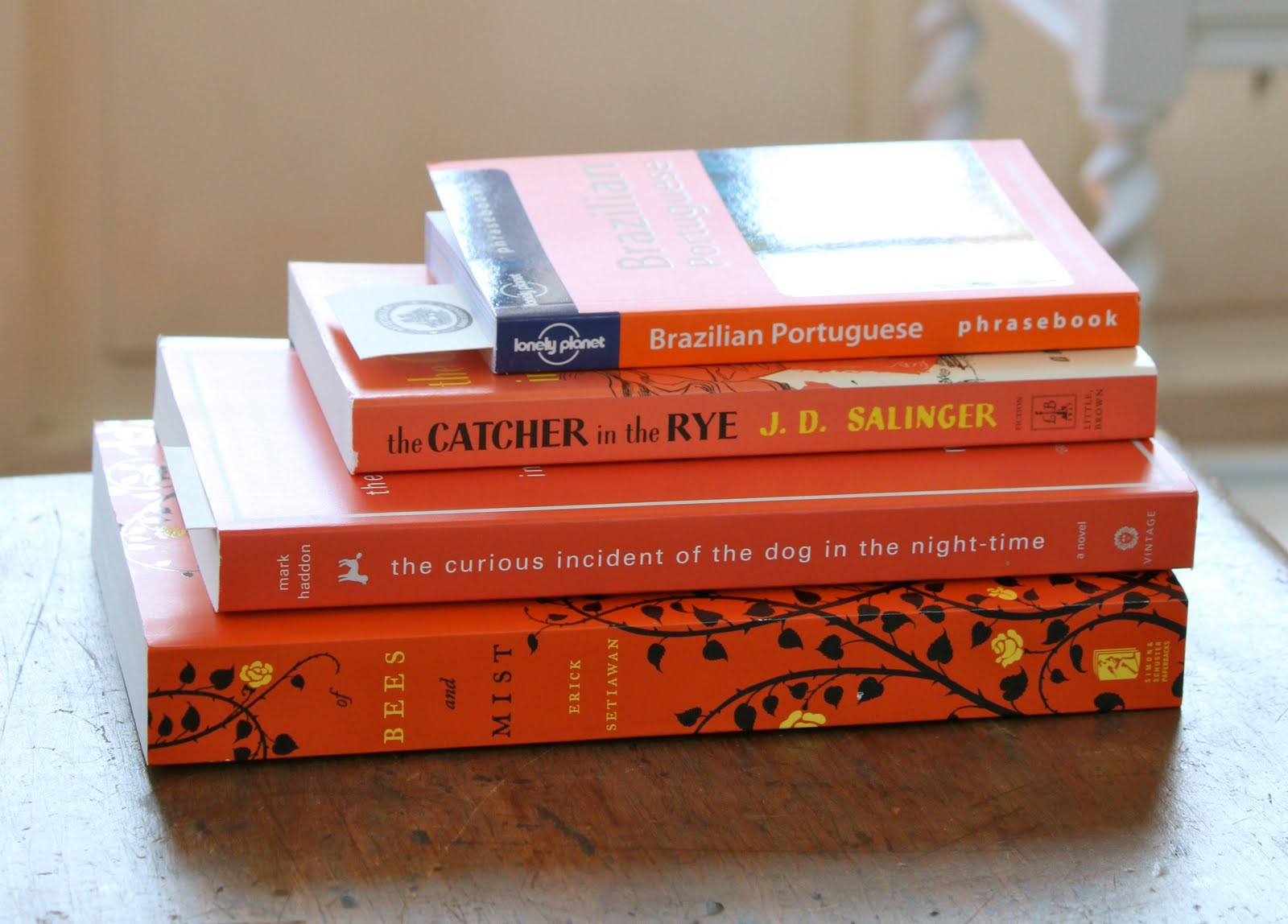

Where I bought these paperbacks, mainly because they are bound in orange covers.  I believe I may have even read The Catcher In the Rye here on Nantucket many years ago as a summer reading requirement.  I'm going to leave the books behind in the house we've rented at the end of our vacation.


While walking back to the Rover I passed this orange bicycle.  How fun is that?  I can just imagine its pretty owner, pedaling through the streets of this lovely town.


Back at the house, it was time for a pre-lunch refreshment of San Pellegrino Aranciata.


At lunch I served Nigella Lawson's "Rainbow Room Carrot and Peanut Salad" which I made from her Forever Summer cookbook that I found in our house.  I highly recommend the cookbook, Dear Reader, as it is full of delicious recipes, and Ms. Lawson's writing is exceptionally clever and funny.  I laughed out loud when reading through it.  Delightful.

Ford Waring's stylish orange watch band

After lunch our friends George Pinckney and Ford Waring arrived to stay with us.  Both Ford and Boy are great clothes horses, and they have been engaging in an amusing pseudo fashion war during George and Ford's visit.  At least that's how Ford and Boy have been describing it.

Ford's orange and blue ribbon belt

And the next thing I knew, it was cocktail hour!


At Darlington we exclusively use cloth napkins, even for cocktails.  However, we picked up these paper ones at the (late lamented) Charlotte Moss store in Manhattan to use when we let our guard down, such as when staying in a rental beach house.  Besides, the saying printed on the napkins resonated with me.


And what WASP cocktail hour would be complete without Pepperidge Farm Goldfish?


Our favored summer cocktail at the beach this August is made with Stolichnaya's Stoli Ohranj.  I admit that I bought it chiefly for the bottle to show in this story, but I found that it makes a remarkably refreshing cocktail.   Pour a jigger of the vodka over ice, add equal parts tonic water and club soda, and garnish with a healthy slice of naval orange.  Trust me, you'll like it.


Here's a photograph that I took of Boy the other day during cocktails, looking out to sea.  He's wearing a fun hat that he bought in Rome when we visited there earlier this summer.


Here is a shot of yesterday's sunset, taken from our deck overlooking the ocean.   If you look closely, you'll see a sliver of the moon about two-thirds of the way up the image.

And that wraps up my essay about the oranges of Nantucket.

All photographs by Boy Fenwick and Reggie Darling

Wednesday, August 11, 2010

A Beach Chair Revival, Part II

As I wrote in Part I of this essay, several weeks ago we dropped off three vintage wooden folding beach chairs at Sausbier's, an awning shop in Hudson, New York, to have their torn seats replaced.  We have since picked them up and transported them to Nantucket, where we are renting a house overlooking the ocean, and where I am writing this post to you, Dear Reader.

Our chairs and umbrella set up on the beach

We are quite happy with the way the chairs turned out.  While the Sunbrella awning fabric we chose is handsome and colorful, it is admittedly not quite as attractive as what was used when the chairs were made in the 1930s/40s.  However, as I wrote in Part I of this essay, the modern-day awning fabric we chose is sturdier and far more resistant to splitting or ripping than what was available when the chairs were made.  And besides, it was in stock.

I decided to post this series not only because it is a fun before-and-after story, with an attractive subject, but also because there is a lesson to be learned here, Dear Reader.  And that is, with but a little planning and foresight one can find far more attractive and green alternatives to what is generally available in big-box and other mass-market retailers.  And one needn't pay an exorbitant price to do so, either.  Of course it would have been easy for us to go to Target or similar (we are most decidedly not Wal*Mart shoppers at Darlington, at least when humanly possible) and pick up some cheap and cheaply-made beach chairs.  But then I would have cheap and cheaply-made beach chairs whose likely near-term fate would be to wind up in landfill in the all-too-short time it would take for them to fall apart.  And not only that, but for the brief period I owned them I would be annoyingly confronted by their pedestrian ugliness.

Boy's crushable Borsalino, ideal for beach and travel, on his chair

Instead, we own attractive, sturdy wooden beach chairs covered with good looking awning fabric.  The chairs are not only a delight to look at, but they are fun to sit in as well, because they are--as I wrote in my last post--attractively beachy in a 1940s way.  And for Reggie, that's a good thing.

By re-using and reviving the chairs I believe we are doing "our part" for the environment, and are being far greener than if we had bought new ones.  And while we did put new, petroleum-based synthetic fabric on them, we did so to extend their lives for many more years and to provide honest income for a small, independent family-owned business rather than the shareholders of a global conglomerate.

The photographer's shadow sur la plage

Now, Dear Reader, I know that you are wondering: "So, Reggie, how much did all this good-feeling-inducing work actually cost you?  How much did you have to pay to get such chairs to loll upon oceanside at Fancy Land by the Sea?"  Well, the answer is that it did cost more than what it would have had I bought the cheapest alternatives available.  But that is not Reggie's objective in life.  Reggie's goal is to live in an alternate world to the degraded, cheap, mass-market vision that is generally foisted upon us today, and that in many areas of this country is driving out what was once unique, regional, and attractive.

We had the beach largely to ourselves

Reggie aspires to live in a world of grace and honest beauty, and prefers to spend his dollars with local, independent businesses, when possible.  And that is why, more often than not, I buy used, vintage, or antique furniture and furnishings.  Not only is the craftsmanship better than what is generally available today, but it is usually more attractive, and can often be purchased for less than what new choices cost today.  In addition, I am confident that I am acquiring something whose production hasn't contributed to today's environmental woes.  And on top of that, I know that once such goods pass out of my hands they are not likely to wind up in landfill, but will be recycled and re-used by future generations of appreciative owners.

The surf was perfect for frolicking

Now, to answer the burning question of how much Reggie paid for all of this.  He spent a total of $50 to buy the chairs at assorted tag and yard sales, which he admits was a score, and another $270 to have them tightened and recovered.  That works out to a total of $320, or a little more than $100 per chair.  That seems like a very reasonable price to me because what I got for that is three honest wooden folding beach chairs covered with striped awning fabric that will last another fifty-plus years, and not some junky mass-market alternative that will wind up in landfill in only a few.  And what else did I get?  I also got two posts out of this subject that I have the pleasure of entertaining you with, Dear Reader.

Off for a walk

All photographs by Boy Fenwick

Saturday, August 7, 2010

Lunch At Jack's Oyster House

Darlington House is not all that far from Albany, New York, the state's capital, and a city that Boy and I find ourselves in at least several times a year, often at lunch time.  One of our favorite watering holes there--well our only watering hole there--is Jack's Oyster House, a venerable, old-line seafood and chop house established in 1913.

Jack's Oyster House's business card

As readers of this blog know, I am a great fan of authenticity.  And, as I wrote on my essay on the Pursuit of Authenticity awhile back, that includes restaurants.  In addition to enjoying new restaurants, I like to visit old-line ones that have been around for many years and still retain a unique, vibrant, non-corporatized image all their own.  Prime examples would be Keens Steakhouse and '21' Club in New York City, Galitoire's in New Orleans, and D'Ignazio's Towne House in Media, Pennsylvania, to name a few.

Old-line favorites needn't be expensive (but some are) or glamorous (which few are), but they do need to be authentic, and retain a look and feel of what made them famous in the first place, while still evolving to meet their customers' changing tastes.  Otherwise they die.  The streets are littered with ones that have failed at such a challenge.  Sad examples of ones that lost their way--and therefore their clientele--and closed in recent years include Gage & Tollner of Brooklyn, now the site of an Arby's; Haussner's of Baltimore, which stands empty and derelict; and Blackie's House of Beef of Washington, D.C., a great favorite of my family in the 1960s and more recently the victim of the wrecker's ball.

But Jack's Oyster House of Albany retains its relevance, even after almost 100 years, and is a place that Boy and I enjoy visiting whenever we find ourselves in that city.  I encourage you to do so as well, should you find your way to the Empire State's capital.

Jack's main dining room, pre-renovation
Image courtesy of www.lostnewyorkcity.blogspot

Boy and I first came across Jack's a decade or so ago, shortly after we bought Darlington House.  We were visiting downtown Albany one Saturday to see what was what there, and found ourselves hungry and in need of lunch.  Just as we agreed that it was time to feed ourselves we literally drove by Jack's.  We liked the look of its exterior and its old-fashioned signage, and decided to give it a try.

Jack's facade, July 2010

Little did we realize as we walked through Jack's doors that we had stumbled across one of the city's most beloved dining establishments.  As it turns out, the restaurant is great favorite of the capital's politicians, and is frequented at lunch during the week by state senators and congressmen, and those who lobby their patronage, and a table is reserved there for whenever the governor stops by.  It does an active business at lunch and dinner, attracting not only politicians but also business people and professionals during the day, and pleasure seekers out for the evening at night.  Boy and I usually find our way to Jack's for a lunch a couple of times a year, including one during the week between Christmas and New Year's, a minor tradition of ours.  During the holidays, Jack's tables are packed with groups of friends, families, and colleagues out for a celebration.

Jack's main dining room, pre-renovation
Image courtesy of Jack's Oyster House

The restaurant's menu features an extensive raw bar (not surprisingly, given its name) and a large selection of grilled and broiled seafood, chops and steaks.  At dinner Jack's menu is dominated by such classic standbys as Oysters Rockefeller, Maryland lump crab cakes, grilled lobster, Steak Diane, rack of lamb, duck "A L'Orange," and at least several Surf and Turf options.  For lunch Jack's offers a lighter selection, including a variety of sandwiches, chopped and assembled salads, and pastas.  Desserts include at least several cavity-inducing cream pies, Banana's Foster, and--more recently--cotton candy.  But we usually skip dessert at Jack's since by then we're already full, as the portions are generous.  With the arrival of Chef Luc Pasquier two years ago, Jack's menu has expanded to include more contemporary options, but the restaurant remains firmly grounded in providing the classic American food that its regulars return for again and again.


Jack's has been owned by the Rosenstein family since it was first opened in 1913, and today it is run by Brad Rosenstein, the grandson of its founder.  The restaurant has recently undergone a major renovation, which, to be honest, I have somewhat mixed feelings about.  As can be seen from the pre-renovaton photographs on this post, Jack's had a 1930s/1940s feel about it, much like a classic roadhouse restaurant of that era.  The renovation has taken Jack's back to a turn-of-the-century look, circa 1900/1910, when it was originally opened (but in a different location).  I'm okay with the intention and the end result, but I think that the quality of the renovation could have been better.  If you stop and really examine it, as Reggie is wont to do, the details and finishes look a bit more Home Depot than I'd like.

Jack's new (old) look
Image courtesy of Jack's Oyster House

But that's really a minor complaint as far as I'm concerned, and certainly no reason to stay away.  Because, while the renovation gives Jack's more of a concept steakhouse look than I would have chosen, the food has actually never been better.  Boy and I recently stopped in for lunch one Saturday between errands, and enjoyed the best meal we've ever eaten there.  We started out with a round of ice-cold Beefeater martinis (couldn't have been better) and a dozen perfectly shucked and briney Bluepoint oysters (a Jack's signature).  We each then followed that with one of the best BLTs we've ever eaten, accompanied by a mound of delicious potato salad.  The sandwich was built out of thick, toasted artisinal bread drizzled with olive oil and rubbed with raw garlic, spread with a delicious, flavorful mayonnaise, and layered with slabs of smokey, peppery bacon, thick slices of perfectly ripe, juicy tomatoes, and buttery, tender Bibb lettuce.  Incredible.  We finished our lunch sharing a plate of butter cookies and cups of coffee.  'Nuff said.

Jack's butter cream mints

As one leaves Jack's it is advisable to help oneself to at least several of the restaurant's butter cream (or "creme") mints before walking out the door.  Prior to its renovation, Jack's mints were heaped in an open bowl and filled with flavored jellies.  They've since lost their jelly fillings and are now solid butter creams, and covered with wrappings emblazoned with "Jack's Oyster House, Established 1913."

Its a nice souvenir to come across in one's pocket several days later, as I did just the other day.  

Jack's Oyster House
38-44 State Street
Albany, New York 12207
(518) 465-8854
www.jacksoyterhouse.com


Unless noted, all photos by Boy Fenwick

Thursday, August 5, 2010

Long Lost Brothers?

Well, I thought the saga of the mustache cup was mined for everything it could offer, but I guess I was wrong.  One of the commenters to my last post, Greek Girl, asked me if I was aware that my great-grandfather bore a passing resemblance to a mustachioed Jude Law?  This hadn't occurred to me, as Reggie admits he is not always entirely up to date on popular culture, but Greek Girl's observation peaked my curiosity, and I did a bit of image searching to see what she was on to . . .

And lo and behold, this is what I found:


On the left is a photograph of my great-grandfather, taken in 1888, and on the right is one of the actor Jude Law, taken in 2008, or 120 years later.  Not exactly identical twins separated at very distant births, but the resemblance is close enough that they look as if they could be brothers, if not even fraternal twins.  Greek Girl was right!

Reggie is grateful to Greek Girl for leading him down this entertaining path, and thanks her for doing so.  Reggie also admits in his heart of hearts that he would not be unhappy if he had been the recipient of more of his great-grandfather's good looks, and less of his fine china . . .

Tuesday, August 3, 2010

The Mustache Cup Saga Continues . . . Sort Of

My post(s) on invalid mustache cups keep(s) paying dividends.  Yesterday, as I was looking through photographs while working on a different post on another subject, I chanced across a picture of my mother, Mummy Darling, that my dear brother Frecky sent me several weeks ago.  Taken in the 1940s when my mother was in her twenties, the photograph shows several shaving mugs displayed on the shelves behind her.  These are, I believe, the very ones that my sister Camilla referred to in her comments to my last post on the subject of invalid mustache cups.  What a funny coincidence, I thought.

Mummy Darling in her early twenties

Supposedly, the mugs in the photograph, which I recognize from when I was a child, once belonged to MD's grandfather (her mother's father).  He is shown sporting a rather impressive mustache in this cabinet photograph, from 1888, also sent to me by Frecky:

My mustachioed great-grandfather

Frecky reminded me after reading my last post that he had sent me the photograph of our great-grandfather and suggested that our handsome ancestor's mustache would rank well amongst those that I featured in my post(s) on invalid mustache cups.  And for that I am grateful, and I share the photograph herewith for my readers' edification.

Now, the mugs shown in MD's photograph do not appear to me to be mustache cups, as Camilla recalls, but rather shaving mugs, and similar to the one I inherited from MD that was once part of her collection.  I still do not recall ever seeing a mustache cup before purchasing the one that came with the Paris porcelain part-service we acquired several weeks ago.  But, who knows?  As I said, MD inherited rather a lot of Paris porcelain from her grandparents, and it is possible that a mustache cup, in addition to shaving mugs, was included in the china she got from them.  I just don't recall seeing one.

By the way, it was through this great-grandfather that I am related to my great-great-uncle Augustus Bertram Coolidge, whose silver I inherited.  The letter 'C' engraved on the silver is identical to the one painted on the china we bought that precipitated this series, pictured in the original post.

And with this, I believe I have exhausted the topic of invalid mustache cups in its entirety.  At least Boy hopes so, as he tells me he now knows more about this arcane subject and its peripheral connection to my family than he cares to.

Sunday, August 1, 2010

Reggie Stands Corrected . . .

Two weeks ago, in my post on our recent purchase of a large, part service of old Paris porcelain, I speculated that one of the pieces we acquired, a handled cup with a ledge across the top that limits the flow of liquid when drinking from it, was likely designed for use by a bed-ridden invalid.  I thought the piece across the opening was intended to protect a patient from having the cup's contents spill upon him or her when drinking from the vessel.  I assumed that this was the cup's purpose, since our 19th-century forebears were far more plagued with bed-confining illnesses than we are today.

I thought this was possibly an invalid cup . . .

Two of my commenters, however, speculated that what I thought was an invalid cup was, in fact, a mustache cup, a form popular in the latter half of the nineteenth century, when men fashionably sported impressive and elaborate mustaches, often waxed.  The design of the cup, they wrote, was to allow mustachioed men to drink hot liquids without risking melting the wax in their mustaches, or staining them.

A mustachioed sipper of beverages

When I read that I was, to be frank, skeptical.  I had never heard of a mustache cup, and I suspected that such term was a later, made-up name that romanticized the original and less happy intended use of such a cup by invalids.  It reminded me of the modern-day and ridiculous use of "petticoat table" to describe a pier table, or "Holy Lord Hinges" to describe HL hinges.  In other words, I thought it sounded like a silly faux-bit.

He'll have some coffee, please, but only if you have a mustache cup

My commenters wrote that an invalid cup actually has a spout, unlike my cup, to pour liquids into the mouth of the afflicted.  I doubted that, too, as I thought they were probably referring to a posset pot, a handled vessel with a spout used to drink posset, a drink popular in England in to the nineteenth century at celebrations such as weddings.  Here is an example of a posset pot, circa 1705, found on the website of antiques dealers Mark and Marjorie Allen:

I thought my commenters were referring to this, a posset pot . . .

But Reggie stands corrected.  After doing some basic research I have determined that what I speculated was an invalid cup is, as my commenters correctly guided me, actually a mustache cup.  And for that correction Reggie is most grateful, for he humbly strives to use accurate and precise language and terminology whenever possible, and is most happy to be corrected when he hasn't.  Besides, being gracious about it makes him feel better about his own, at times tedious, propensity to correct others' errors in matters of terminology, pronunciation, and language.

He requires a more elaborate delivery device than a mere mustache cup

According to what I learned, the mustache cup was a form initially popularized in the mid-nineteenth century by a potter named Harvey Adams, of Longton, Stoke-on-Trent, England, and which came to peak popularity in the second half of that century, when mustaches were in their greatest vogue, or, should I say, flower.  Adams' mustache cup included a ledge, called a mustache guard, with an opening at the cup's edge that allowed the mustachioed user to drink hot beverages through the opening while keeping his mustache safe, dry, and unstained.

A fastidious candidate for a mustache cup

Here is an example of a mustache cup that I found that is similar to ours, as featured on the Cajun Collection:

. . . but what they were really referring to was this, an actual mustache cup

One of the more entertaining blogs that I came across in my search on this subject is Mustaches of the Nineteenth Century, a site that features many period photographs of mustachioed men who were the prime market for such cups.  I found this image of a mustache cup there:

A mustache cup with an appropriate theme

Reggie is confident that what he has is a mustache cup, and not a shaving cup or mug, an example of which he found on Antique Associates of West Townsend, Inc., and which looks like this:

This is not a mustache cup; this is a shaving mug

And here is an example of a shaving cup/mug that is in Reggie's own collection, that he inherited from his mother, whose childhood nickname appears somewhat incongruously upon it:

Mummy Darling's mug

So, what, in fact, is an invalid cup?  I found a good example of one on The Pirate's Lair, a site that features antique china, silverware, and furnishings used by the U.S. Navy and other navies:

So, this is an invalid cup!

An invalid feeding cup, as it is more prevalently known, is similar to a mustache cup in that it has a ledge covering a portion of the cup's opening so that fluids do not spill out of it when feeding a bed-ridden invalid.  However, unlike a mustache cup, but similar to a posset pot (and as my commenters noted), it has a spout attached to it so that its contents, most usually a restorative broth, can be easily poured into the mouth of the waiting patient.  It is thought that the one featured in the above photograph was made circa 1890-1915, and would have most likely been sold by a chemist for residential use.

He probably owns a mustache cup, or two

Reggie thanks the two anonymous commenters who brought to his attention the error of his description of what he now believes is, indeed, a mustache cup.  He is most grateful for the journey into the arcane world of china terminology that it precipitated, and for the knowledge that he has since gained.

A regular tea cup will do for him, at least for now . . .


All cabinet photographs of mustachioed men from the collection of Reginald Ambrose Darling.  Photos, except where noted, by Boy Fenwick
Related Posts with Thumbnails