Tuesday, September 21, 2010

A Peale, a Plant, and a Pot Update

As a number of my readers may remember, earlier this year I posted a story titled A Peale, a Plant, and a Pot, about finding a clay pot modeled after one containing a geranium that appears in the portrait of Rubens Peale, painted by his brother Rembrandt Peale in 1801, in the collection of the National Gallery of Art in Washington, D.C.  In the post I described a trip that Boy and I made to the studio of potter Guy Wolff, who made the pot--known as a Peale pot--to purchase it in several sizes (along with a number of his other beautiful pots and vessels).  And where, serendipitously, I received a gift of a cutting of the geranium that appears in the painting, given to me by Erica Wolff, Guy's wife and business partner.  For the Wolffs had been given a cutting of it by the horticultural curator at Monticello, who did so when he learned that the Wolffs were making such a pot.  Apparently, Thomas Jefferson had received a cutting of the geranium from Rubens Peale, and its offspring resided in the collection at Monticello.  So, not only did I come away from the Wolff studio with a Peale pot, but I also came away with a cutting of the very geranium depicted in the painting.  It was all so deliciously--and unexpectedly--six degrees of separation.


But in Reggie's case it was not six degrees that separated him from Rubens Peale, but only three: the Wolffs, Monticello's horticultural curator, and Thomas Jefferson.  Well, maybe--Reggie isn't exactly clear about what happened to the geranium between Thomas Jefferson's death and when it was then passed on to the Wolffs.  But he is happy not to delve too deeply into that because he likes the story as it is just fine, thank you.


And I am pleased to show you my Peale-potted geranium several months later, sporting its very first flowering.  It is now well established and has put on a lot of growth over the summer.  I had been warned by Mrs. Wolff that it is a rangey, healthy plant that, once-established, grows like Topsy, requiring regular cutting back.  Such a reputation is well founded, I can say with assurance.  I plan on repotting the geranium soon in a larger Peale pot that I have waiting for it and also pruning it back to promote bushier growth, as Mrs. Wolff advised me when she gave me the cutting.

I cherish this storied geranium, and I consider myself extremely fortunate to have it at Darlington House.  I don't intend on keeping it only to myself, either.  For I plan on passing on cuttings of it to like-minded friends for as long as I have the pleasure of owning it.

Please click on the link noted above to see the original story, as well as for contact information for Guy Wolff Pottery


Photos by Boy Fenwick

Friday, September 17, 2010

Reggie's Advice For the Tongue-Tied Guest at Table Amongst Strangers

The other day Reggie received a telephone call from a lady friend.  A charming, game gal with a swell sense of humor and great style, she is at ease and in her element in the elegant drawing and dining rooms of what is left of society, the waters in which she and her dapper husband swim effortlessly.  They are a sought-after couple in the county where Darlington House is situated, where they spend the warmer months of the year in one of the great and important houses.  And they are a fun and interesting addition to any party or dinner table.  I like her, and I always look forward to seeing her when our paths cross.

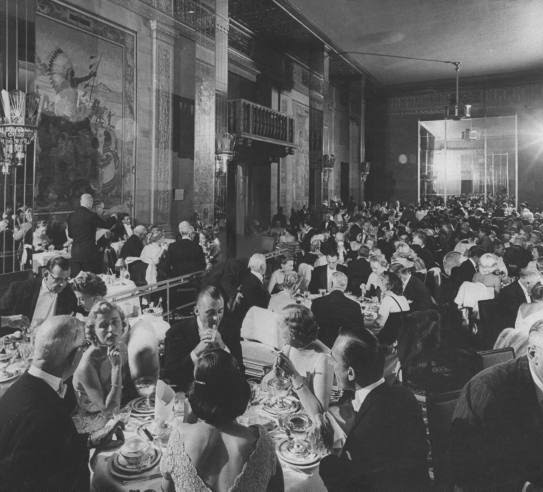
Whoever did the seating here didn't follow the alternating "boy/girl" rule.
Plus, Reggie thinks those look like electrified candles!

She was quite exasperated when she called me.  "Reggie," she said, "I've got to ask you to write about something on that blog of yours.  Last night I sat a table at yet another benefit, and neither the person on my left nor on my right knew how to talk to me.  It was like pulling teeth just to get them to say anything.  After two inteminable courses of grunts and monosyllabic answers to my questions, and not a single one in return, I finally just got up and left.  I couldn't take it anymore!  Why do these people go to parties if they can't--or won't--at least do their dinner partners' the decency of talking to them?  Would you please write about this on your blog?  I think your readers would be interested to know what you have to say about this."

Lots of good conversation going on here, but whose hand is that
holding the cigarette on the bottom left?

Of course Reggie was rather flattered that such a lady as my caller would ask his opinion and think that he might even have something to say on this matter.  And since she did, he does.  For this is a subject that Reggie has given considerable thought to over the years.  Namely, how does one navigate the waters of social intercourse when one finds oneself at a table, adrift amongst a sea of strangers?  And, in particular, what does one talk about under such circumstances?


The answer is it is remarkably easy to start the juices of dinner party table conversation running, Dear Reader, and then keep them flowing for as long as one is at table.  It really only requires the most minimal of effort.  To start the conversation one need do nothing more than be a good asker of questions, and a good listener.  And then once the conversation has begun, it is easy to keep one's dinner partners engaged in pleasant banter throughout the meal by volunteering bits and pieces of information and one's opinions in response to one's dinner partners' comments, all with the goal of eliciting additional pleasant conversation for the duration of the meal.  But like many simple things, Reggie believes that achieving success at such intercourse requires effort, practice, and a willing audience.  Just as it takes a chef years to master turning out a perfectly roasted chicken every time he is asked to do so, it takes practice to become a good party conversationalist under all circumstances.

Nice, but couldn't they have rented some decent ballroom chairs?

For when one accepts an invitation to a party, whether large or small, private or public, one enters into a contract to perform at said party appropriately.  And that means playing ball with the other guests.  No, not literally--unless the party is a tennis round robin--but figuratively, where the game played is one of wit and verbal volley.  And that means keeping the conversation going.  Just as many a party is helped along by the flow of spirits, so is it aided by the ready flow of conversation.  And the responsibility of a guest to keep the conversation going is a broad one.  It does not apply only to intimate private parties where the guest list is carefully chosen, and where conversation often runs freely as a result, but it applies also to more public gatherings, such as large benefit dinners, where one can find oneself assigned to sit at a table surrounded by strangers.


But if one is not as facile as Reggie or his lady caller are at instigating and carrying on such conversations (Reggie can converse with a door knob, if required), one shouldn't be content to just sit there quietly, either, waiting for others who are better equipped to do so to start and then keep the conversation going.  One must gather up one's bespoke britches and stride forth into the conversational maelstrom, leaving one's cautions and inhibitions behind to gather dust amongst the wreckage of dinner parties past.  For a dinner party--and I'm including benefits here, too--without conversation at table is a wreck of an evening, indeed.

Ah, the days of cigarettes at table . . .
An otherwise perfect dinner marred by those nasty folding chairs again

To address the very serious shortfall in the understanding of those who drove my lady caller to distraction, Reggie has come up with a set of pointers and suggestions for the tongue-tied party guest to grease the wheels of conversation when he (or she) finds himself sitting at a dinner table amongst strangers.  The employment of these conversational gambits, I might add, Dear Reader, will ensure that said guest will soon find himself (or herself) at the happy center of a freewheeling and enjoyable conversation that can last the better part of an evening, and certainly through at least the several courses required in a sit down dinner.


Success in these matters requires but that you ask any of these seven questions, either individually or serially:
  • Tell me, how do you know the host and hostess?
  • Are you affiliated with this charity/organization/worthy cause?  Do you support its work?  If so, in what way?
  • That's a lovely brooch/dress/tiara you are wearing, is there a story behind it?
  • Isn't this a lovely night for such a party?  What did you do today leading up to it?
  • Do you live here, or are you visiting?  If you do not live here, where are you from?
  • Are you here with a group, or are you on your own?
  • Isn't this a marvelous band?  Have you heard them before?  Would you like to dance?
Failing all of the above, here is a sure fire way of eliciting a response:
  • This party is a goddamn bore, would you like to do some blow?
Reggie is, of course, joking with this suggested last question . . . at least he thinks so.

Well, they thought it was amusing!

All funning aside, and with the exception of the last query, each of these are positive and leading questions that give one's dinner companions the opportunity to open up and volunteer information that can then be the basis for further questioning by the perspicacious listener.  And once your dinner partner's attention has been engaged, and the conversation is flowing, here are six further things to ask or say that ensure its happy continuation:
  • Do you really think so?
  • And then what happened?
  • Really?  How so?
  • Do tell me more . . . 
  • That's the most interesting thing I've heard all evening!
  • How remarkable, what a coincidence . . .
And failing that:
  • Would you like to do some more blow?
Wait a minute, that was supposed to be a joke!

That gal on the left would have a better time if she followed Reggie's advice

Anyway, back to the subject at hand.  You will find yourself a popular dining companion, indeed, if you take it upon yourself to engage in polite conversation at parties with those on either side of you that keeps your companions wanting more, rather than less, of your company.  If, on the other hand, you just sit there, awkwardly pushing your food around because you haven't anything to say, then you really shouldn't have bothered to go out that evening.  Parties require a certain level of behavior from the guest, and that includes keeping the conversation going in a pleasant and diverting manner.  If you are not able or willing to do so, then your time (and that of your unfortunate dinner companions) will be much better spent if you stay at home, alone, catching up on--and then taking to heart--insightful past Reggie Darling posts on matters of etiquette and social comportment.


And with that, Reggie wishes to leave you with but a few more thoughts on this topic that are well worth considering:
  • Don't take this all too seriously, we're talking about parties here;
  • Believe it or not, your new found dining companion probably isn't as interested in what you have to say as they may appear to be.  They, like you, are at a party and likely understand that conversation at such gatherings is, by its nature, expected to be light-hearted and non-confrontational.  If they are asking you such questions it is because they are polite and well-versed in party etiquette, and they know how to keep the conversation going.  Don't read too much in to their attention; 
  • If you find success in your conversations, do not then monopolize them.  Allow your companions the opportunity to ask questions or volunteer information, too.  Do not become the dreaded Conversation Hog, as deliciously skewered by my quite brilliant fellow-blogger Social Primer;
  • Avoid the "no-no" topics of religion, politics, and money--and tread lightly in discussing one's work or profession; and
  • Watch you alcohol consumption--don't drink so much that your ability to navigate such events or conversational engagements becomes compromised.
So, who forgot to order the candles and centerpieces?

It's as simple as that.

Tell me, Dear Reader, what are the questions and topics in your conversational arsenal that you employ when you find yourself seated amongst strangers?

All photographs from LIFE Images; all cartoons by William Hamilton

Sunday, September 12, 2010

The Squirrels of Darlington

One of the pleasures of living in the country is the closeness that one has with nature.  Although Darlington House is in a hamlet setting, it is surrounded by fields and forests teeming with life.  On our property stand half a dozen enormous old oak and black walnut trees that produce a bounty of nuts each autumn.  And where there are nuts, there are squirrels.

A 19th-century cast-iron and wood squirrel nutcracker

There are two types of squirrel that live at Darlington.  One side of the property is inhabited by red squirrels.  They are very playful, aggressive little creatures who spend much of their days gamboling about their territory, skittering up and down the trees and chattering in high-pitched voices.

A 20th-century cast-iron squirrel nutcracker
perched on the edge of a cast-iron birdbath

The other side of the property is inhabited by a population of larger and somewhat more docile gray squirrels.  We see more of the gray squirrels at Darlington than we do of the red ones.  That's because the grays live on the busier part of our property, where much of our day-to-day activities take place.  It is also where we keep several bird feeders, filled throughout the year.  The gray squirrels scavenge for fallen seeds on the ground below the feeders and occasionally try to get to the source themselves, often with hilarious results, as the feeders are designed to thwart such efforts.

A 19th-century cast-iron squirrel nutcracker,
surrounded by recently fallen black walnuts

The grays are are not as aggressive as the smaller red squirrels, and they appear less frantic and frenetic in their activities.  They are more of a "hang-out" squirrel, if there could ever be such a thing.

A 20th-century cast-metal squirrel sprinkler

Although there are more gray squirrels on the property than red ones, there is little risk that they will drive out the red squirrels anytime soon.  That's because the red squirrels are feistier than the gray ones and vigorously defend their turf from all encroachments by the grays.

The water sprays out of the squirrel's head

I've seen numerous altercations between red and gray squirrels at Darlington over the years.  And in each and every case the red squirrel has been the victor, with the gray one scurrying away at the end, having been soundly thrashed by the smaller red squirrel.  The red ones are tough little cookies indeed, and I certainly wouldn't want to tangle with one of them.

A 20th-century cast-stone squirrel garden ornament 

Boy and I are quite fond of the squirrels that live at Darlington, and we enjoy sharing the property with them.  We recently lost a very large, very old oak tree in a freak tornado, and we were concerned that our squirrel population would decline as a result of acorn diminishment.  But that doesn't appear to be the case, I am happy to report.

Two 20th-century cast-stone squirrel garden ornaments

Not surprisingly, and as is seen in this post, we've collected a number of squirrel-inspired objects over the years.  Most of them are vintage or antique, but we have some other, new ones as well.

A 19th-century squirrel taxidermy under glass

We always keep our eyes out for interesting, well-priced examples to add to our collection.  But we are discriminating in what we buy.  That is because if one isn't careful, it is possible to find oneself in possession of too many squirrels, since there are many opportunities to collect squirrel-related objects, given their popularity.  And just as one does not wish to be overrun with an explosion of live squirrels, one does not care to be inundated with a collection of inanimate ones, either.

Thursday, September 9, 2010

The Old Mill Hillians Rugby Football Club

While the majority of Reggie's ancestors came to America well before its War of Independence, his grandfather Darling emigrated to this country in 1905.  Born Francis Ambrose Longbottom Darling, Reggie's grandfather was a schoolboy of fourteen when he left England, the land of his forebears, to spend the rest of his days in America.


Francis A. L. Darling was not what one typically thinks of when considering the masses of humanity that emigrated to this country at the beginning of the last century.  He came from a comfortably off, upper-middle-class English family and arrived as a first-class passenger on the ship he sailed in on.  Francis was sent to live with relatives in Massachusetts because his father had been killed in a freak accident while riding in a hansom cab in London, and his mother was considered incapable of raising Francis and his sister Nanette on her own due to a propensity to dipsomania, which became chronic with the shock of her husband's untimely death.  Or so the story goes.  Interestingly, Francis' mother was also named Frances (pronounced identically but spelled differently), but was known as Fanny, which caused me and my siblings no end of amusement growing up, since her maiden name was Longbottom.

Prior to moving to this country, Grandfather Darling attended Mill Hill School in London, an all boy's public school (it has since gone co-ed).  He finished his secondary school education in America, where he attended the Mount Herman School for Boys (as it was then known), followed by Yale, and then the Union Theological Seminary.  As I have written in a previous post, Grandfather Darling was a man of the cloth and spent the better part of his career as a minister leading a large and robust congregation of the faithful in Grosse Pointe, Michigan.

Dr. and Mrs. Frank A. Darling, circa 1938

At some point after moving to America, Francis A. L. Darling legally changed his name to Frank A. Darling, masculinizing his first name and dropping his second middle name.  When I asked him as a boy why he did this, he told me that it was because it sounded more American to him, and he wanted to fit in in his adopted country.  However, given what I have subsequently learned about his rather tumultuous adult relationship with his mother, who ultimately went certifiably mad, I believe his real motive was to sever such a direct connection to the woman whom he believed to have abandoned him as a boy, when he was sent off to live in this country with no prospect of ever returning to England.  He clearly had issues with this, and with her.  And I think I would have issues, too, if I had been sent off as a boy of fourteen by my mother to live with distant relatives in a foreign land, never to return.

Frank Darling was a great clothes horse for most of his life and also a great pack rat.  It was a family joke that it was virtually impossible to get him to part with something once he had acquired it, clothing in particular.  When he died in the mid 1970s he left behind an astonishing amount of clothes and related accessories that he had accumulated over fifty or more years.  If I remember correctly, and it has been some time now, I think there were more than sixty suits in his closets, over forty sport jackets, and seventy or so pairs of trousers.  Plus there was an equally jaw-dropping number of shirts, ties, shoes, hats, etc.  Included in this mass of clothing were such oddities as a pith helmet (to our knowledge he had never been to such a place that required the use of one), his running shoes from when he was on the Yale track team, and a blazer from the Mill Hill School.

While most of my grandfather's clothing was sent to a nearby college's theater department, my mother--who was given the task of sorting through and packing up his clothes--put aside several of the more interesting pieces for me and my brother, Frecky.  The frock coat and collapsable silk top hat that I got are long gone, but I have managed to hold on to my grandfather's Mill Hill blazer.


Made out of chocolate brown wool with stitched binding in the same color, the blazer has silver buttons and the school's crest on the breast pocket, along with the letters OMRFC.  The maker's label is so frayed that it is impossible to read who made it.  Inside the blazer's breast pocket I found this card, written in my grandmother's handwriting, that explained what OMRFC stood for:


"Old Millhillians Rugby Football Club."  I have always found it amusing that my grandfather, who, according to my grandmother did not play rugby at Mill Hill, owned this blazer.  Clearly he had fond associations of the school, for he bought the blazer twenty or more years after he would have graduated from it, had he stayed in England.  But how is it that he came to own this particular one, with the OMRFC letters upon it?

When I inherited the blazer it did not fit me.  I was able to wear it for a time, though, after I had the body taken in and the sleeves lengthened.  However, with the thickening that middle age has brought upon me the blazer no longer fits me, and it mostly hangs in a closet.  That is, when Boy doesn't wear it, as the blazer fits his more youthful figure, and he goes about in it from time to time.  But it is a rather fragile garment, having been made over eighty years ago, and Boy only wears it infrequently, on special occasions.


My grandfather's blazer is a treasured possession of mine, and something that I will never part with so long as I remain sentient.  I value it because it is a vivid connection with him, and one that is intensified by knowing that he not only owned it, but wore it, too.  The blazer was something that my grandfather valued sufficiently to seek out and buy on a return trip to England, and then kept (along with a lot of other clothes) for more than fifty years.  While I also own a number of other things that I inherited from him (bits of silver, cufflinks, and such), none of them resonate with me in quite the same way.

Tell me, do you have something that you inherited that you also treasure?

Monday, September 6, 2010

The Urns of Darlington: Summer

As I have written in the past, we fill the metal urns at Darlington with new plantings every spring, summer, autumn, and winter.  And as I have also written, I plan on posting images of each of the seasons' plantings for your delectation, Dear Reader.  I've already published essays on our winter and spring urns.  Now I turn my attention to this summer's.


And it is a good thing that I do, since the summer is rapidly drawing to a close.  Even though we technically have more than two weeks to go before the autumnal equinox that marks the season's end, I, like many people, think of summer as drawing to a close at Labor Day.  Yes, the warm weather will linger for some time before the first heavy frost, but the rhythm of the school year beginning anew still lingers with me, even though it has been over three decades since I left the hallowed halls of academe.  And for me, the start of the new school year means that autumn has arrived.


Over time our gardening at Darlington has become more restrained than it was when we first acquired the property, and this summer we planted our urns with a more subdued palette than we have in years past.  As we usually do, we planted grasses in the two urns at the entry to the house.  But this summer we planted a type of grass that we haven't before.  Named Carex flagelliferra 'Toffee Twist', it is loopier and more subtle in its appearance than the grasses we've used previous summers, and reminiscent of the plumage of an exotic bird.  I'm mad for it.  In fact, I like it so much that I am reluctant to pull it out and replace it with something more autumnal in several weeks' time.  We just might leave it in the urns this fall.


Boy planted the larger urn on our terrace with a deep purple Coleus solenostemon 'Dark Star' and trailing Ipomoea batatas 'Sweet Caroline' vine for the summer.  It makes a handsome contrast to the green of the landscape surrounding it.  Fortunately the deer did not find their way to eating the vine this year, which they have done in summers past.


We planted a single Beschorneria yuccoides, commonly known as Mexican Lilly, in the large urn that stands at the front of the walkway to the house.  We generally choose to fill this urn for the summer with a hardy, heat-and-drought-tolerant plant, since it sits in full sun throughout the day, and its soil dries out easily.  This is a striking, noble plant, and I plan on repotting it to over-winter inside the house.  I've had good luck doing so in the past, and I hope this will flower during the winter, as several others have.

And with that, Dear Reader, you have Darlington's urns in all their summer finery.  Please stay tuned for the next installment in this series, the Urns of Darlington: Autumn.

Friday, September 3, 2010

Winning Bid: Silver for the Entertaining Household

This past weekend Boy and I attended a sale at an upstate New York auction house.  In addition to featuring an array of furniture and decorations, the auction included an extensive selection of tablewares up for sale, including china, glassware, and silver.  I am happy to report that we were the successful bidders on a number of pieces of silver that were of interest to us for use when entertaining at Darlington House.


As should be apparent to readers of this blog, we enjoy entertaining, both intimately and on a larger scale, and we do it with some frequency.  In addition to the expected drinks parties and dinner parties, we also throw luncheon and bruncheon parties, and we occasionally throw themed parties--we once gave a birthday party for Pompey where we invited thirty of our friends and their dogs for an afternoon's romp.  Although Darlington is a commodious house, it is not a large one, and we generally limit most of our parties to several dozen guests.  We've had as many as one hundred at a time, but that's the limit for what the house can hold, and even then it's rather a crush.

As our parties have grown larger and more elaborate over the years, so has our need grown for stocking Darlington House with the necessary goods to support the requirements of what I call "the Entertaining Household"--one that entertains at an advanced level and with sufficient frequency to merit the provisioning of its cabinets, chests, and closets with an abundance of china, silver, glassware, and linens to amply support such an establishment's varied and extensive entertaining needs.  And although we are well provisioned at Darlington House with such goods (some of our friends think astonishingly so), we are always looking for interesting and more specialized pieces to add to our collections.

And that is where the beauty of buying at auction comes in.  I'm not referring to serious, catalogued sales of important, rare, or pedigreed offerings, such as those found at Sotheby's or Christie's, but rather sales at local and regional auction houses where good quality, decorative, and useful household goods are sold, often as part of an estate's disposition.  Such auction houses are a particularly good source for the sets of tablewares, linens, and serving pieces that are necessary when throwing larger-scale parties.  Although goods sold at auction are in "as-is" condition, oftentimes all they need is a good cleaning or polishing when brought home to have them gleam anew.  But the best part of buying at auction is that the offerings sold at such venues are often hammered down at prices well below what one would have to pay once said goods have swum upstream and into a dealer's inventory.  Bargains are to be had at auctions for the lucky, eagle-eyed bidder.  

In previewing the lots at the sale we attended last weekend, I identified three silver serving pieces that I thought would be useful to add to our store of entertaining goods at Darlington House.  We were pleased to find ourselves the winning bidders on each piece and especially pleased that we were able to acquire them at what Reggie believes to be very reasonable prices.

Here's what we brought home:

A Good-Size Silver Bowl

We have many bowls suitable for use during parties at Darlington House, in many sizes, most of which are--not surprisingly--made of ceramic or glass.  Our bowls range from perfectly good, modern-day ones found in department and specialty stores to delicate and difficult-to-replace ones bought in antiques stores and shows.  While I am more than happy to put out most of our bowls at parties, I am reluctant to use our early nineteenth century Chinese Export, Coalport, or similar antique bowls at our larger parties for fear of them being chipped or broken--either by a guest or by the person in the kitchen responsible for washing up.  Although we own half a dozen small silver bowls suitable for scattering about tables filled with nuts and candies, we did not have a good-sized silver bowl, useful for holding larger amounts of food.


That is, until we were the winning bidder on this one.  Made by Georg Jensen, the Danish jeweler and silversmith (in business 1904 to the present), of sterling silver in the "Dublin" pattern for the American market, it is a flared and melon-round footed serving bowl of a good, medium size, measuring 8½ inches diameter and 4½ inches tall.  It is more than sufficient to hold several large bunches of grapes, a mound of ice cream scoops, or an abundance of nuts in their shells ready for cracking open.  Unlike our more delicate antique porcelain bowls, however, I have no reason to be concerned that a guest's overzealous clattering of a serving utensil (such as grape shears or a nut cracker) will damage it, nor is there any risk that it will shatter should it be dropped in the kitchen.  A good-size, medium silver bowl is a useful addition to the Entertaining Household, and I am quite happy to now have one.

A Medium-Size Silver Tray

Over the years we have accumulated rather a lot of trays suitable for use at parties.  Initially we concentrated on acquiring large trays, most useful for serving and clearing up, but in the last five years or so we have concentrated on buying smaller trays suitable for use by staff in the passing of hors d'œuvres and for serving drinks during cocktails.  As our parties have gotten larger, the number of staff and serving rotations has increased, as has the need for additional trays.  Although we already had half a dozen medium-size silver trays suitable for such purposes, we found during our last large party that we could have used at least one more.


And that's what we found at the auction.  Made by the Frank W. Smith Silver Company of Gardner, Massachusetts, (in business 1886-1958) of sterling silver in the "Chippendale" pattern, the tray measures just shy of 12 inches across.  It is perfect for holding two or three glasses, or a dozen hors d'œuvres.  Admittedly not as fine as the Jensen bowl, it is nonetheless a perfectly serviceable, handsome tray and suitable for parties.  An assortment of such trays is a must-have in the Entertaining Household, and one really cannot have too many of them in such an establishment.

A Commodious Silver Chafing Dish

When having a dozen or more guests for cocktails or a buffet-style luncheon or dinner party, one often serves at least one dish that benefits from being served piping hot.  That means having a serving dish that has a heat source in it, such as burner or an electrical heating element.  But we didn't own any such vessels at Darlington House, and relied on our caterer(s) to supply them.  That can be a tricky proposition, however, as one is relying on what said caterer has in their inventory, or is able to rent for the occasion from a party supply company.  And that usually means industrial quality stainless steel.  While that's fine in a corporate setting, or for a public gathering, it is less than desirable for those of us who are as careful in our presentation as we are at Darlington House.  We prefer something finer and more comme il faut for our antiques-filled dining room.  And for us that means silver.


Well, in this case, silver plate.  At the sale we were the successful bidder on a generously scaled chafing dish.  Manufactured by Israel Freeman & Son, Ltd. of London (in business from 1928 until only recently), the dish we acquired measures 16½ inches by 11 inches and stands 8 inches high.  It has two burners to keep its contents hot.  It is perfect for use at large parties, for serving such dishes as my dear Aunt Joanna's Swedish meatball recipe, a particular favorite, as well as other comestibles that benefit from being served hot, hot, hot!  Such a chafing dish is a useful addition to the Entertaining Household, and is well worth owning in such an establishment.

And that is why Reggie goes to auctions.  For it is at auction that he is able to acquire such pieces at a very reasonable price, often for far less than what he would have to pay otherwise.  He understands that buying well at auction requires an educated and informed eye, otherwise mistakes can be made, and he knows that not all possess his level of knowledge in these matters.  But that is one of the reasons why Reggie writes this blog, so that he may pass along to you, Dear Reader, what he has learned.

All photographs by Boy Fenwick

Wednesday, September 1, 2010

You May Call It Eggplant, But I Call It Aubergine

Last weekend Boy and I stopped by the local farmers' market in the town near Darlington, as we usually do most Saturdays when the weather is nice.  Ours is a vibrant, thriving farmers' market and a terrific source for locally grown vegetables, fruits, flowers, meats, and eggs, as well as locally made cheeses, baked goods, and delicious organic foods not found in mass-market supermarkets.  We are lucky to have such a good farmers' market nearby, and we enjoy supporting it.


Now, I know that such markets are all the rage these days and that everyone is mad for locally raised food and all that, but Reggie isn't exactly new to this particular party, for he has shopped at farmers' markets since the one at Manhattan's Union Square--the granddaddy of all such things here in New York--opened in the early 1980s.  Reggie, of course, more than approves of the locavore movement in this country, and he strives to support whenever possible purveyors of locally sourced, raised, and grown, organic, non-industrial-food-complex comestibles.  And Reggie is thrilled with the success and momentum of the food revolution that continues to take place in this country.


Our local farmers' market was founded but a few years ago and has grown to become a truly excellent one in the short time it has been in business.  One of the more recent additions to the market's vendors includes a seller of heirloom vegetables who last weekend offered a mound of glossy, round, deep-purple aubergine displayed on her table, the likes of which neither Boy nor I had seen before.  She said it was Sicilian eggplant, particularly good for grilling.  Of course, Boy and I call this vegetable (well, fruit, actually) aubergine, as we find it amusing and rather recherché to refer to vegetables (or in this case fruit) by the names more commonly used for them in England (one's mother country, after all), instead of on this side of the pond.  Wouldn't you much rather eat courgette instead of zucchini?  I would.  And I do.


Anyway, we decided this aubergine was so gorgeous that we had to give it a try.  So we brought one home with us, sliced its creamy-white, sweet, and meaty flesh--remarkably low in seeds and moisture, I might add--brushed it with extra-virgin olive oil, and browned it on a sizzling-hot grill.  After we took it off the heat we drizzled it with just a bit more olive oil and seasoned it with a grinding of pepper and a dash of fleur de sel, and served it with several sprigs of curly purple basil, grown in pots at Darlington, that added a delicious licorice element to the dish.

I say, Dear Reader, I don't care what one calls it, I thought it was perfectly mahvelous.

All photographs (and cooking) by Boy Fenwick
Related Posts with Thumbnails